Location
States
New MexicoEcosystem
River/streamIntroduction
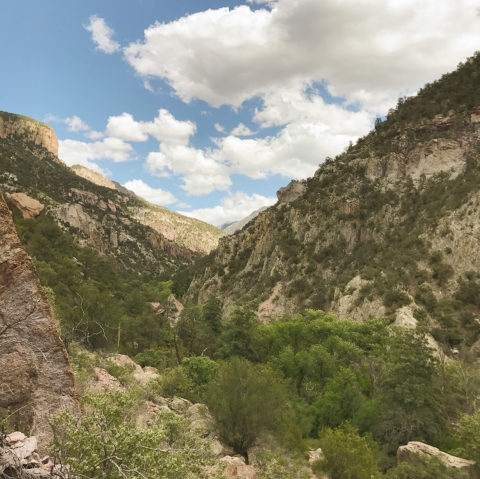
Whitewater Creek, located near Glenwood, New Mexico in the Gila National Forest is within the historic range of Gila Trout (Oncorhynchus gilae). This species inhabits headwater mountain streams throughout the Gila River Basin in Arizona and New Mexico. A Gila Trout is “readily identified by its iridescent gold sides [and] profuse black spotting” (USFS 2017 Environmental Assessment). Fish typically occupy clear mountain streams above 5,400 feet with water temperatures below 77 degrees Fahrenheit. Gila Trout need access to clean gravel for spawning, deep pools for refugia during summer low flows and high-flow runoff events, and woody debris for cover.
Whitewater Creek, located mostly in Wilderness, contains populations of non-native Rainbow Trout and Brook Trout, but prior to this project was devoid of Gila Trout. Gila Trout were federally-listed as Endangered in 1966 under the precursor to the Endangered Species Act due to a combination of habitat loss and degradation as well as competition, predation, and hybridization with non-native salmonids. By 1950, only five relict populations existed in headwater streams in the upper Gila River basin. With increased restoration efforts since the 1970s, including Gila Trout re-establishment in over 80 miles of stream throughout New Mexico and Arizona, Gila Trout were down-listed to Threatened in 2006. In 2012, the Whitewater-Baldy Fire burned through the Whitewater Creek drainage, severely reducing Brook Trout and Rainbow Trout populations. Given its suitable trout habitat, location within the historical range of Gila Trout, and fire that eliminated most non-native fishes, the Department of Game & Fish (NMDGF), U.S. Fish and Wildlife Service (FWS), and the Gila National Forest sought to restore Gila Trout populations in Whitewater Creek. Before stocking Gila Trout, however, managers needed to eradicate populations of non-native Brook Trout (Salvelinus fontinalis) and Rainbow Trout (Oncorhynchus mykiss). Once completed, Whitewater Creek will contain 23 miles of occupied habitat towards meeting native Gila Trout recovery goals.
Key Issues Addressed
Brook Trout (Salvelinus fontinalis) and Rainbow Trout (Oncorhynchus mykiss) have established populations in Whitewater Creek since they were first stocked in the early 1900s. It is assumed that they directly predated on native Gila Trout and outcompeted them for limited habitat and prey availability, causing local extirpation. While Gila Trout had already been extirpated, the Whitewater-Baldy Fire in 2012 jump-started the process for biologists to take a proactive approach to non-native trout eradication. Yet, post-fire conditions made field logistics and access difficult, and already complex stream habitat posed challenges to implement chemical (rotenone) non-native fish treatments.
Project Goals
- Eradicate populations of non-native Brook Trout and Rainbow Trout in Whitewater Creek using rotenone treatments
- Monitor effectiveness of treatments using environmental DNA (eDNA)
- Reintroduce Gila Trout to 23 miles of stream once eDNA surveys confirm absence of non-native Brook and Rainbow Trout
Project Highlights
eDNA Confirmation: In 2019, biologists began using eDNA to evaluate the efficacy of rotenone treatments on non-native trout. eDNA samples collected in May 2020 revealed no Rainbow Trout or Brook Trout, paving the way for Gila Trout reintroductions.
- A Creek-Wide Approach: From 2013-2015, the project team conducted multiple electrofishing surveys throughout the drainage to document non-native fish presence and perform reconnaissance for the rotenone treatments. Due to an abundance of standing dead trees that are prone to falling, trails required clearing of downed trees repeatedly in order to access the project sites. Arduous and remote field conditions meant that field crews had to cover multi-day distances from the top to bottom of the drainage. Pack mules hauled equipment and camp gear to project sites and helicopters were used to transport gear to areas inaccessible by pack mules. Field crews of 25-30 people total covered 23 stream miles in rugged, remote conditions to survey, implement, and monitor non-native trout treatments in Whitewater Creek. Camps were set up for the duration of the rotenone treatments for up to two weeks of field work.
- Non-Native Trout Eradication: Rotenone is a commonly-used piscicide treatment for non-native fish control. The project team applied rotenone once a year from fall 2017 to fall 2019 (three total treatments) to the mainstem and headwater tributaries to eradicate non-native Brook Trout and Rainbow Trout. Aquatic macroinvertebrates were collected pre and post treatment to determine effects on non-target species. No Brook Trout were detected after the fall 2017 treatment, however Rainbow Trout detections after 2017-2018 led to two consecutive annual rotenone treatments through fall 2019.
- eDNA to Monitor Success: Starting in spring 2018, project biologists integrated eDNA sampling to evaluate the efficacy of rotenone treatments on non-native trout. eDNA is DNA released by an organism into its environment. In aquatic systems, eDNA shed by organisms disperses in the water, and the DNA can be detected in water samples using genetic extraction techniques. In Whitewater Creek, the project team followed rotonene treatments in fall with spring and summer eDNA surveys to detect if Brook Trout and Rainbow Trout were present. Negative eDNA samples for each species would suggest that they were not present in the creek site when surveyed.
- Gila Trout Stocking: In spring 2020, all eDNA samples collected resulted in no detection of Brook Trout and Rainbow Trout. Gila Trout were successfully stocked into Whitewater Creek in summer 2020.
- Gaining Community Support: After the 2012 Whitewater Fire, local community attitudes shifted with increasing support towards stream conservation, native fish recovery, and establishing recreational fishery opportunities, enabling NMDGF to focus Gila Trout reintroduction efforts on Whitewater Creek. Project managers held two public meetings in Glennwood, New Mexico beforehand to increase public engagement. Letters of support from local community members further enabled project managers to implement this project.
- Non-Native Aquatics Treatment Options: The project team used a combination of methods to eradicate Brook Trout and Rainbow Trout. CFT Legumine (with a target concentration of 1-2ppm) was applied via drip bucket. Backpack sprayers with diluted liquid rotenone and a sand mixture (with rotenone powder) targeted small springs and seeps. Project biologists used 1ppm of rotenone for the first treatment in 2017, and visually observed fish in treated areas afterwards. Crew members followed up by spot-treating difficult to access stream habitats via backpack sprayers. In 2018 and 2019, project biologists increased rotenone concentrations to 2ppm, the highest level that can be applied as stated on the product label. Rotenone monitoring was in conjunction with multiple-pass backpack electrofishing to remove remaining trout. eDNA samples were collected to monitor the effectiveness of treatments.
Lessons Learned

While the Whitewater Fire in 2012 decimated aquatic communities in Whitewater Creek, this created an opportunity for native fishes as project managers garnered local, state, and federal support to implement non-native trout eradication efforts in the following years. Decreased numbers of Brook Trout and Rainbow Trout from the fire made the project more attractive and reduced the complexity of removing non-native trout. Post-fire conditions with debris, dead trees and shrubs, and blowdowns from storms made field logistics even more challenging, given that the project area is only accessible at the bottom and upstream reaches. Detailed coordination among field crew members, helicopter crews, and pack mule teams, based on drainage-wide field surveys conducted before rotenone treatments, increased the chances for project success. Adaptability and having on-the-ground access and experience from field crew members improved project implementation. To date, NMDGF has spent approximately $800,000 on this project.
Multiple rotenone treatments were needed to eradicate non-native trout, as well as spot-checking with backpack electrofishing. Complex habitat including riffles, runs, large boulders, and deep pools as well as in-stream large woody debris were difficult to consistently target with rotenone. During the fall 2018 treatment, heavy rains, snow, and fluctuating water levels were present for the 12-day field duration, which not only challenged field logistics but also implementation of effective rotenone application due to changing water conditions. Rainbow Trout were still detected afterwards, however, warranting a third rotenone application in 2019. Project biologists hypothesize that in small stream complexes, like Whitewater Creek, trout could perhaps escape to small pockets of fresh water, as upwelling is common in Whitewater Creek due to underlying bedrock.
eDNA can be a powerful tool to detect targeted organisms particularly in areas that are difficult to survey without traditional equipment such as nets, electrofishers, and field personnel. For example, whereas electrofishing surveys in complex habitats may fail to yield trout, water samples collected from the same area could confirm trout presence. eDNA is less labor intensive than traditional methods and in some cases is more effective at detecting individuals that are present at low densities, or in habitat that is difficult to sample via electrofishing like in Whitewater Creek (e.g. large, deep pools, undercut banks, and large debris piles).
eDNA sampling pinpointed exactly where remaining Rainbow Trout were located. eDNA detected fish that were not detected using electrofishing, and the last trout were eradicated in the exact location where eDNA results indicated, even four months after the eDNA samples were collected. Initial eDNA results revealed Rainbow Trout presence in one location, but field crews could not find trout with electrofishing afterwards. A second round of eDNA surveys still produced positives for Rainbow Trout, which led to the third rotenone treatment, eradicating trout in the exact locations eDNA had detected them. This raises the question, if samples are collected throughout the entire drainage and only a few return positive for trout, should managers go back and treat the entire drainage, or just those particular sites?
While eDNA can provide detailed results, limitations include false positives (i.e. from sample contamination), intensive sampling to cover an entire drainage, and consideration of sampling intervals as it is uncertain how long eDNA remains in the stream after organisms are removed. This means that eDNA samples can not answer movement questions, if for example, an individual trout remains in the same site (and was not killed via rotenone), or was detected because it moved to a different stream location. If project managers had not used eDNA to verify removal efforts after the second rotenone treatment, they would have moved forward with stocking Gila Trout despite at least one remaining Rainbow Trout (discovered via eDNA). Project managers would have needed to consider if one Rainbow Trout would have impacted establishment of Gila Trout, and at what threshold managers decide to move forward with repatriation.
The questions and field considerations above demonstrate the need to define what success looks like before sampling. Project managers did not set specific metrics during early project stages, and in hindsight, setting metrics would better inform project success. Particularly with eDNA, where samples can be readily collected from many locations, defining specific parameters and targets before starting rotenone treatments would have helped project managers better evaluate rotenone success. While eDNA is a useful tool to evaluate success it can also be utilized in concert with other detection methods. Project managers should be cognizant of the types of questions that can be answered from eDNA, when treatments are sufficient (how many negative results from eDNA are needed to confirm Brook Trout and Rainbow Trout are no longer present), and identifying a level of risk for moving ahead (e.g. reintroducing Gila Trout).
Next Steps
- Monitor native Gila Trout reintroductions
- Restore populations of additional native fishes including Speckled Dace (Rhinichthys osculus), Desert Sucker (Catostomus clarkii), and Sonora Sucker (Catostomus insignis)
Funding Partners
- Wildlife and Sportfish Restoration Funds
- State Wildlife Grant Funding
- New Mexico Game Protection Funds
- US Fish and Wildlife Service
- US Forest Service
Resources
- Western Native Trout Initiative Gila Trout Species Profile
- New Mexico Game and Fish Gila Trout Recovery and Angling Website
- USFS Environmental Assessment (2017): Restoration of Gila Trout (Oncorhynchus gilae) and other Native Fishes to Whitewater Creek, New Mexico
- USGS: Application of Environmental DNA for Inventory and Monitoring of Aquatic Species
- Gido et al. (2019). “Pockets of Resistance: Response of Arid‐land Fish Communities to Climate, Hydrology, and Wildfire.” Freshwater Biology 64(4): 761-777.
- Whitney et al. (2016). “Metapopulation Analysis Indicates Native and Non‐native Fishes Respond Differently to Effects of Wildfire on Desert Streams.” Ecology of Freshwater Fish 25(3): 376-392.
- Gila National Forest Glenwood Ranger District
Contacts
- Jill Wick, Native Fish Program Manager, New Mexico Department of Game and Fish, jill.wick@state.nm.us
- Ryder Paggen, Gila Trout Biologist, New Mexico Department of Game and Fish, ryder.paggen@state.nm.us
Case Study Lead Author
- Alex Koeberle, CART Research Specialist, University of Arizona: akoeberle@arizona.edu
Suggested Citation
Koeberle, A.,L. (2020). “Non-Native Trout Removal for Native Gila Trout Recovery in Whitewater Creek, New Mexico.” CART. Retrieved from https://www.fws.gov/project/non-natives-removal-gila-trout-recovery.