


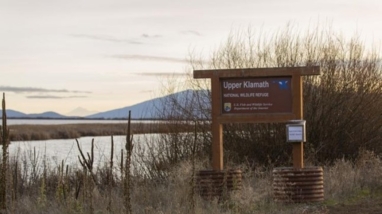
After nearly 16 years, the U.S. Fish and Wildlife Service has completed a Final Environmental Assessment and a Finding of No Significant Impact for the restoration of a full range of wetlands (open water, submergent, emergent and seasonal fringe) across 14,000 acres of Upper Klamath NWR that will reconnect the Agency Lake and Barnes Units and other Service easements with Upper Klamath Lake. The action fulfills the primary refuge purpose by contributing to wildlife goals and objectives as detailed in the UKNWR Comprehensive Conservation Plan (USFWS 2016), as well as larger regional and continental landscape goals to conserve priority bird habitats.
The Service, along with our partners, will restore and reconnect historic fringe wetlands to benefit the greatest number of wildlife species in and around the refuge. Specifically, the project involves removing sections of levees on these units which will facilitate comprehensive wetland restoration on more than 14,000 acres. The restoration is expected to increase habitat for migratory waterfowl, restore historic stream channels, improve water quality, enhance passage and habitat for important fish and aquatic species in the Upper Klamath Basin, and increase water storage in Upper Klamath Lake.
Publication date
Facility

Program

Ecosystem
FWS and DOI Region(s)