At dusk in a shrubby grassland valley within northern Arizona, U.S. Fish and Wildlife Service Biologist Jessica Miller and several volunteers look for a reflective shine. After they spot the eye-catching flash, they take a small pet carrier from the truck and set it near the source: a red driveway reflector that marks a dusty prairie dog burrow. They open the cage door, and an endangered black-footed ferret cautiously considers the tunnel and then quickly darts underground. The release of the next ferret, as Miller recounts, goes a little differently.
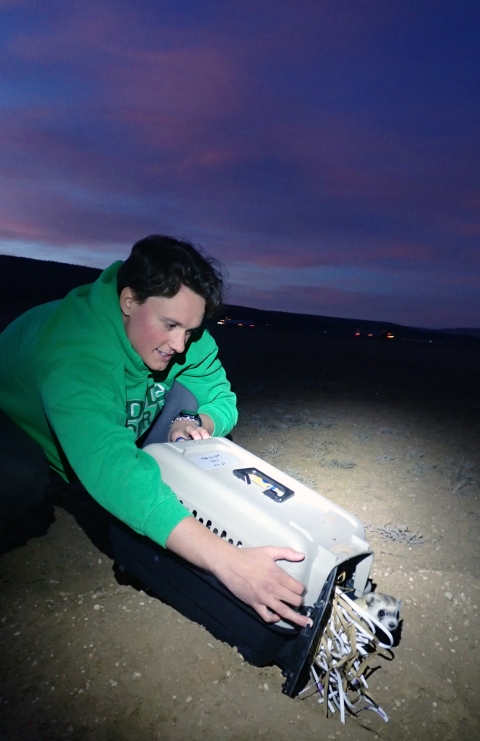
“The [second] ferret kept popping out of the burrow, and then it'd go over to another burrow, go down there, and come back out. It was burrow-shopping for about half an hour. I guess it just had very specific preferences for what it was looking for.”
Releasing black-footed ferrets raised under human care into appropriate wild habitats is a key action to support recovery of this iconic species. The U.S. Fish and Wildlife Service’s Arizona Ecological Services Field Office works alongside the Arizona Game and Fish Department to recover black-footed ferrets, and are part of the larger, range-wide Black-Footed Ferret Recovery Implementation Team. This team includes other state and federal agencies, tribes, and non-governmental organizations.
“Black-footed ferret recovery is a team effort,” said Holly Hicks, Small Mammal Project Coordinator with the Arizona Game and Fish Department. “Multiple agencies including the U.S. Fish and Wildlife Service, the U.S. Forest Service, and The Phoenix Zoo make releases like this possible and would be very difficult to accomplish without their support.”
This past spring, the Arizona team helped release 19 ferrets at designated sites in northern Arizona. After the ferrets find their perfect burrow and stay underground, the team sets up trail cameras to monitor them. When biologists review the footage, they get a glimpse into the world of ferrets, from evading badgers and hunting prairie dogs to playing with other ferrets.
The Most Endangered Mammal in North America
Once common across the grassland habitats of the Great Plains, black-footed ferret populations plummeted as the prairie was turned into farmland and the ferret’s primary food source, prairie dogs, was devastated by intentional eradication and the non-native sylvatic plague (yes, the same plague responsible for the Black Plague of Europe). Not only are black-footed ferrets dependent on prairie dogs for their main food source, but they also live in prairie dog burrows. Therefore, prairie dog habitat is black-footed ferret habitat.
The black-footed ferret was listed as endangered in 1967, but the species was thought to be extinct by the 1970s. Amazingly, the species was rediscovered in 1981 on a ranch in Wyoming. From that single population the Service and partners have supported a slow but steady recovery. About 300 black-footed ferrets live in the wild today at reintroduced sites, 20 of which live in Arizona at two reintroduction sites.
Landowners Support in Northern Arizona
In Arizona, black-footed ferrets are reintroduced at very specific places selected based on prairie dog densities and partner cooperation. These areas include the expansive shrubby fields in Aubrey Valley and Double O Ranch near Seligman, and the smaller Garland Prairie site, near Parks. The sites are also working ranches, and cattle and some sheep live alongside the prairie dogs and ferrets.
Recovering ferrets means working with private, state and federal land managers. The ferret populations in Arizona are classified as parts of a non-essential experimental population, under section 10(j) of the Endangered Species Act, which allows landowners to continue their regular ranching operations without worrying about violating the Endangered Species Act by accidentally harming a ferret.
“With the 10 (j) rule, there's more regulatory certainty and flexibility for landowners and land managers with the activities they do on the land,” said Miller. “This facilitates support and contributes to the success of the recovery efforts.”
Garland Prairie: The First Nursery Site
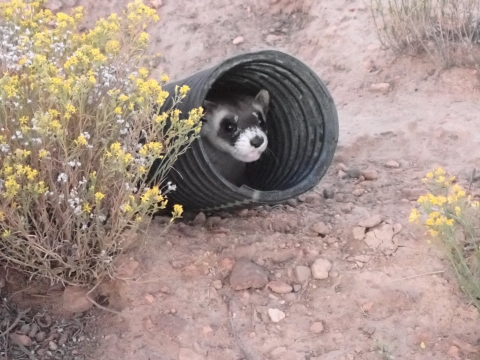
Black-footed ferrets are bred and raised under human care at various facilities across the country. Once they are weaned from their mother, they are taken to the U.S. Fish and Wildlife Service’s National Black-Footed Ferret Conservation Center in Colorado for pre-conditioning, otherwise known as “training on how to act like a wild ferret.” They learn how to hunt prairie dogs, hide from predators, and use underground tunnels. This behavioral training boosts their chances of survival. But survival is still a struggle, and the Arizona recovery team hopes to improve the ferret’s odds.
The first ferret release at Garland Prairie was in 2025, and there are plans to continue releasing ferrets at the site for at least three consecutive years. This establishes Garland Prairie as a first-ever “nursery site” for the black-footed ferret. The National Black-Footed Ferret Conservation Center typically chooses reintroduction sites based on their potential to support 30 breeding adult ferrets. But Garland Prairie is smaller than typical sites and will likely never contain enough prairie dog habitat to support that many ferrets.
“This will be the first time this concept of a nursery site is being implemented,” said Miller. “So that's pretty exciting.”
As a nursery site, the hope is that the Garland Prairie ferrets will successfully breed, successfully raise kits (baby ferrets), and reach the site’s carrying capacity. Once the ferret population has no more room to grow, future kits will be translocated to other sites. Because they would be born in the wild and would learn survival skills from their parents, the team expects that these ferrets will have a leg-up from the facility-trained kits and that their survival rates will further increase. Garland Prairie is an ideal location for a nursery site, because it is enclosed by ponderosa pines to discourage dispersal away from the site, and it is small so the team can more easily monitor and capture the animals.
Recovering Ferrets in Arizona is Different
Biologists release ferrets in the fall because it coincides with the time when kits naturally disperse from their mother to establish their own territories. Spring releases have been avoided because there were concerns that holding ferrets over-winter would acclimate them more to captivity and reduce success in the wild. However, in Arizona after fall releases, the team has observed poor recapture rates, indicating low survival rates. This could be due to the prairie dogs’ behavior in the area.
Northern Arizona is the southern end of the black-footed ferret’s range. The prairie dogs that occur in northern Arizona are Gunnison’s prairie dogs, while most of the other ferret reintroduction sites are in black-tailed prairie dog colonies. Unlike black-tailed prairie dogs, Gunnison’s prairie dogs hibernate for four to five months during the winter. So not only does this population of ferrets in Arizona have to learn how to live in the wild for the first time, but they also must figure out how to dig out hibernating prairie dogs from their plugged burrows. The lower survival rates may be because ferrets are challenged with being able to get to their hibernating food.
The Arizona team released ferrets this spring and plan another release in the fall and next spring. They will have a total of three years of fall and spring releases to compare and see which is most successful. Most of the year, ferrets are solitary except when they come together to mate. During the first survey following this past spring release, the team found a male and a female in the same burrow and that is encouraging.
The Black-Footed Ferret Recovery Implementation Team continuously looks for innovative ways to recover this endangered species. In addition to releasing, tracking, and surveying ferrets, the team vaccinates kits soon after they are born because the young ferrets are extremely susceptible to the plague. Plague is spread via fleas, so the team also disperse flea control to prevent spread of plague, which kills prairie dogs and ferrets. While the fates of the ferrets released this spring are still uncertain, Miller knows that all these efforts bring the endangered black-footed ferret one step closer to recovery.
“It is inspiring to work alongside the people that have been involved in recovering the ferret for over 30 years, including developing new creative tools and techniques that are bringing us closer to recovery,” said Miller.