On a humid July night, biologists strung mist nets through the canopy of an Indiana hardwood forest on Tribal Nation land. It was the first night of the inaugural Indiana Tribal Bat Blitz, where we at the U.S. Fish and Wildlife Service participated in a joint effort for threatened and endangered bat species and the recovery of their habitat. The 2026 event was hosted by the Pokagon Band of Potawatomi Indians, or Pokagon Band, and the Indiana Department of Natural Resources. Biologists from the Little River Band of Ottawa Indians also participated.
Biologists designed the activities at the bat blitz to assess which bat species were present and whether those bats were raising young on the property. The event provided the Pokagon Band with valuable information about the bats on their land and gave biologists of all experience levels a chance to gain hands-on field experience with bats and new telemetry technology.
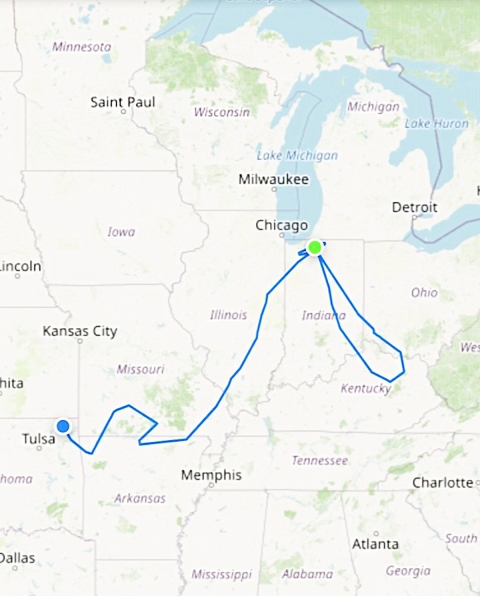
One of the tagged bats would go on to travel more than 1,000 miles in the following weeks, offering biologists new insight into how far these bats travel.
Catch and release
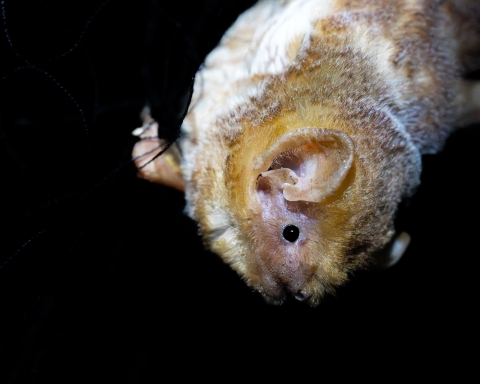
The mist nets hung by biologists are as fine as hairnets and nearly invisible in the dark. These nets are the standard tool for catching bats without harming them: a bat brushes the mesh, drops into a soft pocket and waits, unharmed, until a biologist carefully retrieves it from the net.
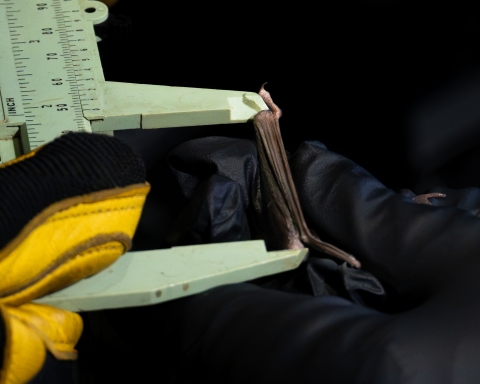
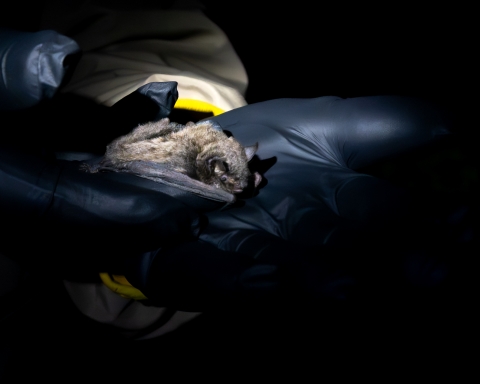
Checking a mist net is quick, careful work. After carefully removing a bat from the net, a biologist records its species, sex, age and reproductive condition, weighs it, and measures its forearm. The biologist also examines the wings for scarring left by white-nose syndrome, the primary fungal disease that has devastated bat populations across the eastern United States. Finally, the bat is released back into the dark.
Over the course of two nights, 27 bats were caught, including the federally listed Indiana bat (Myotis sodalis), the eastern red bat (Lasiurus borealis), a species of special concern, and the big brown bat (Eptesicus fuscus).
For some of the Tribal biologists, the blitz was their first hands-on training with bats. With experienced mentors, they learned how to site and set up a mist net, carefully retrieve a bat from the net, identify the species, record data, and attach monitoring tags. For biologists new to bat surveys, skills like these are often the hardest to build without direct, in-field mentorship.
“This work is only possible because we are all willing to learn from one another,” said Rich Geboy, U.S. Fish and Wildlife Service biologist and expert on white-nose syndrome. “Together, we are building something that none of us could have accomplished alone. Every bat we document and every skill we share strengthens partnerships across the conservation community while equipping Tribal biologists with the expertise needed for long-term bat conservation in the midwest.”
By the end of the bat blitz, it was confirmed that the Pokagon Band’s land stewardship has helped maintain healthy habitat for multiple rare bat species. Biologists found that eastern red bats and big brown bats were raising new generations at this property, evidence that the habitat supports healthy, diverse insect populations that bats need to sustain their populations.
“Bat mist netting and handling are skills that many biologists do not have, and agencies like U.S. Fish and Wildlife Service are great partners for Tribal staff to gain this experience,” said Vic Bogosian, Pokagon Band’s natural resources manager for Kowabdanawa odë kė (They watch over this land). “We have been fortunate to receive funding from the Service that we will use to increase our ability to monitor bats that use Tribal properties.”
Why tagging bats matters
Bats are among the hardest-working and least-appreciated animals in North America. A single bat can eat thousands of insects in one night, including crop pests and mosquitoes. Across all U.S. agricultural production, bats’ consumption of insect pests saves an estimated $3.7 billion a year. That value is under threat. White-nose syndrome is fatal to 70% to 100% of infected bats in some affected populations and has killed more than 6 million bats across North America since it was first detected in 2006.
Using tagging and tracking technology, biologists can collect novel data and insights that reveal how far bats may travel and how their ecological value extends from their fragmented habitats across multiple states.
An eastern red bat tagged during the Indiana Tribal Bat Blitz offered a clear example. Over the following weeks, it flew approximately 280 miles round trip from northern Indiana to western Kentucky and back, completing the journey in three days. About a week later, it set out again, this time flying approximately 870 miles over roughly seven days, through Indiana, Illinois, Missouri, Arkansas and Oklahoma. That distance reminds us that protecting bat habitat depends on coordination across boundary lines. Efforts like the Indiana blitz demonstrate how that work can be accomplished.
A growing effort
The idea for these Tribal bat blitzes traces back to the Keweenaw Bay Indian Community, in Michigan, where the groundwork was built years before Indiana’s first bat blitz.
“Conversations about a Michigan Tribal Bat Blitz started in 2021, when we planned to collaborate and gain experience with staff from the Michigan Department of Natural Resources and U.S. Fish and Wildlife Service,” said Kyle Seppanen, wildlife coordinator for Keweenaw Bay Indian Community.
Seppanen said that after beginning with acoustic monitoring, they wanted hands-on experience with mist netting and telemetry to understand bat movements. Their first Michigan bat blitz was in 2024 and has continued annually, under a U.S. Fish and Wildlife Service permit for handling and monitoring endangered bats.
“Watching how bat conservation with Tribes has expanded from Michigan to another state is exciting to see,” he said.
The work doesn’t stop at netting and tagging. In 2025, the Michigan effort supported a Great Lakes Coastal Program pilot project that trains dogs to detect bat roosts on the Beaver Island Archipelago, a partnership with the Little Traverse Bay Bands of Odawa Indians. Guano, or bat excrement, and handling equipment collected during bat surveys are helping train the dogs to find roosts that are nearly impossible to locate any other way.
The blitzes in both Indiana and Michigan are expected to continue annually.
The Indiana bat tracking effort described in this story is supported with funding from the U.S. Fish and Wildlife Service through a White-nose Syndrome Grant. The U.S. Fish and Wildlife Service’s Coastal Program efforts to track bats in Michigan are supported in part with funding from the Great Lakes Restoration Initiative, a multi-agency collaborative led by the Environmental Protection Agency.
Keep reading: This Michigan story features dogs that are trained to track bats.