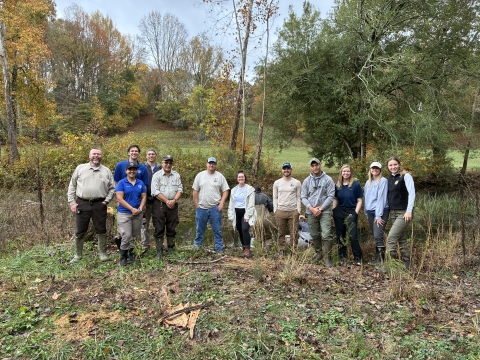
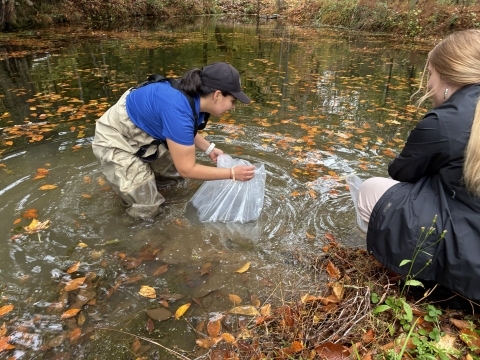
On November 4, 2026, conservation partners from across Tennessee gathered to celebrate an important milestone in the ongoing effort to conserve one of the state's rarest native fish, the Barrens Topminnow. Braving the heavy rain, biologists, hatchery staff, refuge managers, and conservation organizations came together to release fish into three important recovery sites. While the species remains imperiled, the establishment of these new populations represents meaningful progress toward recovery and a brighter future for the Barrens Topminnow across its native range.
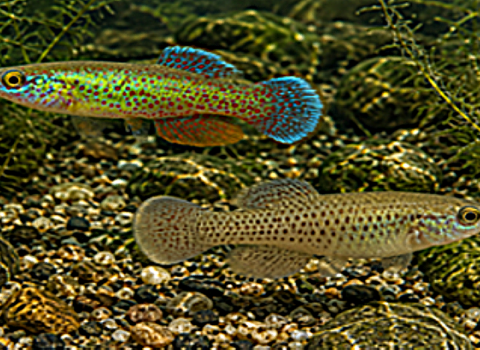
The Barrens Topminnow (Fundulus julisia) is a small, endangered fish restricted to streams of the Barrens Plateau in middle Tennessee. Though only a few inches long, it represents a unique piece of the region's natural heritage. Prior to the November 4th releases, the species was known from just six populations. With the establishment of three additional populations, that number has now increased to nine!
Two of the release sites were especially significant because it expanded recovery efforts within the Elk River Evolutionarily Significant Unit (ESUs - a historically isolated group of populations on an independent evolutionary trajectory). Before this release, only one population of Barens topminnow survived within the Elk River ESU. The new sites provide an important safeguard for this unique lineage and offers renewed hope for its future.The second release occurred at Tennessee National Wildlife Refuge’s Vervilla Tract, a property purchased specifically to support Barrens Topminnow recovery. For several years, Vervilla successfully supported a thriving Barrens topminnow population. However, a major flood event overtopped a water-control structure over 15 years ago, allowing invasive Western Mosquitofish (Gambusia affinis) to enter the site.
Although native to Tennessee, Western Mosquitofish are not naturally found on the Barrens Plateau and pose the largest and most direct threat to the continued existence of the Barrens Topminnow. Where the two species occur together, mosquitofish prey upon larval and juvenile topminnows and harass both juvenile and adult fish, reducing survival and reproduction of the topminnow. Their introduction ultimately eliminated the Barrens Topminnow population at Vervilla.
Fortunately, the story did not end there.
This year, the Vervilla Tract underwent extensive restoration and management efforts. Through the dedication of the Partners for Fish and Wildlife Program, Tennessee Wildlife Federation, and Tennessee Wildlife Resources Agency, habitat improvements were completed and invasive mosquitofish were successfully removed from the site. These efforts created the conditions necessary for the Barrens Topminnow's return.
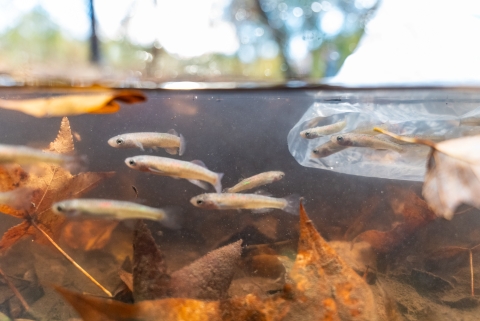
On November 4th, that return became a reality. More than 15 years after disappearing from the property, Barrens Topminnows once again swam in the waters of Vervilla.
This achievement is a testament to the power of collaboration. This recovery effort brought together numerous partners, including Wolf Creek National Fish Hatchery, Dale Hollow National Fish Hatchery, Tennessee Aquarium, Conservation Fisheries Inc., Tennessee National Wildlife Refuge, Tennessee Wildlife Federation, Tennessee Wildlife Resources Agency, and the Tennessee Ecological Services Office. Each organization contributed expertise, resources, and unwavering commitment toward a common goal.
Together, these partners have demonstrated that conservation success is built on science, persistence, and teamwork. The releases on November 4th were more than the restoration of fish to streams. They represented renewed hope for a species found nowhere else in the world and a promising step toward ensuring that future generations can continue to find the Barrens Topminnow swimming in the waters of middle Tennessee.
To learn more about the Barrens Topminnow and recovery efforts, visit its Species Profile: Species Profile for Barrens topminnow(Fundulus julisia)