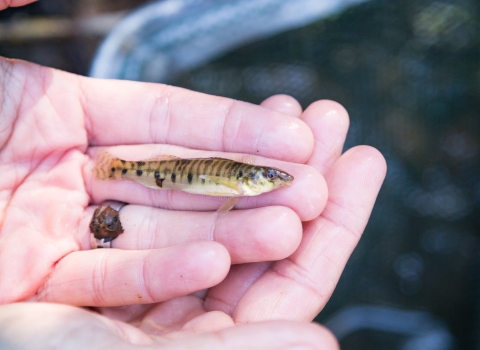
April 7th, 2026, marked the beginning of a new chapter for the endangered Barrens topminnow (Fundulus julisia) at Dale Hollow National Fish Hatchery in Celina, Tennessee. After more than three years of planning and collaboration between the hatchery, the Service’s Ecological Services Program, and Conservation Fisheries, Inc., a new building has been constructed to house the endangered Barrens topminnow and, in the future, other endangered species.

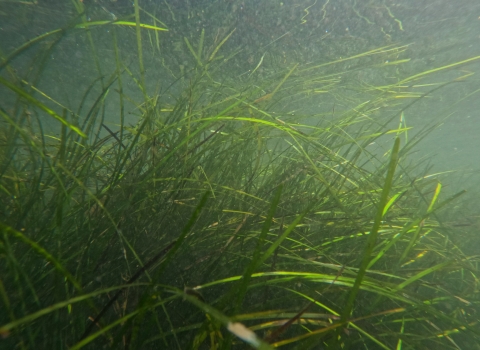
The Barrens topminnow is an extremely rare fish native to springs and spring-fed streams on the Barrens Plateau in south‑central Tennessee. Dale Hollow National Fish Hatchery has been part of the Barrens Topminnow Working Group, which is focused on protecting remaining wild populations, maintaining captive‑bred populations, and restoring and reintroducing the species across its historic Tennessee range. Reintroduction efforts depend on habitat restoration work with private landowners through the Partners for Fish and Wildlife Program. Major threats to this species include competition from invasive western mosquitofish (Gambusia affinis), which prevent successful reproduction, and severe droughts that dry out spring pools, requiring emergency removal and temporary holding of fish.

Historically, captive propagation has been done at Conservation Fisheries, Inc. Juveniles were then sent to Dale Hollow for grow‑out and later release. At the hatchery, the fish were raised in controlled, closed systems of 300‑gallon tanks with filters, gravel, plant cover, and specialized diets. The grow‑out period typically took 6 to12 months.
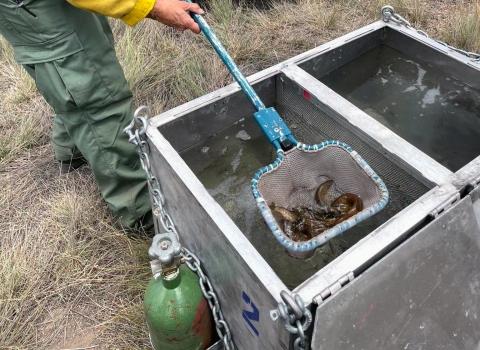
With the new building, captive propagation and rearing of Barrens topminnows can be done in one location that has more than double the previous space. Recently, Service staff from Dale Hollow and the Ecological Services Program joined Conservation Fisheries, Inc. to move the first 63 Barrens topminnows, last year's breeding pairs, to their new homes until they are released later this year. The next group in May will include this year’s breeding pairs, ready to start the next breeding cycle.

Conservation Fisheries, Inc. not only brought the fish from Knoxville, Tennessee, but also their original tank and part of their tank water to ease the transition to their new location at Dale Hollow National Fish Hatchery. The process was slow but needed for the health and survival of every fish. Once the tanks were moved in and set up, the fish were floated in a mixture of their original tank water and new water to equalize the temperature. Cups of water from the tank were added several times over the course of 30 minutes to help them adjust to the new water quality. The fish were then released into the tank.

The successful move of the first Barrens topminnows into the new facility at Dale Hollow National Fish Hatchery marks an important milestone in a multi‑year, multi‑partner effort to secure the future of this imperiled species. With expanded space, improved infrastructure, and the ability to conduct both propagation and rearing onsite, the new building represents a major step forward for conservation. The teamwork shown by Dale Hollow National Fish Hatchery, the Ecological Services Program, and Conservation Fisheries, Inc. ensures that each fish is cared for with precision and dedication. As additional broodstock broodstock
The reproductively mature adults in a population that breed (or spawn) and produce more individuals (offspring or progeny).
Learn more about broodstock arrive in the coming months and breeding efforts begin anew, this facility will serve as a cornerstone for long‑term recovery and restoration across the species’ historic Tennessee range. This moment not only celebrates a new home for the Barrens topminnow, but also a renewed commitment to safeguarding one of Tennessee’s rarest native fishes for generations to come.