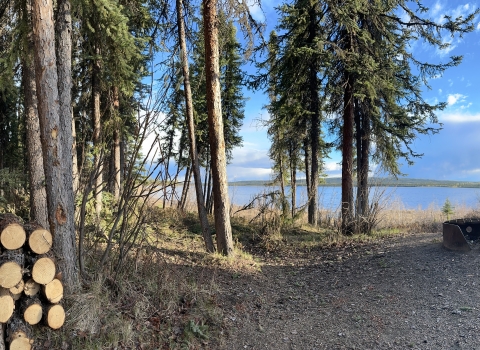
Invertebrate Wildlife Program Manager Jeff Sorensen with the Arizona Game and Fish Department is not carrying his lunch today. Instead, inside the cooler in his backpack, within a plastic food container, he transports something far more precious: individuals from a unique population of the Three Forks springsnail. Because the weather in the mountains of eastern Arizona can change rapidly, U.S. Fish and Wildlife Service’s wildlife biologist Nichole Englemann carries a light jacket as she walks alongside him. Together, they lead a team of nine downstream half of a mile to another springhead, with the goal to translocate, or move, about 50 of the endangered springsnails to their new home. This move is significant since these tiny snails live their whole lives within 10 to 20 feet of their occupied springheads in the alpine grasslands and forest.
Joining the Arizona Game and Fish Department and U.S. Fish and Wildlife Service in recovery efforts for the Three Forks springsnail include the U.S. Forest Service, the Phoenix Zoo, the National Wild Turkey Federation, and The Nature Conservancy. “This recovery effort is the second in the nation that is actively and repeatedly conducting translocations of springsnails,” said Sorensen. “We work together as partners to establish additional wild populations and return populations to their historical springs. Although we're still very new at this, we are experiencing a great deal of success.”
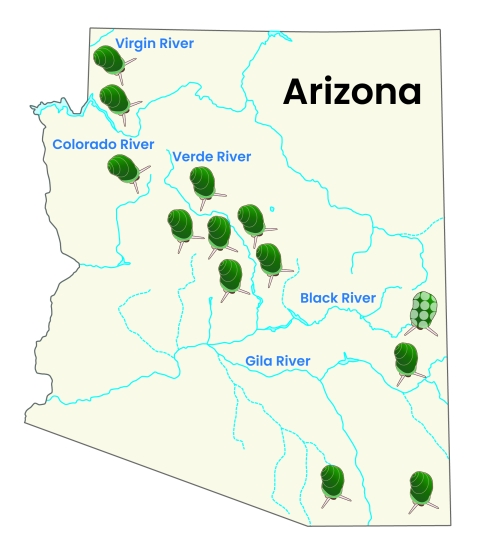
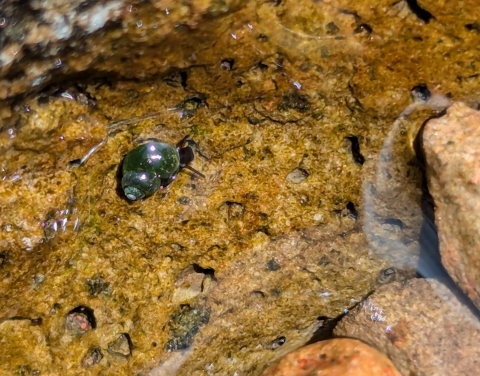
Arizona is home to a high diversity of springsnails with 13 described species of the genus Pyrgulopsis, mostly narrow endemics (naturally found in only one small area). The Three Forks springsnail lives along a single three-mile drainage in eastern Arizona within the Apache-Sitgreaves National Forests, high within the White Mountains. Three Forks springsnails, like all springsnails, are extremely sensitive to changes in water conditions including temperature, spring flow, pH, and contaminants. They breathe through their gills and require year-round, high-quality water. The springsnail’s presence or absence reflects the springs’ health.
Checklist for Translocating
Around 50 of these poppy-seed sized mollusks fit comfortably in a plastic tub, so translocating them should be easy, right? Wrong. This process requires extensive effort and coordination with multiple partners. Both the new site and the host population must pass a stringent checklist. First, the new site must have a healthy habitat with good water quality, be free of non-native crayfish that would otherwise feast on the springsnails and be far enough from the creek channel to avoid flooding near the springhead. In addition, the host population must be robust enough to withstand the removal of individuals.
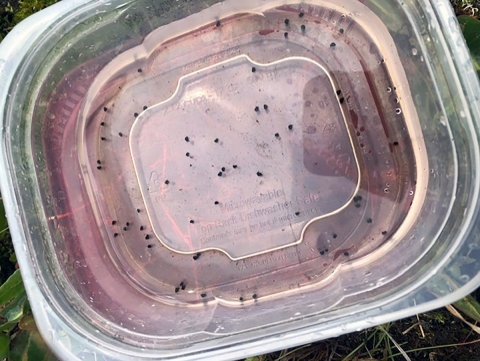
“We make sure to address threats before we can release the snails at host sites,” said Englemann. “And we don't remove springsnails unless that population is healthy enough to withstand the loss of the snails. Although we're only taking one-third of their individuals that we visually counted, we don't want to take from a really low population because that could cause negative impacts."
Partners have improved and maintained additional sites for future host springheads. They have added pea gravel within spring boxes to mimic natural, rocky springhead habitats. They have also constructed imitation artesian springs by bringing up the water level to the ground surface and allowing it to flow off the sides.
Recovery effort partners reduce threats to the springsnail habitat by installing fences around the springs to prevent trampling and wallowing by livestock or elk. Partners also prevent invasive crayfish from access to the springs by installing plastic walls around spring boxes and placing hardware cloth screening at the inflows and outflows. They will also remove crayfish from the sites, often collecting hundreds within a couple hours of effort.
Careful Collection and Release
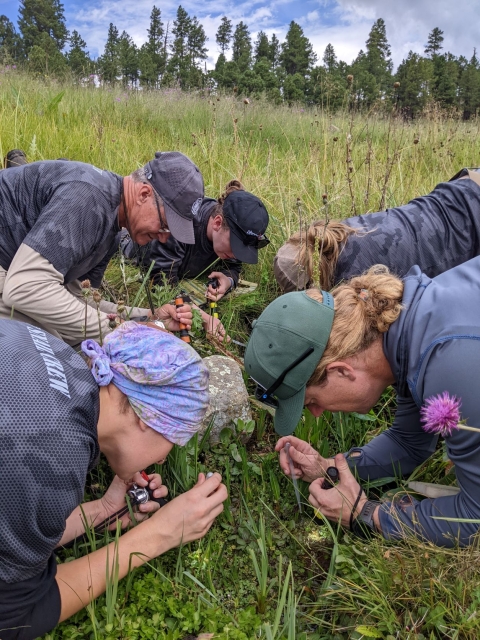
Crouched in the grass at the edge of the spring and with their faces close to the ground, the field team uses hand lens and flashlights to confirm the identity of the Three Forks springsnail. Their protocol calls for three people to independently verify the rare species, making sure pond snails and aquatic bugs stay behind. Once confirmed, biologists slowly and carefully collect the springsnail using pipettes or soft-tip tweezers and place them in a plastic container with water collected from the host site.
Before releasing them to their new home, the springsnails are acclimated through a process known as a soft release. The water from the translocation container is mixed with water from the host site to match similar water conditions and temperatures. This prevents shock and increases their chance of survival. After double checking that the water conditions are similar enough, the field team carefully releases the springsnails into the springhead.
“We repeated techniques developed by the Bitter Lake National Wildlife Refuge folks, who were probably the first ever that were successful in getting wild to wild translocations of Koster’s and Roswell springsnail,” said Sorensen. “We keep them in a large cluster so that it's easier for them to find each other, and they're more likely to establish at the springhead.”
Reasons to Shell-ebrate
The first time that recovery partners returned to survey the creek after releasing the springsnails, they didn’t find any and thought the translocation hadn’t worked. Later, Sorensen returned to the host site to investigate and collect water to try to detect environmental DNA of the springsnail. After another search of the spring, Sorensen counted over 40 springsnails. The translocation worked, and the new site is on its way to hosting a healthy population. The techniques learned from this successful translocation will be applied elsewhere and help in other species’ recovery efforts.
“We have to be responsive when recovering an endangered species,” said Engelmann. “When we try new things, they don’t always work, but it's better to try than not.”
The Three Forks springsnail was listed as endangered in 2012 and currently consists of fewer than 2,000 individuals. Although wild to wild translocation of the springsnail will still occur, one of the future recovery goals is to establish a captive population at the Phoenix Zoo to help reestablish populations at sites across its historical range. As Sorensen and Engelmann reflect on their nearly decade-long working relationship, they both agree that recovering species is not quick and requires long-term commitments with dedicated partners. They are in it for the long haul and find that enthusiasm about snails is contagious.
“It's neat to see mammal biologists come out into the field and get excited to recover this exceptionally small, endangered snail,” said Sorensen. “The more you learn about something, the more you love it, and the more willing you are to fight for it and conserve it.”