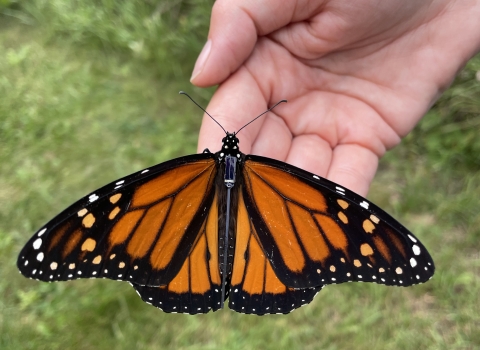
For almost 70 years, Patrick Bell’s family has owned and operated farmed land in Johnston County, Oklahoma. For generations, his family ran a cow-calf operation, raising beef cattle to provide for their family and support the ranches that feed America. For continuous operation, the fields were overrun with Bermuda grass, fescue, rye, vetch, and Johnson grass. Patrick said he remembers seeing scores of monarch butterflies migrating through Oklahoma as he was growing up. About 15 years ago, he started noticing an unrelenting decline in monarch numbers. Over the last few years of the operation, Patrick also noticed he was not seeing nearly as many other species of butterflies and pollinators. He picked up on a trend researchers are concerned about across the nation: Pollinators are facing a growing crisis of declining populations. Patrick decided to do something about it.

In the past, if you looked out of the window during fall, you could see hundreds or even thousands of monarch butterflies migrating through Southern Oklahoma to their winter homes in Mexico. Today, however, there is a noticeable decline in the number of butterflies in the sky, just as Patrick noticed on his family’s property. The decline in pollinators holds serious implications for natural ecosystems, agricultural security, and rural economies.
Interested in learning more about this decline, Patrick organized and attended a lecture hosted by the Oklahoma Native Plant Society in 2016, where Dr. Orley "Chip" Taylor spoke on the declining monarch and pollinator populations. He and a few other attendees were inspired to do something about the problem, and the Oklahoma Monarch and Pollinator Collaborative was born. Patrick decided that as a co-founder, he should lead by example and create a pollinator haven on his property.
“I felt like I needed to take action,” said Patrick. “I had started a small-scale pollinator garden at my home in Edmond but wanted to do something more substantial.”

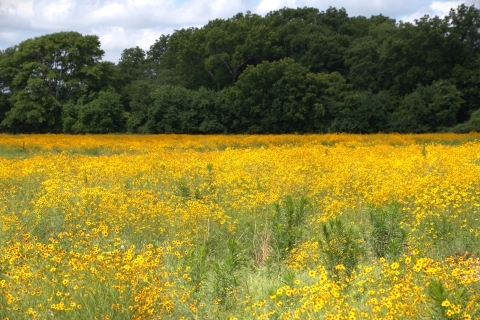
Patrick reached out to the U.S. Fish and Wildlife Service Partners for Fish and Wildlife (PFW) Program, Oklahoma Department of Wildlife Conservation, Natural Resources Conservation Service (NRCS), and the Oklahoma Prescribed Burn Association (OPBA) for their expertise in pollinator conservation. Through this collaboration, he began to transform his vision into reality, restoring 130 acres to create a haven for pollinators. Using information he learned from years of research and from the technical assistance provided by numerous organizations and agencies, Patrick made significant changes in land management for pollinator conservation.
He divided the land into sections and then began experimenting with an “herbicide-fire-planting" plan in one of the sections. He would treat the invasive species invasive species
An invasive species is any plant or animal that has spread or been introduced into a new area where they are, or could, cause harm to the environment, economy, or human, animal, or plant health. Their unwelcome presence can destroy ecosystems and cost millions of dollars.
Learn more about invasive species with multiple herbicide applications, each followed with prescribed fire, and finally till the soil before planting native seeds. He found mixed results from the native forbs and grasses.

A prescribed burn is the controlled use of fire to restore wildlife habitat, reduce wildfire risk, or achieve other habitat management goals. We have been using prescribed burn techniques to improve species habitat since the 1930s.
Learn more about prescribed burn conducted on Patrick Bell’s property.
After consulting with the NRCS and the PFW Program, he decided that a no-till drill was imperative to his success. Through funds provided by the Chickasaw Nation, the nearby Pontotoc County Conservation District was able to provide Patrick with an agricultural no-till drill. Soon, his strategy in the experimental section was successful enough to begin implementing it on the rest of the land.

“It was a labor of love for 7 years,” said Patrick. “It took years of experimentation and research before I made lasting progress. The project wouldn’t have been possible without everyone’s help.”
But persistence paid off for Patrick. To date, he’s treated and replanted 118 acres. The remaining 12 acres have native vegetation. He plans to continue using prescribed fire for habitat management through a partnership with Johnston County Prescribed Burn Association. The lasting change doesn’t stop there, however. Ultimately, he hopes the land will be available, in perpetuity, to educate students and train future land managers.
“Conservation needs to be done one step at a time,” said Patrick. “I hope that my story can inspire others.”
Conserving ecosystems within the Central Grasslands is no small task, but Patrick faced it head-on and set an excellent example of how private landowners can make a tremendous impact in restoring and maintaining declining habitats. From a curiosity about a decline in butterflies bloomed an expanse of native grasses, forbs, and wildflowers. Now, the species that help produce roughly one-third of all the food humans eat have a safe-haven on Patrick’s pollinator paradise in Southern Oklahoma.