The U.S. Fish and Wildlife Service’s Partners for Fish and Wildlife (PFW) Program recently completed 2026 breeding season surveys for golden-winged and blue-winged warblers at 11 habitat restoration project sites on private lands across Rutland and Addison counties in Vermont. Fifteen singing warbler males were documented, an encouraging sign of the value of restoration work.
Golden-winged warblers are an at-risk species and have one of the smallest populations of any North American songbird not listed under the Endangered Species Act. Because the species’ range overlaps with blue-winged warblers, which are often present in the same areas, biologists survey both species to better understand how restored habitats are being used.
Working in collaboration with willing landowners, Audubon Vermont and the Vermont Land Trust, the PFW Program identified potential project sites where habitat could be improved and has been working to restore habitat in these areas primarily through removing invasive trees and shrubs. These dense plants crowd out the open, shrubby habitat and young forests that both warbler species need for nesting and foraging.
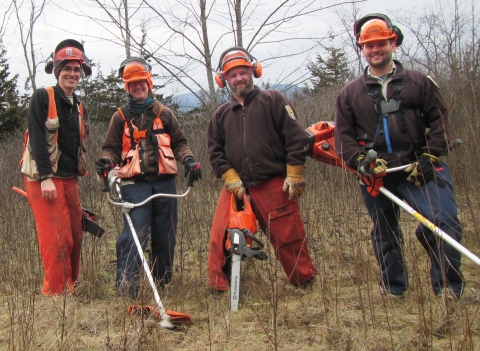

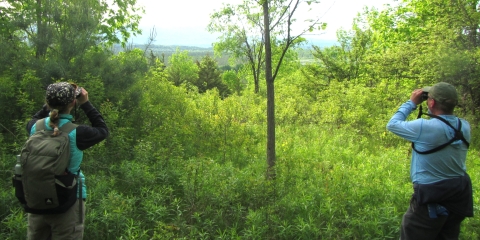
During May and June, PFW Program biologist Ryan Crehan and staff from Audubon Vermont conducted point-count and area surveys across the 11 project sites. The data collected this season help show how the restored habitat is functioning and will guide future restoration efforts.
Additional restoration work is planned for fall and winter to further enhance breeding habitat for these species.