Along Maine’s coast, underwater eelgrass meadows provide essential habitat for fish and wildlife, while improving water quality, reducing shoreline erosion, and buffering coastal communities from storms. Yet these valuable habitats are declining. Some areas of Maine have lost more than half of their eelgrass in recent decades. This significant decline has prompted researchers, conservation partners, and local communities to take a closer look at what is happening and what can be done.
That work begins with good information.
This summer, U.S. Fish and Wildlife Service (Service) biologists with the Gulf of Maine Coastal Program worked with partners to advance eelgrass assessments and ultimately restore eelgrass in Casco Bay, Maine. With financial support from a Restore America’s Estuaries, the partnership combined careful planning and pre-restoration monitoring with an increasingly useful conservation tool: drones.
Seeing What Lies Beneath
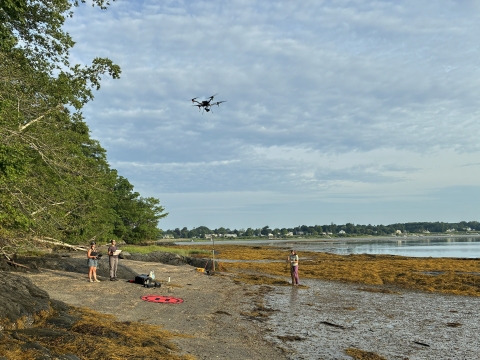
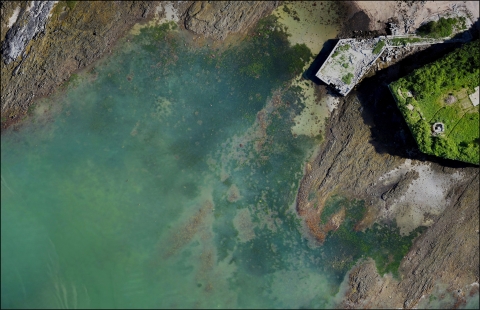
In July 2026, Coastal Program biologist and drone pilot Bonnie Turek collected high-resolution aerial imagery of seven eelgrass beds in Casco Bay: three declining, three healthy, and one that had disappeared but was beginning to recover. The imagery helped map the meadows’ boundaries, evaluate their condition, and identify healthy donor meadows – beds with enough reproductive shoots to serve as a source for restoration elsewhere. This information also makes restoration efforts more strategic, allowing scientists to focus on efforts where there is the greatest potential for success and a need to measure outcomes. This is a stellar example of adaptive conservation by using the best available information to make sound decisions and improve conservation science.
Looking Above and Below the Water
However, aerial imagery cannot tell the whole story. Water clarity, sunlight, and other conditions can make some areas difficult to assess with drones. To validate the maps, the Service worked with the Maine Department of Environmental Protection’s Marine Mapping Program to ground-truth the imagery.
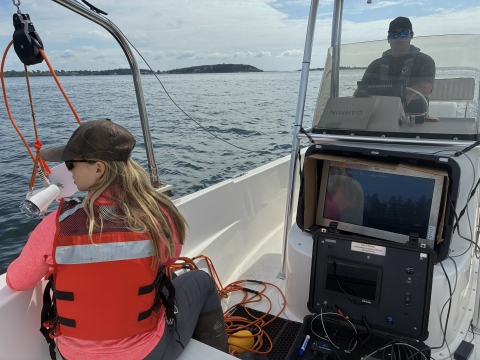
Using underwater cameras towed by boat, researchers surveyed transects along the mapped beds to confirm the presence of eelgrass. Together, aerial imagery and underwater observations provide a clearer picture of meadow health and a stronger foundation for restoration and future monitoring. At the same time, partners are collecting data on other factors that influence eelgrass health, including water quality, invasive green crab populations, and turbidity.
From Healthy Meadows to New Beginnings
The goal is not simply to map eelgrass meadows, but to retore them. The partners are evaluating techniques to collect and store eelgrass seeds from healthy meadows to use later for eelgrass restoration. This approach to restoration has shown promise in other states and will be piloted in Casco Bay in fall 2026.
The Service drone mapping team will return in summer 2027, when eelgrass beds reach their peak biomass, to map the sites again. Comparing the new imagery with this year’s baseline will reveal changes in meadow size and guide future restoration efforts.
Conservation Works Best Together
Saving Maine’s eelgrass meadows brings together federal and state agencies, universities, nonprofits, researchers, volunteers, and other partners – each bringing their different expertise, tools, and perspectives to the work. Coastal Program biologist Julia Kemnitz helps connect these partners and resources in Maine, while providing technical expertise, supporting project development, and helping turn practical plans into meaningful conservation outcomes.
It is a simple but tested approach: ask good questions, gather better information, work alongside partners, and use what is learned to improve the next restoration project. For eelgrass, this approach can help transform a declining meadow into a healthy meadow and a healthy meadow into a source of hope for impaired meadows elsewhere along the coast.
There is still much to learn about why Maine’s eelgrass is declining and where restoration will succeed. But by looking more closely, working together, and acting on the best available information, conservation partners are giving these underwater meadows a better chance to thrive.