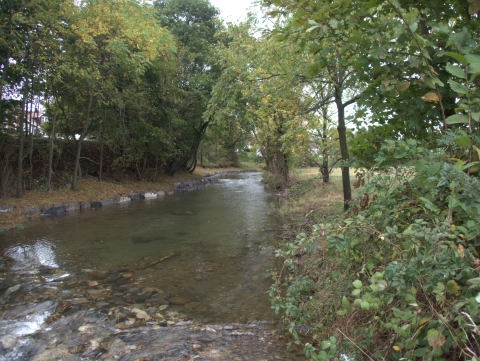
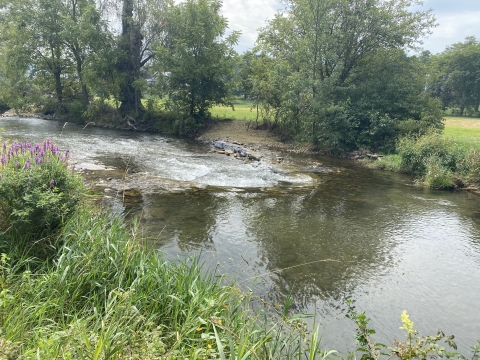
In Bedford County, Pennsylvania, the U.S. Fish and Wildlife Service’s Partners for Fish and Wildlife Program restored 2,442 feet of Yellow Creek—a high-quality cold-water stream that supports trout and other native species.
Yellow Creek, likely named for its characteristic color in high water, is a 20.9-mile tributary of the Raystown Branch of the Juniata River. Though lesser known than some of Pennsylvania’s famous limestone streams, it offers exceptional habitat and scenic beauty. At its headwaters near the town of Woodbury, Yellow Creek is a classic limestone meadow stream, winding its way through barnyards, hayfields and pastures. Further downstream, flowing through the Loysburg Gap—a dramatic mountain pass—the creek transforms from a gentle spring-fed stream into a fast-moving boulder bouncing waterway.
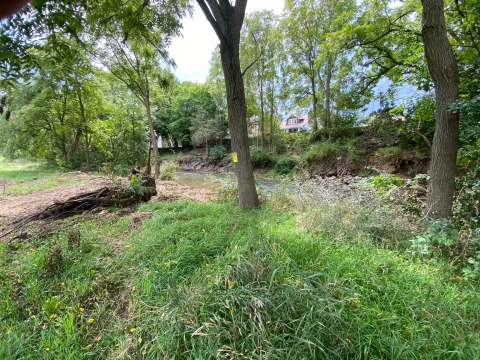
Back at the headwaters near Woodbury, many stretches of stream have been straightened for ease of farming, while in other sections livestock have unfettered access, and still other stretches have been altered by road and bridge construction. This combination has eroded streambanks, multiplied stream sediment, and lead to overall habitat loss, increased water temperatures, and compounded flood risks.
Restoring Natural Stream Function
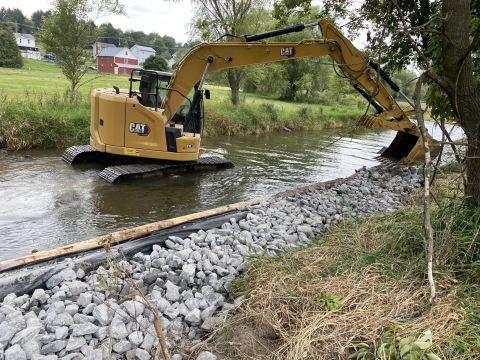
To address these issues, the Partners for Fish and Wildlife Program worked with the Western Pennsylvania Conservancy, a local stream consultant, Bedford County Conservation District, the Foundation for California University of Pennsylvania, Pennsylvania Department of Environmental Protection, Pheasants Forever, and a dedicated private landowner to restore Yellow Creek using natural stream channel design. With excavators, skid loaders and lots of logs and rock, the team installed a variety of in-stream structures—including mudsills (log cribbing), log and rock vanes, brush mattresses, and boulder clusters—to stabilize the banks, reduce erosion, and improve habitat for fish and aquatic insects.
These improvements:
- Enhance habitat by creating better spawning areas, feeding lanes, and overhead cover for trout and other species.
- Reduce sediment entering the Juniata River and Chesapeake Bay watershed by an estimated 142 tons per year.
- Reduce nitrogen by approximately 219 pounds per year and phosphorus by 73 pounds per year.
- Reconnect the stream to the riparian riparian
Definition of riparian habitat or riparian areas.
Learn more about riparian buffer, allowing the adjacent lands to function as an effective floodplain. - Support agricultural landowners by improving stream health and slowing erosion without reducing productivity.
- Increase recreational opportunities for fishing.
- Restore nearly 11 acres of native riparian habitat for birds and mammals as well as pollinator habitat in the stream buffer.
Benefits for Wildlife and Communities
Healthy streams like Yellow Creek are essential to both wildlife and the people who live nearby. They provide clean water, reduce flood risks, support agriculture, and offer habitat for fish and other native species. By restoring natural stream function and reducing sediment and nutrient pollution, this project helps protect the Chesapeake Bay watershed—one of the most important estuaries in the country.
Just as importantly, it shows how conservation can be a community asset. This project protects private property, strengthens working lands, and brings together landowners, conservationists, and local organizations to achieve shared goals. It’s a model for how restoration can benefit ecosystems and people alike.