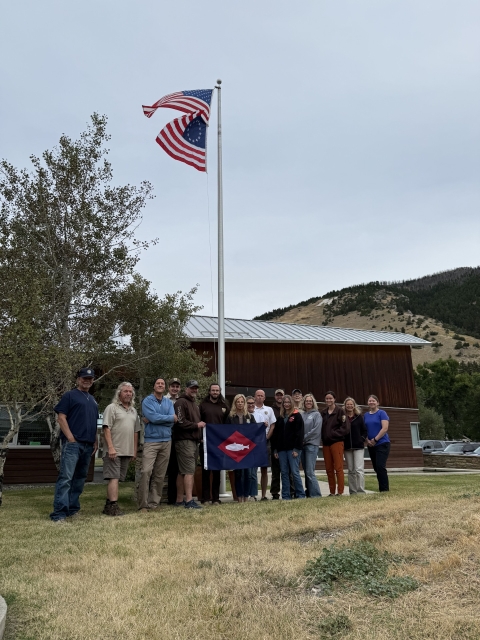
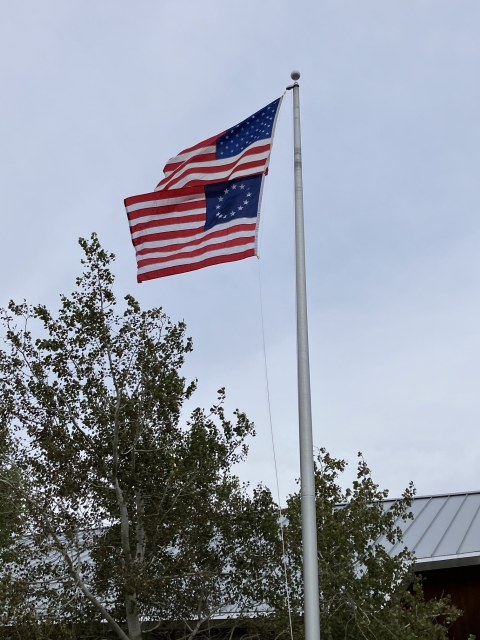
As part of the Flags Across America initiative for America’s semiquincentennial celebration, the U.S. Fish and Wildlife Service is sharing stories from the places where our commemorative flags have traveled. From historic hatcheries to vibrant refuges, each stop celebrates conservation as an enduring American value. Join us as we highlight the lands, waters, and wildlife that connect our nation’s past, present, and future.
Located in the heart of Montana’s Gallatin Valley, the Bozeman Fish Technology Center combines breathtaking mountain views with cutting-edge aquatic research. With Bridger Creek flowing through the property, and Gallatin National Forest hiking trails nearby, the Center offers a unique setting where science and nature intersect. The facility began as the Bozeman National Fish Hatchery in 1892, producing fish to serve Montana and neighboring states with trout for stocking waterways to support the area’s burgeoning recreational fishing industry. Trout production ceased in 1966 when the hatchery was designated as a Fish Cultural Development Center and, over time, the Center evolved into a place where innovative research is the cornerstone of the mission and the work.
The Bozeman Fish Technology Center’s mission is to advance science-based conservation and management of aquatic resources through pioneering practices. As one of six Fish Technology Centers within the U.S. Fish and Wildlife Service’s Fish and Aquatic Conservation Program, the Center’s highly adept team provides technical assistance to national and state fish hatcheries, tribal programs, and conservation organizations to restore sensitive species and ensure healthy fisheries. Also housed here is the Bozeman Fish Health Center, which provides diagnostic services, inspections for fish transport and nationwide fish health monitoring through the National Wild Fish Health Survey Program.
Co-located with the Bozeman Fish Technology Center, the unique Aquatic Animal Drug Approval Partnership (AADAP) program is the only program in the United States that is singularly dedicated to obtaining U.S. Food and Drug Administration (FDA) approval of new medications needed for use in fish culture and fisheries management. The Service’s AADAP scientists conduct research to support aquatic animal drug approvals and administer the National Investigational New Animal Drug (INAD) Program. Under specific conditions, this program allows fisheries professionals – including state, tribal, private industry, academic, and other federal partners nationwide – to use certain medications while they are undergoing FDA review. This includes essential medications such as treatments for disease and parasites, anesthetics, and spawning aids that cannot otherwise be legally accessed. In addition, AADAP provides the U.S. aquaculture community with up-to-date information on the status, availability and guidance for use of aquatic animal medications to ensure that they are safe, effective, and legal for aquaculture and fisheries management.
“The AADAP Program is a cornerstone in fisheries management, providing fisheries professionals legal access to medications under AADAP’s Investigational New Animal Drug Program,” said Bonnie Johnson, who has been working at AADAP since 1998. “This is important because it helps us maintain fish health in hatcheries and within other conservation programs."

The advanced Bozeman Fish Technology Center also focuses on projects related to conservation physiology, fish nutrition, fish passage fish passage
Fish passage is the ability of fish or other aquatic species to move freely throughout their life to find food, reproduce, and complete their natural migration cycles. Millions of barriers to fish passage across the country are fragmenting habitat and leading to species declines. The U.S. Fish and Wildlife Service's National Fish Passage Program is working to reconnect watersheds to benefit both wildlife and people.
Learn more about fish passage , and sensitive species conservation. Scientists study everything from spawning requirements of endangered fish to developing plant-based diets for aquatic species which, in turn, reduces the reliance on ocean forage fish. The Center also investigates fish passage and screening, using a state-of-the-art open-channel flume used to study fish swimming and leaping abilities and swimming chambers to understand how species navigate barriers. Equipped with high-definition cameras and PIT tag systems, researchers may simulate real-world conditions and design better fish passage solutions. These efforts inform habitat restoration and connectivity projects across the Northern Rockies and Great Plains, ensuring native fish populations, like pallid sturgeon (Scaphirhynchus albus), Westslope cutthroat trout (Oncorhynchus clarkii lewisi), Arctic grayling (Thymallus arcticus), and Yellowstone cutthroat trout (Oncorhynchus clarkii bouvieri) thrive.
America’s fisheries are a shared treasure, and each success story represents a step toward preserving biodiversity and maintaining healthy ecosystems. If you are interested in becoming part of the story, consider volunteering for trail improvement projects, participating in National Public Lands Day, or simply spreading awareness about the importance of healthy waterways. Whether you’re an angler, a nature lover, or someone who values biodiversity, your involvement matters. Learn more, get involved, and help us protect the species and habitats that define our nation’s natural heritage.
Next up, we follow the flags to Marquette Biological Station in Michigan, where teams are working on sea lamprey control to keep the Great Lakes healthy and vibrant. Stay tuned for the next chapter on this historic tour!