In deciding a suit filed by Southwest Center for Biological Diversity last year, U.S. District Court Judge Alfredo C. Marquez ordered the Service to reconsider its decision not to designate critical habitat for these species. The court later ruled the Service must propose critical habitat within 30 days of the court order and finalize a decision within six months.
The Service identified a total of 731,712 acres as pygmy-owl critical habitat in southern Arizona streamside thickets, woodlands, thornscrub and desert scrub. Nearly 52 miles of streams in south-eastern Arizona were designated as critical habitat for the water umbel.
"Both species have declined drastically from their historic population levels," said Nancy Kaufman, the Services regional director for the Southwest Region. "While the two species already are fully protected under the Endangered Species Act, todays designation highlights the habitat needed for their recovery."
Critical habitat does not affect activities on private lands unless Federal funding or a Federal permit is involved.
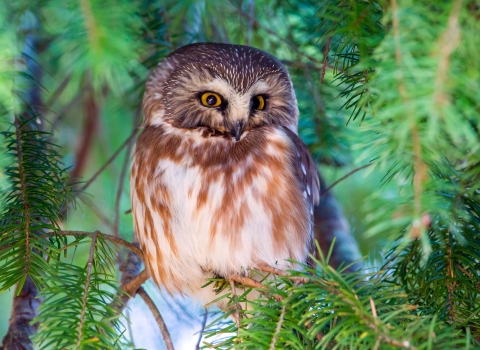
The cactus ferruginous pygmy-owl is a small, reddish-brown bird with a cream-colored belly streaked with reddish-brown and a long tail. The birds eyes are yellow, its crown is lightly streaked, and it has no ear tufts. Paired black spots on the back of the head may resemble eyes.
The pygmy-owl critical habitat consists of a block of Federal, state and private lands in Pima, Pinal and Maricopa counties. The area is designed to connect existing owl populations and provide space for individual and population growth; space for normal behavior; food, water, and other nutritional requirements; cover or shelter, sites for breeding, reproduction, or rearing of offspring; and habitats that are protected from disturbance. The Service does not expect the designation to change appreciably the way Federal agencies manage their lands.
The owl is threatened by loss and modification of its habitat due to dams, water diversions and urban expansion. Biologists located only 35 cactus ferruginous-pygmy owls in Arizona during the 1997-98 breeding season. Surveys for 1998-99 are not yet complete, but preliminary data show at least 30 owls. Biologists have not yet counted fledglings hatched this year.
The Huachuca water umbel is a small (1- to 8-inch tall) semi-aquatic plant with slender, erect leaves that grow from creeping roots. The umbel is found at 20 sites in southeastern Arizona and northern Sonora, Mexico, where it occurs in cienegas (desert marshes), springs, streams, and rivers. Six umbel populations have already been lost.
Threats to the species include competition with non-native species, floods or drought, and degradation of habitat resulting from livestock overgrazing, recreation, water diversions, dredging, and groundwater pumping. The Service anticipates many of these threats will increase as the human population of southern Arizona grows.
The Service designated critical habitat for the water umbel at eight locations in Arizona. Most of the sites are on U.S. Forest Service land. The Service expects the critical habitat designation to have little effect on the management of these lands since government agencies have been required to protect the species on their land since its listing.
Critical habitat refers to specific geographic areas that are essential for the conservation of a threatened or endangered species and which may require special management considerations. These areas do not necessarily have to be occupied by the species at the time of designation.
The Service added both species to the endangered species list in 1997. At that time, the Service determined that designating critical habitat for the two species would not be prudent because publishing species locations could attract plant collectors and vandals and lead to harassment of owls by overzealous birders. An area designated as critical habitat is not a refuge or special conservation area conservation area
A conservation area is a type of national wildlife refuge that consists primarily or entirely of conservation easements on private lands. These conservation easements support private landowner efforts to protect important habitat for fish and wildlife and major migration corridors while helping to keep agricultural lands in production.
Learn more about conservation area . Listed species and their habitat are protected by the Endangered Species Act whether or not they have designated critical habitat.
The U.S. Fish and Wildlife Service is the principal Federal agency responsible for conserving, protecting, and enhancing fish, wildlife and plants and their habitats for the continuing benefit of the American people. The Service manages the 93-million-acre National Wildlife Refuge System comprised of more than 500 national wildlife refuges, thousands of small wetlands, and other special management areas. It also operates 66 national fish hatcheries, 64 fish and wildlife management assistance offices and 78 ecological services field stations. The agency enforces Federal wildlife laws, administers the Endangered Species Act, manages migratory bird populations, restores nationally significant fisheries, conserves and restores wildlife habitat such as wetlands, and helps foreign governments with their conservation efforts. It also oversees the Federal Aid program that distributes hundreds of millions of dollars in excise taxes on fishing and hunting equipment to state wildlife agencies.