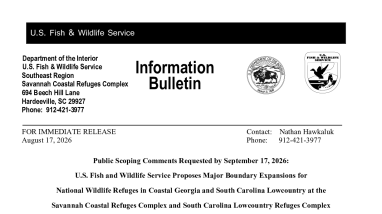
Information bulletin requesting public comment for major boundary expansion of 10 national wildlife refuges in Georgia and South Carolina.

Author(s)
Publication date
Facility
Bobcat kittens
The Savannah River is the lifeblood of the Savannah National Wildlife Refuge which provides rich habitats that support a diverse array of migratory and resident wildlife. Visitors are welcome on the 4.5 mile Laurel Hill Wildlife Drive and all refuge trails daily, from sunrise to sunset. The Visitor...
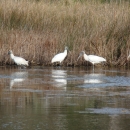
Sunrise over the wading bird rookery at Woody Pond
Harris Neck National Wildlife Refuge (NWR) serves as an important link in the chain of refuges along the eastern seaboard, and is the inland base for two neighboring barrier island refuges, Blackbeard Island and Wolf Island.
View of Ibis Pond with clouds reflecting off of the water.
Pinckney Island National Wildlife Refuge is an important link in the chain of wildlife refuges along the Atlantic Flyway, attracting thousands of migratory birds annually. The refuge also provides nesting habitat, called a rookery, for colonial wading birds such as ibis, egrets, and herons.
Boneyard beach at Wassaw NWR
Wassaw National Wildlife Refuge serves as an important link in the chain of barrier islands that lie along the Atlantic Flyway, providing excellent habitat for a variety of migratory birds. With little development and few management practices, the 10,053-acre refuge is one of the most pristine on...
Sunrise on the shore of Blackbeard Island National Wildlife Refuge
As one of Georgia's barrier islands, Blackbeard Island National Wildlife Refuge provides protection to the coastline and habitat for a diversity of wildlife, including summertime nesting sea turtles, and year-round shorebird activity.
Shorebirds on the beach at Wolf Island NWR
Wolf Island National Wildlife Refuge, which also includes Egg Island and Little Egg Island, is located at the mouth of the Altamaha River on the Georgia coast. The entire refuge was designated a National Wilderness Area in 1975 and provides critical sanctuary for migrating birds and nursery habitat...
Four Wood storks in shallow impoundment at E.F.H. ACE Basin NWR
The Ernest F. Hollings ACE Basin National Wildlife Refuge, steeped in cultural history and natural resources, is located within the larger 350,000-acre Ashepoo-Combahee-Edisto (ACE) Basin System, which represents one of the largest undeveloped wetland ecosystems remaining on the Atlantic Coast. The...
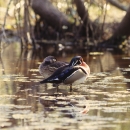
Male and female wood ducks in pond at Santee NWR
Santee National Wildlife Refuge, superimposed on the lands and waters of the 110,600-acre Lake Marion reservoir, protects over 15,000 acres of public lands in four units, Bluff, Dingle Pond, Pine Island and Cuddo. The refuge benefits an abundance of wildlife species in this rich ecosystem of...
Loggerhead sea turtle hatchling in shallow surf heading to the ocean at Cape Romain NWR
Cape Romain National Wildlife Refuge, extending 22 miles along the South Carolina Coast, is a rich mosaic of barrier islands with forest and ponds, vast salt marshes and intricate waterways. This diverse and dynamic system supports over 293 bird species and a myriad of other wildlife. Over fifty...
Kayaking on Crawford Lake at Waccamaw National Wildlife Refuge
Waccamaw National Wildlife Refuge was established on December 1, 1997 to protect and manage diverse habitat within coastal river ecosystems and to provide wildlife-dependent recreational activities such as hunting, fishing, wildlife observation, photography and environmental education. The wetland...
Media Usage Rights/License
Public Domain
FWS and DOI Region(s)