


Species that are considered high risk have a well-documented history of invasiveness in at least one location globally and are of establishment concern for the contiguous United States based on a climate matching analysis.
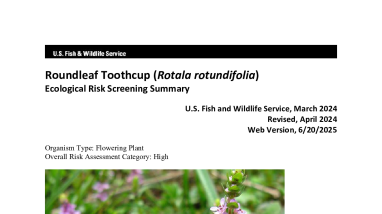
Rotala rotundifolia, Roundleaf Toothcup, is a plant native to southeast Asia, southern India, China, and Japan. This species exhibits great phenotypic plasticity and can grow fully submersed, as an emerged aquatic, and as a terrestrial on shores of drained water bodies. Rotala rotundifolia is popular in the aquarium trade and also present in the water garden trade. It has been introduced and established populations in the United States, Australia, and Hungary. It has also been reported as introduced to Brazil. The History of Invasiveness for Rotala rotundifolia is classified as High due to its reported impacts to ecosystem and water control functions in Florida flood control canals. The climate matching analysis for the contiguous United States indicates establishment concern. High matches were concentrated in the southeastern and central regions of the United States. The majority of the United States had a medium climate match. The Certainty of Assessment for this ERSS is classified as Medium primarily due to the impact information only coming from observational reports through a single non-peer-reviewed source. The Overall Risk Assessment Category for Rotala rotundifolia in the contiguous United States is High.
Publication date
Type of document
High Risk
Media Usage Rights/License
Public Domain
Program


Species