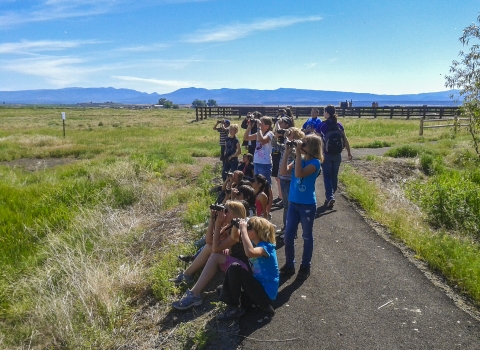
The days are getting shorter, and there’s a crisp breeze in the air. You’re hiking out on the Long Meadow Lake Trail at Minnesota Valley National Wildlife Refuge. You hear a caaw from somewhere above, and a chill begins to creep up your spine. What is that flying between the trees? You hear footsteps crunching behind you. Turning around slowly you see… your friendly refuge ranger handing you a map and bird checklist for your hike!
Located on the Mississippi Flyway, the refuge is home to 100 species of birds and is a popular tourist spot for over 200 species of migrating birds. These birds play essential roles in our ecosystems through controlling pests, pollinating, transforming landscapes, dispersing seeds and more! But for thousands of years, birds have also been played many other roles in literature and legends – for better or for worse. In honor of the spooky month, we’ll be diving deeper into ten of these birds’ foreboding folklores and their peculiar traits that make them fundamental to their habitats.
American Crow
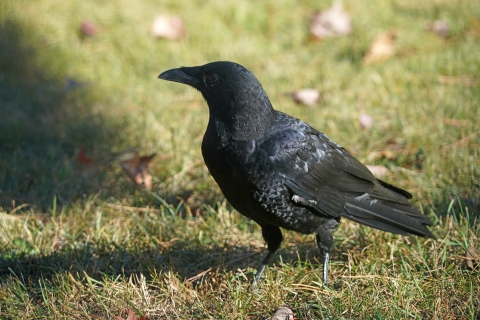
American crows are one of the most iconic emblems of omens, ranging from a prophetic symbol of Apollo in Greek mythology to the Celtic goddess of death and war, Morrigan. Due to their ability to eat carrion, otherwise known as dead animals, and their presence on battlefields and cemeteries, the collective term “murder” is used to reference a group of crows. Seen in media ranging from the CW’s The Vampire Diaries to “Corviknight” in Pokémon, crows are often cast as a dark presence in both past and modern lore. Even counting crows used to be a way of predicting the future. According to Brewer's Dictionary of Phrase and Fable, the rhyme goes,
“One's sorrow,
Two's mirth,
Three's a wedding,
Four's a birth,
Five's a christening,
Six a dearth,
Seven's heaven,
Eight is hell,
And nine's the devil his old self.”
Despite their conspicuous portrayals, crows are one of the most intelligent birds in the world. From the family Corvidae, crows can identify faces, deliver gifts, use and make tools and even make rule-based decisions. These sleek all-black birds are primarily identified by their color or by their distinct hoarse carr/caaw and can be found in every state in the USA.
Turkey Vulture
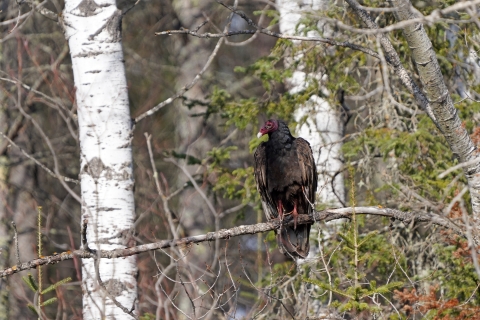
Speaking of birds that eat carrion, the turkey vulture is one of the only birds that exclusively eats it. With their bald red head, sharp pale bill and large wingspan (can be up to 70 inches!), these imposing birds aren’t winning any beauty contests. Often seen circling dead or dying animals from above, these birds can be signs of death to those who notice. In western movies, the cowboy is often quoted saying they’ll “leave you to the buzzards”, referring to vultures despite buzzards being a separate species.
While these birds can be rather striking compared to others, they are essential to our ecosystems. Turkey vultures are the clean-up crew of our open spaces. Through their keen sense of smell, they can locate animals that have “softened up” (been dead for longer) to allow them to feast easier. Without turkey vultures, there would be a lot more roadkill seen on your way to work!
American Coot
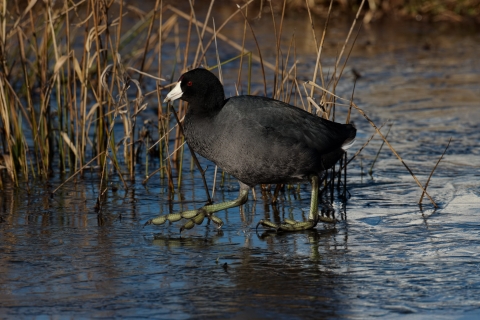
Although typically not associated with any superstitions or bad omens, these birds have a secret lurking underwater. Helping them to not only swim, dive and navigate soft surfaces, the lobed foot of the American coot is both unexpected and uncanny. Look at the picture below and tell me you aren’t surprised by this adaptation. In addition to their red eyes, white bill and dark plumage, they make an interesting bird to see both on and off the water. Through their diverse diets, American coots can control aquatic invasive species invasive species
An invasive species is any plant or animal that has spread or been introduced into a new area where they are, or could, cause harm to the environment, economy, or human, animal, or plant health. Their unwelcome presence can destroy ecosystems and cost millions of dollars.
Learn more about invasive species populations, like Eurasian water milfoil. Keep up the good work, weirdos!
Killdeer
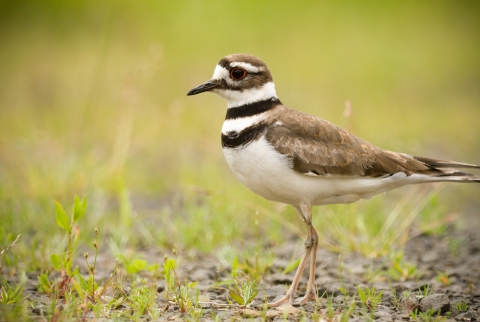
The killdeer, despite the fierce name, is a small, upland plover, meaning they live in areas often far from water like farmlands, lawns and ballfields. This bird can be distinguished by their long tail, long legs, orange rump and two distinct black bands across the front of the breast. Their namesake comes from their drawn-out call of kill-deer, which is honestly a relief.
Typically attracted to human-modified habitats for ground nesting, the killdeer has a clever trick to lure away potential predators when they get too close to their nest. The killdeer will pretend to have a broken wing and make alarm calls, tempting the predator to hunt them instead of their eggs. Once far enough away from the nest, the killdeer will simply fly away from the predator back to safety.
Brown Creeper
Much like the killdeer in terms of a menacing name, the brown creeper is a small bird with incredible camouflage. Named after their ability to “creep” up trees from the bottom of the trunk, they are remarkable at blending in with their surrounding habitat of mature woods with their brown mottled back and hidden white underparts. Due to brown creepers preferring mature forests, their presence is an indicator of the health and management of that forest. Logging of old-growth forests or practices that remove dead trees are the biggest threats to their habitat.

Common Loon
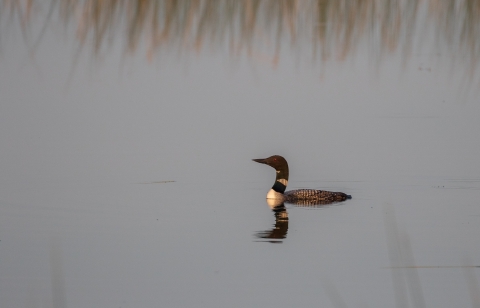
Heard in media like Harry Potter and Game of Thrones during times of mystery or eeriness, the common loon is famous for its tremolo, or alarm call. They are unlike other birds in that their legs are located far back on their body and have solid bones, both adaptations allowing them to be efficiently equipped for swimming and diving. Their contrasting black and white plumage with bright red eyes makes them anything but common looking.
There are a variety of loon myths throughout civilization. Some believe that loons can predict rain or were harbingers, a person or thing that signals the approach of another, of death. The Tsimshiagan people in Canada and Alaska believe that the loon was given a white shell necklace for restoring the eyesight of a leader, explaining the white markings seen in the photo below. In modern figurative language, the idiom “crazy as a loon” is used to describe someone who is foolish or wild, in reference to the wild call of the loon. In science, biologists use them as lake health indicators as they typically prefer to live near pristine lakes.
Double Crested Cormorant
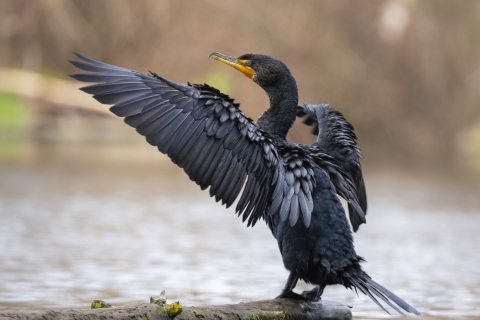
Often seen in lakes and ponds, the name “cormorant” is derived from the Latin corvus marinus, meaning “sea raven.” These large black birds have bright orange chins, long necks and alluring aquamarine eyes, with plumes, or crests, above their eyes. Traditionally a symbol of greed and evil, these birds are keystone species, meaning they are important for controlling invasive species and act as indicators of pollution.
Eastern Whip-poor-wills
The perception of eastern whip-poor-wills change depending on who you ask. Starting as early as 4th century B.C. the nightjar family, Caprimulgiformes, was believed to harm goats and drink their milk leading to some present-day fields guides referencing them as “goatsuckers.” Novels like Stephen King’s, “The Legend of Sleepy Hollow” and H.P. Lovecraft’s “The Dunwich Horror”, depicted the call of an eastern whip-poor-will as a warning of imminent death. In contrast to this, the Mohegan tribe in what is now Connecticut believed that benevolent forest-dwellers transformed into whip-poor-wills to travel through the woods.
With a round head, puffy chest and long tail with mottled gray-brown feathers, eastern whip-poor-wills can blend in seamlessly into their habitat. Due to their endless calls of whip-poor-WILL on summer nights and camouflage, they are more easily heard than seen. This nocturnal bird consumes much of the nighttime “pests” like moths and beetles throughout the night. However, their population has declined ~70% since the 1970s due to decreasing insect populations.

Great Horned Owl
An iconic bird of the night, the great horned owl has several symbolisms casting the bird in a negative light. In Cherokee, skili is used to both describe witches and great horned owls. For the Choctaw, a great horned owl call meant sudden death. However, owls are also commonly symbols of wisdom due to their association with the Greek goddess of wisdom, Athena. With piercing yellow eyes, bulky body and ear tufts that create “horns”, these birds can be intimidating to see out at night. Flying almost completely silent, the great horned owl can have one of the most varied diets of all raptors, including pests like mice and rats.

Northern Shrike
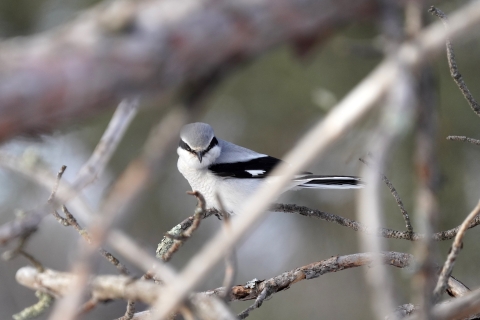
Our final bird you may find on the refuge is the northern shrike. With their Latin name, Lanius excubitor, Lanius meaning “butcher”, they have become otherwise known as “butcher birds.” Known for their brutal way of paralyzing prey through breaking the vertebrate, shrikes will furthermore skewer their dead prey with twigs or barbed wire to store for later. Despite their nine-inch size, northern shrikes can catch prey as large as them, with their diet ranging from insects to mice and to small birds. Acting as top predators, shrikes help control the populations of rodents and insects to promote a healthy ecosystem.
While we acknowledge that these birds have frightening names or negative superstitions about them, each species contributes to the overall health of their environment. Whether it’s through invasive species control or cleaning up carrion, all these birds are valuable whether at the refuge or in our own backyards. So next time you’re out hiking in the refuge, borrow some of our free binoculars to notice what birds you’re seeing and what they indicate for the environment (or for your future).To learn more eerie facts about animals found at Minnesota Valley National Wildlife Refuge, explore our events page to see our October-themed programs coming up. Until the witching hour, have a fang-tastic Halloween!