A striking sand-dune specialist, an important blueberry visitor, a rare social parasite. These are descriptions of just a few of the nearly 400 bee species you might find in Connecticut, according to a recent overhaul of the state’s bee list.
Supported by a State Wildlife Grant from the U.S. Fish and Wildlife Service, the updated inventory of Connecticut’s bees responds to a need for better bee data in the region, and nationwide, to help state agencies and other partners conserve economically and ecologically important pollinators and their habitats.
“You can’t protect what you don’t know you have,” explained Tracy Zarrillo, an agricultural scientist at the Connecticut Agricultural Experiment Station and the project lead. “Between this work and efforts across neighboring states, we can now say with confidence that New England is one of the most well understood regions in the U.S. when it comes to bee biodiversity.”
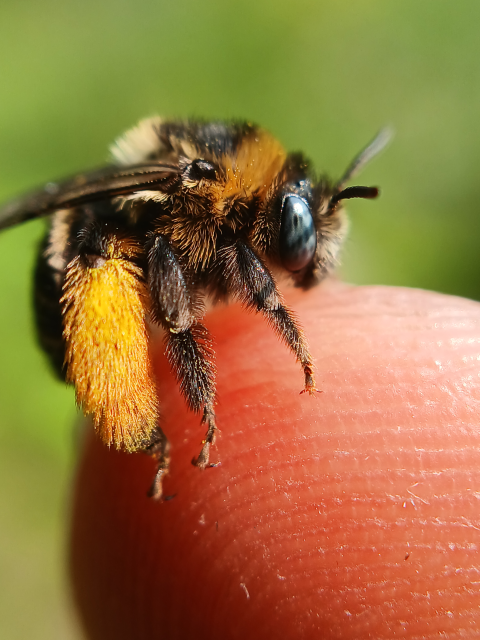
Bees are known to be the most effective pollinators, and research shows native wild bees and introduced European honeybees provide a comparable amount of pollination for most crops in the United States. That means declines in native bees due to habitat loss, pesticides, and other threats, could affect production levels for fruits like apples, blueberries, and pumpkins, as well as flowering plants that wildlife depend upon.
Connecticut’s comprehensive bee inventory — which draws from historical records, online community science platforms, previous checklists, and other publications — directs attention to priorities by identifying bees of greatest conservation concern, bees that are not well studied, and bees that require surveys to confirm whether they are still in the state.
“Reviewing the historical record allowed us to see what we’re not finding anymore, which gave us some species to target in our 2026 surveys,” Zarrillo said.
When the checklist published, there were at least 43 bee species that had not been seen in Connecticut for more than 25 years. In some cases, that was because a species had been extirpated, meaning it no longer exists in Connecticut. In other cases, it was because nobody was looking for it.
Take Andrena nida, a mining bee that had not been seen in Connecticut since 1972.
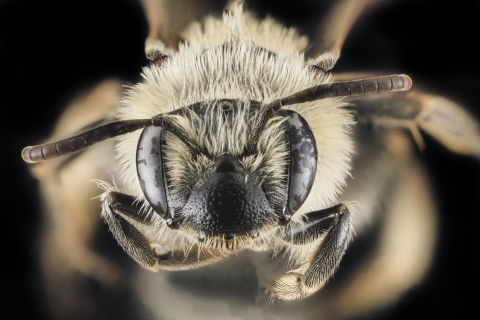
“Before our recent discovery, all we had were two male specimens collected more than fifty years ago,” Zarrillo said.
With funding from the John T. and Jane A. Wiederhold Foundation to support 2026 bee surveys, she and colleagues went out to search for Andrena nida early in the spring, informed by the knowledge that this species feeds its young exclusively on the pollen of willows — which can bloom as early as February. They found a huge aggregation of Andrena nida nests on April 1, a time when most people aren’t usually out looking for bees.
“It was raining and in the mid-50s, but the bees were still out there patrolling nests and gathering pollen,” Zarrillo said. “We were hoping to find maybe one specimen but were absolutely astonished to find the aggregation.”
Timing is everything. Andrena nida are adapted to fly in chilly spring weather and are only active for about a month. “After they lay their eggs in the ground, you won’t see them again until the following spring,” she said.
The Bees’ Needs
The case of Andrena nida demonstrates an important contribution of this project: it highlights species that have specific habitat requirements, specific host-plant requirements, or both.
While many people associate bees with wildflower meadows, these pollinators can specialize in a variety of different habitats.
Lasioglossum nelumbonis is a waterlily bee found only in wetlands. The rare Perdita bradleyi has only been collected in sand plains.Andrena parnassiae loves Grass of Parnassus, an unusual plant that only grows in calcareous spring fens and seeps — rare wetlands that are considered priority habitat in Connecticut.
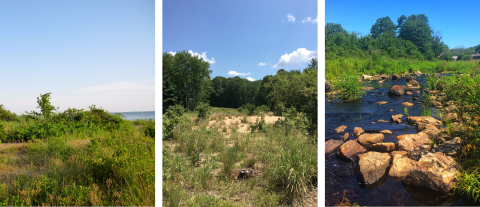
There are currently six bee species listed as Species of Greatest Conservation Need in Connecticut, and now Andrena parnassiae is one of them as a result of the recent update to its State Wildlife Action Plan — a blueprint for proactive species conservation developed by each state and updated every 10 years.
"We're proud to be able to help states advance goals for Species of Greatest Conservation Need through the State Wildlife Grants program," said Jay Rasku, Acting Assistant Regional Director for the Service's Office of Conservation Investments in the Northeast. "This project demonstrates the important role these grants play in meeting needs for species at risk."
The links between species and habitats in the updated bee list will help the Connecticut Department of Energy and Environmental Protection advance conservation priorities identified in the plan.
“Our goal is to enhance biodiversity in our habitat restoration work, and the bee atlas is a great tool to help us recognize where priority species might be located and the types of vegetation they need,” said Pete Picone, a wildlife biologist for Connecticut Department of Energy and Environmental Protection.
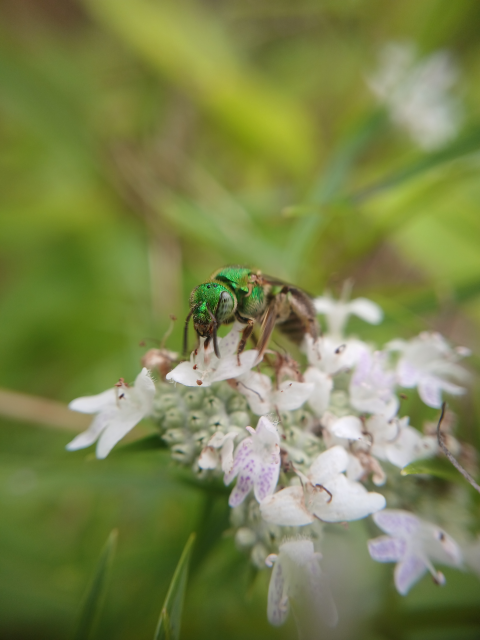
When we spoke, Picone was on his way to plant native blue lobelia at Robbins Swamp Wildlife Management Area. The state had focused habitat enhancements for pollinators at this large freshwater wetland and Zarrillo has found rare species there during surveys.
With additional funding from NatureServe, Zarrillo has also been working with colleagues Laura Saucier and Karen Zyko from the Connecticut Department of Energy and Environmental Protection to assign conservation rankings to bees in the state based on trends over time, with the goal of identifying needs for future efforts, such as surveys, monitoring, and habitat restoration efforts.
Of the 124 bee species they have reviewed so far, 22 have been given the highest rank, meaning they are at greatest risk.
A Bee Baseline
The updated bee checklist builds on a long history of bee research in Connecticut. The state was home to many important insect collectors in the late 1800s and early 1900s, and one of them, Henry Lorenz Viereck, authored its first bee checklist in 1916.
The bee enthusiasm has continued into the 21st century. As part of the project, the collaborators, led by co-author Dr. John Ascher of the University of Singapore, reviewed every bee or wasp record in Connecticut that has been posted on iNaturalist — a free online platform for identifying flora and fauna and tracking observations.
iNaturalist relies on volunteer identifiers, like Ascher, who are experts in their fields to review observations and suggest species names. Not only does this help observers learn, it vets observations, adding to their value for research and conservation.
For Connecticut bee researchers, iNaturalist was a treasure trove, with a total of 18,471 records.
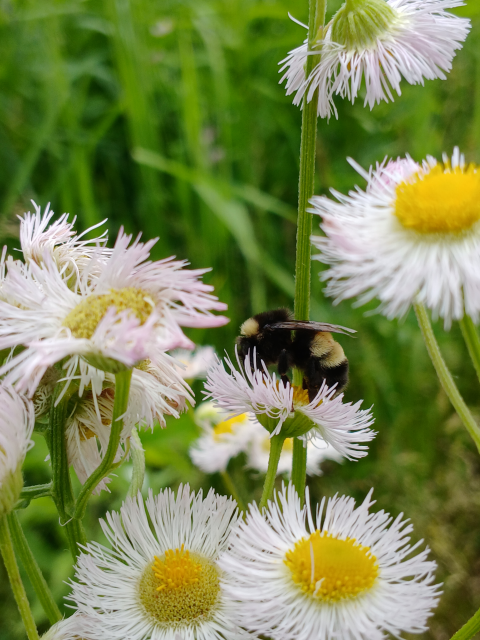
"It was an impressive amount,” Zarrillo said. “There were lots of fairly common bumble bees and honeybees, but in between those, there were interesting species that people were finding, even the state-listed yellow-banded bumble bee, Bombus terricola, and the black-and-gold bumble bee, Bombus auricomus — last seen in Connecticut in 1919!”
The data from iNaturalist is also useful because it captures the location, host plant, and time of year that a species was spotted, providing more information about where bees are found, what plants they are using, and when they are active to support future survey efforts.
“Connecticut has had some really heavy hitters in bee research over the ages,” Zarrillo said. “We are pretty lucky that we still have such an active force out there looking.”