Written by: Chris Best, Retired U.S. Fish and Wildlife Service State Botanist
From hot desert lowlands along the Rio Grande to forests of pine and oak in shaded ravines of the stark, volcanic Chisos Mountains, Big Bend National Park is a treasure trove of plants and animals in Trans-Pecos Texas. The park protects over 800,000 acres of the Chihuahuan Desert within a deep southward arc of the river. As the U.S. Fish and Wildlife Service State Botanist in Texas, I often worked with the National Park Service on scientific studies of the park’s rare plants.
Among Big Bend National Park’s many rare plants, four are currently protected under the U.S. Endangered Species Act. Three threatened species are cactuses of the low desert: Chisos hedgehog cactus, Lloyd’s mariposa cactus, and bunched cory cactus. The other plant, Guadalupe fescue, is a slender bunch-grass that is listed as endangered. The only remaining U.S. population of Guadalupe fescue occurs in the understory of pine-oak woodlands high in the Chisos Mountains in Texas.
In March 2016, I spent several days in remote areas of the park helping the Park Botanist, Dr. Joe Sirotnak, survey the listed plants in monitoring plots. Researchers established the plots in the 1990s to study each species’ life history. These plants are difficult to study as they are widely scattered across expanses of remote, rugged terrain. For efficiency, the researchers intentionally placed the plots in a few areas that had dense clusters of the plant species. In other words, plot distribution was biased.
Joe and I observed that the numbers of plants in the plots of all four species had declined. As we finished the annual plot censuses, he asked if I thought the data meant the species were declining. We understood that the established monitoring plots did not represent entire populations. Since their placement was biased, the data collected could not be used to determine their population sizes or demographic trends. Consequently, we decided to seek funding and partners to conduct improved population size estimates of the park’s four listed plants.
Counting Plant Populations
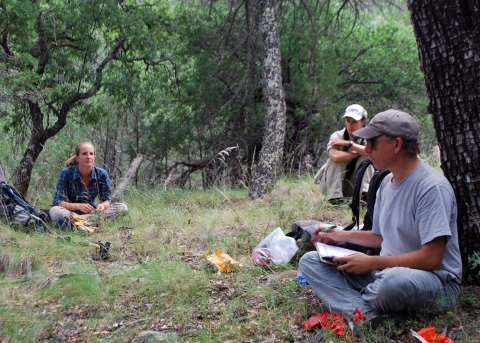
The Service’s Cooperative Endangered Species Conservation Fund awards grants on an annual basis to state wildlife agencies to support recovery actions for listed species. With guidance from Texas Parks and Wildlife Department’s botanist Anna Strong, we secured funding from this source, which Texas Parks and Wildlife Department awarded to researchers from the University of Texas at Austin and Sul Ross State University to conduct the research project. By then, Joe had accepted a new job in Idaho after 16 years at Big Bend, so he was unable to conduct the monitoring with us.
To assess a species’ viability, biologists need to know the sizes, demographic trends, numbers, and distributions of its populations. Rare plants often have extremely uneven or patchy distributions within their habitats. This trait makes it challenging to estimate their population sizes and may lead to incorrect conclusions about their viabilities.
The new sampling method required trudging off trail across the low desert and the high Chisos, systemically searching for many days in arrays of transects or circular plots regularly distributed throughout each species’ habitat. Preferably, the field work should be done during each species’ flowering season to aid identification and detection. I volunteered for most of the field work and had no trouble recruiting my co-workers at the Service’s Austin Ecological Services Field Office.
Field Notes through the Flowering Seasons
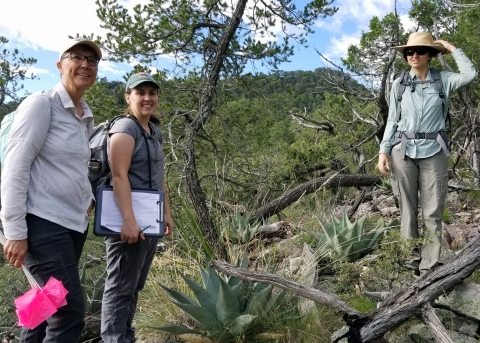
When I arrived for the first week of field work in March 2019, the park bunkhouse was crammed with college students we had recruited for the field work. I wondered who was in charge. Just then, Carolyn Whiting, graduate student at the University of Texas, appeared with a clipboard in hand and a no-nonsense attitude. Without even raising her voice, she doled out assignments and quickly transformed us into an effective transecting force. She led the project from start to finish.
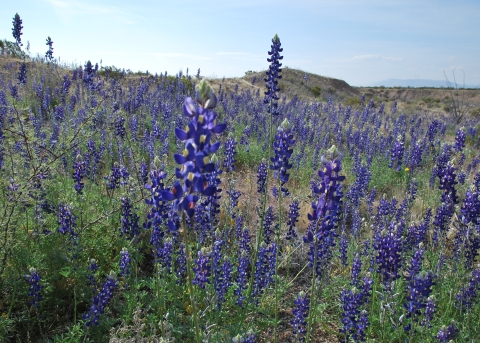
Chisos hedgehog cactus and Lloyd’s mariposa cactus flower in early spring, a pleasant time to bushwhack the spiny lowlands. Thanks to a rare abundance of rainfall during the preceding months, the desert erupted in a spectacular display of long-dormant wildflowers.
In contrast, bunched cory cactus flowers during the late summer monsoon, when the heat is intense and the days are long. We worked on those transects in August, beginning our field day in the dark at 4:00 a.m. so we could start our surveys just as the rising sun cleared the Dead Horse Mountains. We’d hike transects until 1:00 p.m., when the temperature passed 106° F, then seek shady refuge during the scorching afternoons.
We worked on the Guadalupe fescue plots in the fall, when the weather can change quickly. The plant’s population is scattered in Boot Canyon at 7,000 feet above sea level. From the trail head, it was a three-hour uphill hike, so we made camp in the backcountry. After our first day of plot work in October, we returned to our camp to find that a bear had shredded all our tents and sleeping bags. During another survey trip, we cowered in our tents one night as a powerful thunderstorm pounded our campsite.
More Survey Efforts
In April 2021, a wildfire, the first in nearly 80 years, burned through Boot Canyon, including most of the Guadalupe fescue habitat. Texas Parks and Wildlife Department extended the research project for one year so we could document the effects of the wildfire. Thankfully, the fire’s intensity was mostly low to moderate; it cleared understory brush and reduced the amount of dry fuel while leaving the forest intact and more open. Periodic burning benefits most grasses, but the Guadalupe fescue population was reduced by about half. Most of the surviving population occurs where the plants were protected by layers of loose rock. As of November 2024, the population still had not recovered. Nevertheless, we project that the fire will have longer-term benefits to the species through habitat improvement.
Carolyn Whiting became Big Bend’s park botanist in September 2021. She worked with the non-profit Rio Bravo Restoration and the Mexican Commission on Protected Natural Areas to conduct similar rare plant studies in Coahuila, Mexico. During these surveys, they found three new populations of Lloyd’s mariposa cactus in Flora and Fauna Protected Area (APFF) Ocampo, across the Rio Grande River from Big Bend. I joined them in April 2024 for a survey of APFF Maderas del Carmen, where we found a new population of Guadalupe fescue..
Success through Cooperation
The collected field work revealed many previously unknown individuals and allowed us to estimate more accurate population sizes for all four plant species. These efforts provided the bulk of new information reported in the most recent status reviews of each species. We documented at least five protected, viable populations of Lloyd’s mariposa cactus in Big Bend National Park and additional protected populations in Texas managed lands and protected areas in Mexico. This new information was incorporated into the Service's five-year status review of Lloyd's mariposa, which recommended delisting the species.
But perhaps the project’s best accomplishment was the seamless cooperation among researchers, non-profits, state agencies, and federal agencies of the U.S. and Mexico, to achieve common purposes for conservation.
Thankful for Collaboration
I would like to thank many people for making this project happen, including botanist Anna Strong with Texas Parks and Wildlife Department, Carolyn Whiting at Big Bend National Park, ecologist Norma Fowler with the University of Texas at Austin, botanist Martin Terry with Sul Ross State University, Jeff Renfro with the non-profit Rio Bravo Restoration, and self-trained botanist and volunteer Deb Manley at Big Bend National Park. Finally, I would like to thank Joe Sirotnak, who inspired me to search for answers in the hot, lowland desert and steep mountainous terrain of Trans-Pecos Texas.