When I accepted a position as a seasonal technician with U.S. Fish and Wildlife Services in Alaska, I didn't quite know what to expect. I assumed it would be a chance to apply my lifelong interest in the natural world and (hopefully) some of my undergraduate course work. I envisioned mountain ranges, bears, moose, and wildlife everywhere. I certainly wasn’t expecting mosquitoes 5x bigger than the ones I knew, temperatures hovering around 30°F in June, or highways that felt like rollercoasters. Also, I wasn’t prepared to find a strong sense of value inspecting watercraft hundreds of miles from Alaska’s second largest city.
My job as a watercraft inspector offered a chance to learn in a unique manner. I worked at the port of entry between Alaska and Canada (Alcan), where I interacted with all sorts of people. I met life-long Alaskans hauling up their charter boats for the season, retirees with kayaks taking their first road trip to the state, Europeans trekking the length of the Americas, and everyone in between. Each had their own story to tell, but nearly all were united that protecting Alaska is critical and answered my questions about their watercraft.
How does answering questions about watercraft protect Alaska?
The answer is simple and concerns something most people don’t often think about: mussels.
No, not brute strength and going to the gym type of mussels, but zebra (Dreissena polymorpha) and quagga (Dreissena bugensis) mussels. Together, they are often referred to as dreissenid mussels from the genus of their scientific names. They are one of the most notorious and destructive invasive species invasive species
An invasive species is any plant or animal that has spread or been introduced into a new area where they are, or could, cause harm to the environment, economy, or human, animal, or plant health. Their unwelcome presence can destroy ecosystems and cost millions of dollars.
Learn more about invasive species . Native to Europe, they were originally introduced to the U.S. in the 1980s. Since then, they have spread across much of North America and present a huge threat to ecosystems and infrastructure, causing an estimated $300-$500 million annually in damages to the Great Lakes region alone! Thankfully, as of 2026, Alaska remains one of five western states not infested with invasive dreissenid mussels.
While dreissenid mussels themselves are small (only 1-3 cm long), they can quickly accumulate on the surfaces of objects in water containing mussels. This phenomenon is called “biofouling.” While biofouling on watercraft is dangerous and can bring mussels to new areas, it is more visible than another method of mussel transport: veligers. Veligers are the microscopic larvae of dreissenid mussels. Invisible to the naked eye, they can survive in residual water or trapped water compartments on a boat for weeks! If the boat is launched into a new waterbody, the veligers are unknowingly released, allowing them to grow, reproduce, and infest the new waterbody.
While adult mussels can be seen and identified, I often found myself haunted by the idea of veligers sneaking into Alaska undetected.
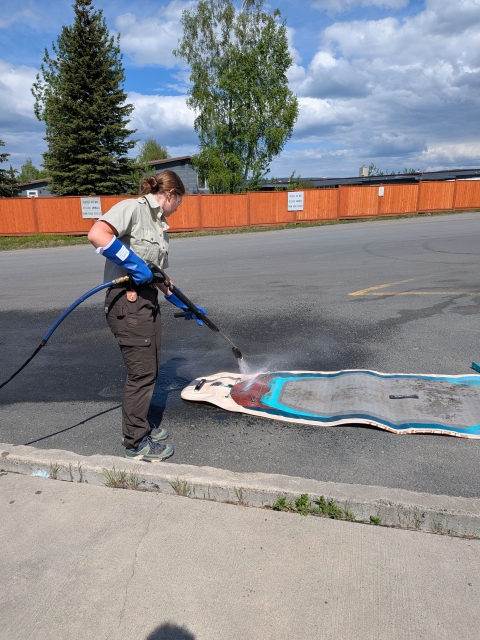
Thankfully, there is a process to decontaminate watercraft with residual water that may contain veligers using a portable decontamination unit. The high pressure, high temperature pressure washer is designed to destroy any potential aquatic invasive species. It is equipped to decontaminate both the watercraft’s internal compartments and engines, as well as the external portion of the watercraft in a timely and efficient manner.
When I began this job, I didn’t consider the pressure that it would bring. Both metaphorically and literally [see photo on right]. Bearing witness to just how much is at stake for the ecosystems and all that rely on them, I realized how immensely important invasive species prevention is. I found a strong sense of value and accomplishment in being at the front lines of prevention. The responsibility to uphold the mission of USFWS – work with others to conserve, protect, and enhance fish, wildlife, plants, and their habitats for the continuing benefit of the American people – was something I took great pride in.
We all share the responsibility.

Most people coming through the port shared that same sense of responsibility. Even those without boats often thanked me for my work or asked about what they could do to help. Those outreach interactions were some of my favorites. Each person I empowered to prevent invasive species on their own adds to the collective protection against invasive species establishing. It has been such a privilege to learn about the rich cultures and people of Alaska in an incredible natural environment. And an honor to share my new knowledge with others and to make a difference.
Do your part to prevent the spread of aquatic invasive species: Clean Drain Dry.
- CLEAN off all plants, animals, mud, and debris from watercrafts and equipment before leaving waterbody.
- DRAIN all water from watercrafts, live wells, motors, and equipment before leaving waterbody.
- DRY everything in the sun for at least 5 days or wipe with towels before entering a new waterbody.

3 Things I Learned in 3 Months…
There were quite a few adjustments to be made upon my arrival from North Carolina to Fairbanks and subsequently, my duty station near the border of Canada and Alaska.
- Staying in touch is hard! I quickly learned that cell coverage is spotty at best, and mostly downright nonexistent near the border. Time zones were equally difficult to navigate, especially with friends and family on the East Coast.
- Freeze-thaw cycles turn highways into rollercoasters! Frost heaves, loose gravel, and potholes created bumpy, hazardous trips in the long stretches between towns and cities.
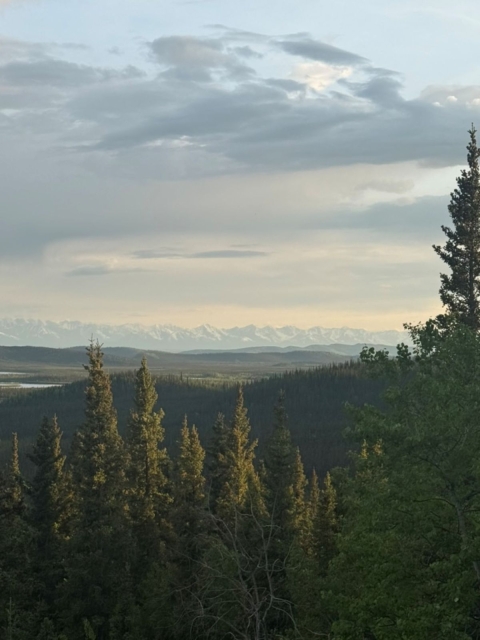
- Mountain ranges are visible 24/7 thanks to the seemingly ever-present sunlight!Arriving in June, I was privileged enough to witness the snowcapped mountains slowly give way to green as the trees began to take advantage of the 20 hours of daylight. I, too, took advantage, fishing, hiking, and exploring the outdoors after work with almost unlimited time to soak in the beauty of interior Alaska. Surrounded by wildlife and nature instead of cell towers and delivery drivers, I felt a peace I hadn’t known anywhere on the East Coast.