Steve Earsom, Division of Migratory Bird Management, and Matt Weegman, Big Oaks National Wildlife Refuge, USFWS
Our survey this year was one of the smoothest I have experienced. We always try to ride the front of the phenology wave – we want the ice to be gone and the trees starting to bud, since these are visible surrogates for knowing that most ducks and geese headed to more northerly breeding habitats have already passed through. If we are in front of the wave, our data suffer because birds are still in larger groups rather than breeding pairs or are absent because the ice has not cleared from the habitat Our data also suffer if we are behind the wave because leafed-out trees can make it impossible to see the waterfowl, or we see many drakes that are flocked together making it impossible to know whether they ever paired.
This year, we were able to begin the survey at the right time (unlike last year when we were delayed over a week by weather and a closed airport that precluded us from departing) and were able to progress quickly through the habitat that was ready. Further, our weather “delays” allowed habitat further north in the crew area to be ready by the time we arrived. And the habitat was good.
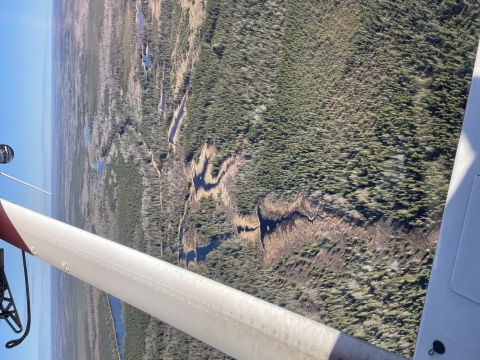
As we observe every year, the healthy beaver population creates wetlands by building and maintaining dams on small streams. This year, meltwater and recent precipitation meant these wetlands were full or nearly so. Rivers, larger lakes, and hydropower reservoirs were similarly near-full. In agricultural areas, the ubiquitous drainage ditches all had some water in them and held quite a number of ducks. In summary, bird numbers appear generally healthy and reproductive success is unlikely to be negatively affected by habitat quality.