Location
States
Colorado, Kansas, New Mexico, Oklahoma, TexasEcosystem
Prairie, RuralIntroduction

Drought is a familiar challenge in Cimarron County, Oklahoma and the neighboring states of Kansas, Colorado, New Mexico, and Texas. This region’s economy is dominated by agriculture, and people experience drought in different ways as they interact with the land through crop irrigation, livestock grazing, and other activities. Land use affects soil quality, biodiversity of native plants and animals, and access to water (Vadjunec et al., n.d.). As climate change climate change
Climate change includes both global warming driven by human-induced emissions of greenhouse gases and the resulting large-scale shifts in weather patterns. Though there have been previous periods of climatic change, since the mid-20th century humans have had an unprecedented impact on Earth's climate system and caused change on a global scale.
Learn more about climate change increases the frequency and severity of droughts, researchers, community members, and decision makers alike need to understand the impacts of human and land interactions (Fagin et al., 2016).
For decades, agriculture in Cimarron County relied on State School Land Leases. Farmers and ranchers leased these lands at a low cost to supplement land needs and sustain their operations in times of drought. When state policies changed in the early 1980s, many farmers could no longer afford leasing fees (Vadjunec & Sheehan, 2010). Ongoing agricultural challenges led to shifts in practice that created additional ecological problems, such as groundwater depletion due to increased reliance on center-pivot irrigation (Wenger et al., 2017). These issues raised questions about how socioeconomic factors shape human land use, and how this land use shapes environmental and community resilience.
The barriers to effective drought management in Cimarron County are closely intertwined with environmental, political, and social factors. In 2008, researchers from Oklahoma State University, the University of Oklahoma, and other institutions began efforts to understand and address these issues. This research is ongoing after nearly two decades, incorporating multiple research fields, community partners, and grant projects. Insights and outcomes are expanded through ecological and spatial land data (Fagin et al., 2016; 2024), examination of land policy variations between states (Straub et al., 2025), oral histories, and community participation (Vadjunec et al., 2022). Long-term efforts and strong relationships between researchers and community members improve drought resilience of communities and ecosystems in the Oklahoma panhandle and surrounding region.
Key Issues Addressed
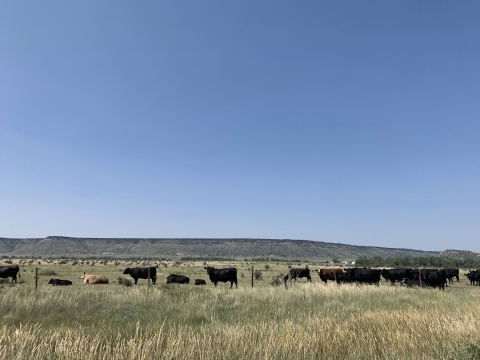
Communities must continuously adapt to drought conditions. Even after extreme historic drought events and challenges from years of variable rainfall, generations of agriculturalists still call drought-prone regions home. Like any natural disaster, droughts strain community resources and livelihoods. However, droughts are unique because they have slow onset effects, often with unpredictable changes in severity. Rather than responding to a single immediate impact, people in drought-prone regions must adjust their practices over time.
Cimarron County, Oklahoma is unique because it is the only county in the United States that borders four other states. Neighboring counties have similar physical environments, but there are different forms of land and resource governance across state boundaries. Variations in formal policies and informal practices shape how communities respond to drought. However, it can be difficult to clearly identify how the complex relationships between people and the land shape environmental outcomes.
While drought impacts, community resilience, and land governance are important areas of research, studies only go so far in directly addressing community needs. Land and water use data is not always accessible or useful for farmers and land managers. Additionally, even when negative governance outcomes are identified, it can be difficult to change statewide policies. Without community input, research may do little to address relevant barriers and or improve future drought resilience.
Project Goals
- Explore how recurrent drought shapes cultural practices and land management decisions in agriculture-dependent communities in the Great Plains.
- Incorporate land use data to identify the effects of formal and informal governance on landscapes and community and household-level experiences in drought conditions.
- Connect people to pixels by ensuring land use findings and other research insights are applicable to community needs.
Project Highlights
- Combined Research Approaches Provide Insights into Adaptation and Resilience: What began as an oral history project with women Dust Bowl survivors led to new questions about how generational knowledge shapes responses and adaptation to drought. Bringing together research perspectives from human-environmental geography, ethnography, biology, geospatial sciences, and other disciplines uncovered new insights about how communities adapt to cyclical drought. Resource sharing, social capital, and varying uses of land and groundwater impact ecological and economic resilience in rural communities (Straub et al., 2025).
- Land Use and Land Change Analysis Shows Different Governance Outcomes Across State Lines: Oklahoma’s land and water use policies differ from those in neighboring states, so researchers compared physical land and water data across state lines to understand the outcomes of human-land interactions. By mapping the area and utilizing satellite data from sources such as the NASA Landsat program and the USGS National Agriculture Imagery Project, researchers could see where differing state policies affected environmental outcomes such as growth of invasive woody plants or water availability. These results highlight how varying policy outcomes, such as overgrazing or groundwater depletion, create barriers or facilitate successful adaptation in drought-prone communities (Fagin et al., 2016; Wenger et al., 2017).
- Community Deliverables Bridge Gaps Between Scientific Research and On-the-Ground Needs: Lead researchers made a commitment to assist with community-based projects whenever possible. This resulted in collaborations such as local well monitoring, grant writing initiatives, community mapping, and exhibits for town museums. Small-scale projects provide ongoing opportunities to involve students in research efforts. Community presentations create space for local residents to provide feedback on how data relates to lived experiences, affirming formal research findings.
Lessons Learned
Informal rules based on culture and tradition can shape day-to-day resource use more than statewide regulations. Research may be seen as a tool to inform policy decisions, but when state policies adversely affect rural communities, advocacy efforts and immediate changes may be limited. When researchers work closely with community members, they gain the insights necessary to help develop more accessible and flexible solutions. Providing information to shape community planning, risk management, and community organizing can result in more immediate outcomes.
Transdisciplinary teams allow researchers to overcome the limitations of individual expertise. In this project, each researcher assists with tasks outside their typical area of focus. When a land use researcher sits in on a community interview or an ethnographer helps compile drought data, there are new insights to gain. Incorporating these new lines of inquiry into existing grant projects helps expand the overall scope of the research. Collaboration across project components eases the workload and helps all researchers understand the importance of combining different areas of study.
Working alongside communities allows researchers to form genuine relationships and build social capital. While traditional research can impose results on others, incorporating interviews, focus groups, and other ethnographic approaches with natural science helps address community concerns and establish trust. Community members were eager to continue contributing even after the COVID-19 pandemic interrupted research efforts and delayed project deliverables. When researchers demonstrate long-term commitment to the communities they work with, reciprocity strengthens research relationships.
Next Steps
- Analyze data from the USDA grant completed in early 2025 to examine shifts in community perceptions and behaviors when land and water use data is readily available. Results will be further expanded by comparing perceptions with actual land use outcomes.
- Continue growing community adaptation capacity through an NSF Research Coordination Network that shares frameworks, protocols, methods, and metrics about people, land, and water interactions for increased resilience in the Great Plains.
- Continue writing and reporting results from past community projects to translate direct outcomes into publishable findings.
Funding Partners
- National Science Foundation Research Grant (#CMMI-1266381) - Land System Vulnerability and Resilience to Drought: A Multi-Scale, Comparative Analysis of Public and Private Lands in the American West
- United States Department of Agriculture-National Institute of Food and Agriculture Grant (2018-68002-28109) - Participatory approaches to Agroecosystem Resilience In times of Drought (ARID): An example from the Southern Great Plains
- United States Geological Survey (104)g Grant (G21AP10597) - Fostering Student Training & Enhanced Educational Opportunities on Groundwater Management
- National Science Foundation Research Coordination Grant (#CHIRRP-2435176)- CHIRRP RCN: Building a Community of Practice for Co-Producing Resilient Socio-Ecological Systems in Grasslands
Sources Referenced
- Fagin et al., (2016). “Land tenure and landscape change: a comparison of public-private lands in the southern High Plains.” Ecological Processes 5.
- Fagin et al., (2024). “Use of Participatory sUAS in Resilient Socioecological Systems (SES) Research: A Review and Case Study from the Southern Great Plains, USA” Drones 8(6): 223.
- Straub et al. (2025). “Networks of Inclusive Exclusion: Social Capital and Resilient Rural Livelihoods in the Southern Great Plains (SPG).” Human Ecology 52: 1309-1327.
- Vadjunec et al., (n.d.). “Experiencing Drought in the Grasslands of the American West.”
- Vadjunec et al., (2022). “Fostering Resilience and Adaptation to Drought in the Southern High Plains: Using Participatory Methods for More Robust Citizen Science.” Sustainability 14(3), 1813.
- Vadjunec, J. & Sheehan, R. (2010). “Ranching and State School Land in Cimarron County, Oklahoma.” Great Plains Research 20: 163-177.
- Wenger et al., (2017). “Groundwater Governance and the Growth of Center Pivot Irrigation in Cimarron County, OK and Union County, NM: Implications for Community Vulnerability to Drought.” Water 9(1): 39.
Contacts
- Jackie Vadjunec, University of Oklahoma: jvadjunec@ou.edu
- Todd Fagin, University of Oklahoma: tfagin@ou.edu
CART Lead Author
- Jessica Zimmerman, Case Study Author, CART: jnzimmerman3@gmail.com
Suggested Citation
Zimmerman, J., N. (2025). “Land Use and Community Resilience to Drought in the Great Plains: The Importance of Transdisciplinary Research.” CART. Retrieved from https://www.fws.gov/project/transdisciplinary-research-drought-resilience