Location
States
LouisianaEcosystem
WetlandIntroduction
Louisiana’s marshes make up 40% of coastal wetlands in the United States. Coastal marshes provide ecosystem services such as habitats for birds and commercially important fish, storm protection, erosion control, and water filtration, and they have a high potential for carbon sequestration (NOAA, 2024; Schoolmaster et al., 2022). However, the marshes in Louisiana’s Mississippi River Delta Plain (MRDP) are currently experiencing rapid land use changes, some of the highest rates of sea level rise in the world, and the highest rates of wetland loss in the U.S. (Stagg et al., 2024). When coastal marshes become permanently submerged by rising seas, they convert to open water and lose their ability to perform important ecosystem services.
Healthy coastal marshes store large amounts of atmospheric carbon dioxide in their plants and soils. Carbon-rich organic matter decomposes slowly in saturated wetland soils and can be stored for long periods of time. This nature-based carbon storage plays an important role in climate mitigation and adaptation plans, such as the Louisiana Climate Action Plan or Coastal Master Plan. However, as sea level rises, marshes transition to open water, losing this carbon storage capacity (Stagg, 2022).
While existing models project carbon cycling in terrestrial ecosystems, few can accurately model wetland soil carbon dynamics. Furthermore, there is limited knowledge of the underlying mechanisms that alter carbon sequestration when coastal marshes transition to open water (Schoolmaster et al., 2022). U.S. Geological Survey (USGS) researchers recognized these knowledge gaps and developed a new wetland soil carbon model to more accurately show the effects of sea level rise and coastal marsh loss on soil carbon storage and greenhouse gas emissions. Quantifying coastal marsh soil carbon loss helps decision-makers develop, fund, and implement conservation and restoration projects for Louisiana's coastal marshes and other wetlands across the U.S.
Key Issues Addressed
Due to the high carbon fixation rates in coastal marshes, these habitats play an important role in the global carbon budget, acting as net carbon sinks. In the U.S., coastal wetlands store an average of 8.5-8.7 million tons of atmospheric carbon dioxide equivalent per year in their soils (Crooks et al., 2018). As sea level rise increasingly contributes to the loss of coastal marsh habitats in Louisiana, there is a risk that the carbon stored in their soils will return to the atmosphere and contribute to global warming, creating a greater need for tools that quantify the impacts of coastal marsh loss on greenhouse gas emissions (Schoolmaster et al., 2022; Creamer et al., 2024).
When sea level rise causes coastal marshes to transition to open water, the vegetation dies because it cannot survive complete submergence. This vegetation loss contributes to changes in the soil chemistry and microbiology, which may reduce carbon storage capabilities. However, without models of the mechanisms controlling wetland soil carbon chemistry, it is difficult to accurately assess how coastal marsh loss affects processes like carbon sequestration. Guidelines for climate change climate change
Climate change includes both global warming driven by human-induced emissions of greenhouse gases and the resulting large-scale shifts in weather patterns. Though there have been previous periods of climatic change, since the mid-20th century humans have had an unprecedented impact on Earth's climate system and caused change on a global scale.
Learn more about climate change assessments, such as those in the IPCC report, rely on the assumption that 100% of soil carbon at one-meter depths is lost when coastal marshes collapse, but this assumption has not been confirmed by existing data.
Continued research on the unique soil carbon chemistry and microbiology of coastal marshes is needed to address knowledge gaps. However, data collection in these habitats is difficult due to accessibility challenges such as muddy and flooded conditions or hurricanes that disrupt monitoring. Without proper data and models, land managers and climate planners cannot accurately incorporate the consequences of wetland loss and restoration into mitigation and adaptation plans.
Project Goals
- Develop a model of wetland soil carbon dynamics to enhance knowledge of coastal marsh carbon storage.
- Collect coastal marsh data to characterize baseline conditions and understand the soil carbon dynamics involved in coastal marsh collapse.
- Use coastal marsh data to calibrate the new wetland soil carbon model and test assumptions to ensure an accurate representation of soil carbon processes.
- Develop more precise carbon budget estimates to inform resource management and climate adaptation plans.
Project Highlights
- Develop a Soil Carbon Model for Wetland Ecosystems: USGS researchers collaborated with scientists from Tulane University, The Water Institute of the Gulf, and Louisiana State University to understand how the loss of coastal marsh vegetation changes the soil microbial community. They incorporated these findings into existing soil carbon models from terrestrial ecosystems. The resulting wetland soil carbon model provides a framework of hypotheses that can be tested with data from different types of wetlands, making it applicable for assessing varying stages of coastal marsh transition to open water (Schoolmaster et al., 2022).
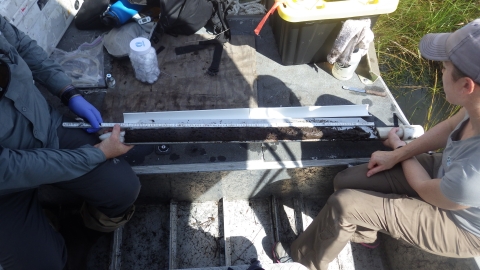
- Collect Wetland Transition Data: The study timeline did not allow for the examination of one coastal marsh site over the decades following the transition to open water. Instead, researchers used remote-sensing data and land change analysis to identify sites at varying stages of submergence. Based on this time sequence, they selected coastal marshes that had been submerged for 20, 11, and one years. Researchers examined the process of wetland loss using geo-technical methods such as cone penetrometer testing to measure soil strength and soil collapse in the open water ponds (Cadigan et al., 2022).
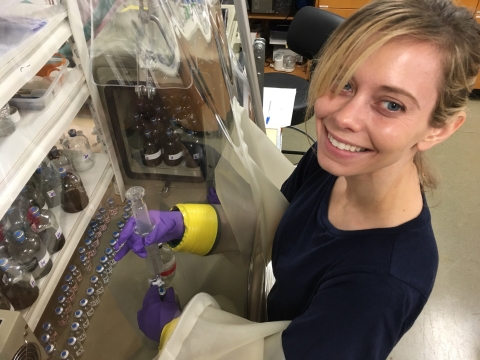
- Test Assumptions of the Wetland Soil Carbon Model: To understand the carbon consequences of wetland loss, researchers collected soil and water samples and used specialized eddy-covariance sites to take high-frequency measurements of gas concentrations and wind speed and direction. They used the soil core samples to conduct incubation experiments measuring how wetland loss impacts greenhouse gas emissions and soil carbon degradability, allowing them to test the soil carbon model (Creamer et al., 2024). They will use the eddy covariance data to estimate photosynthesis, respiration, evaporation, and transpiration exchanges, further validating the landscape scale impacts of wetland loss on soil carbon dynamics.
- Model Soil Carbon Loss Over Time: Models show submerged wetlands lose 40% of stored soil carbon over approximately 200 years, a slower rate than previous IPCC assumptions (Schoolmaster et al., 2022). However, sea level rise and coastal marsh loss still contribute to increased carbon dioxide emissions. When wetlands are submerged, the loss of marsh vegetation eliminates capacity for future carbon sequestration.
Lessons Learned
Vulnerable Wetlands: Coastal marsh restoration is important work, but conservation efforts are also needed. Studies showing the causes and consequences of wetland loss help build support for protecting these habitats.
Quantifiable soil carbon measurements allow land managers and planners to utilize decision support tools. One such tool, the LUCAS model, shows changes in land use and ecosystem carbon storage and flux. Understanding direct impacts of wetland conservation and restoration efforts helps decision-makers confidently support related policies and plans.
Drawing on the innovations, data collection techniques, and study findings from terrestrial ecology enabled researchers to better understand the role of plants in wetland soil carbon dynamics. Wetland ecology is a relatively young field compared to the study of land-based ecosystems. This study’s wetland soil carbon chemistry model was adapted from agricultural models, allowing researchers to apply existing knowledge to advance marsh studies.
The negative effects associated with sea level rise go beyond reduced carbon sequestration, adversely impacting ecosystem services such as habitats for species, recreational uses, and water quality and erosion control. The range of challenges associated with sea level rise creates an opportunity for researchers to communicate the holistic value of coastal marsh habitats alongside their findings about carbon storage and emissions reduction. This project began with conversations about marsh restoration, but results highlight an ongoing need to protect the remaining coastal marshes.
Next Steps
- Apply the wetland soil carbon model to understand other types of coastal marsh loss, including lateral erosion from wind, waves, and storm surges.
- Improve greenhouse gas emission inventories such as EPA’s inventory of U.S. emissions, and update guidelines for assessing wetland loss impacts as needed.
- Provide previously unavailable coastal marsh loss data to the Louisiana Climate Action Plan and inform local advisory boards of the impacts of wetland restoration and conservation
- Utilize the wetland soil carbon model to assess conservation and restoration outcomes for both inland and coastal wetlands with partners such as the state of Louisiana, the National Park Service, the U.S. Department of Agriculture National Resources Conservation Service, and the Department of Defense.
Funding Partners
- U.S. Geological Survey, South Central Climate Adaptation Science Center
- U.S. Geological Survey, Ecosystems Mission Area, Land Management Research Program
- U.S. Geological Survey, Land Carbon Program
Resources
- Cadigan, J. A. et al. (2022). “Characterization of vegetated and ponded wetlands with implications towards coastal wetland marsh collapse.” CATENA 218.
- Creamer, C. et al. (2024). “Vegetation loss following vertical drowning of Mississippi River deltaic wetlands leads to faster microbial decomposition and decreases in soil carbon.” JGR Biogeosciences 129(4).
- Crooks, S. et al. (2018). “Coastal wetland management as a contribution to the US National Greenhouse Gas Inventory.” Nature Climate Change 8(12) 1109–1112.
- National Oceanic and Atmospheric Administration. (2024). “Coastal Wetland Habitat.”
- Schoolmaster, D. R. et al. (2022). “A Model of the Spatiotemporal Dynamics of Soil Carbon Following Coastal Wetland Loss Applied to a Louisiana Salt Marsh in the Mississippi River Deltaic Plain.” Biogeosciences 127(6).
- Stagg, C. L. (2022). “Sea-Level Rise and Land Management Impacts on Critical Coastal Marsh Habitat - Camille Stagg 17Nov22.” [Webinar]. South Central Climate Adaptation Science Center.
- Stagg, C. L. et al. (2024). “Accelerating Elevation Gain Indicates Land Loss Associated with Erosion in Mississippi River Deltaic Plain Tidal Wetlands.” Estuaries and Coasts 47: 2106-2118.
Contacts
- Camille Stagg, USGS: staggc@usgs.gov
CART Lead Author
- Jessica Zimmerman, Case Study Author, CART: jnzimmerman3@gmail.com
Suggested Citation
Zimmerman, J.(2025). “Understanding Impacts of Sea Level Rise on Coastal Marshes Through Soil Carbon Dynamics in Louisiana.” CART. Retrieved from https://www.fws.gov/project/sea-level-rise-and-soil-carbon-coastal-marshes.