An official website of the United States government
Here’s how you know
Official websites use .gov A .gov website belongs to an official government organization in the United States.
Secure .gov websites use HTTPS A lock ( ) or https:// means you’ve safely connected to the .gov website. Share sensitive information only on official, secure websites.
The four refuges that make up the Central Washington National Wildlife Refuge Complex have little in common, other than being in the state of Washington. That makes the Complex a wonderfully diverse blend of habitats, species, and recreational opportunities. There’s something to be found by everyone that will pique their interest or pull them into the landscape. A geology buff? Visit Columbia National Wildlife Refuge, carved by the great floods of the last ice age. Need a scenic landscape to paint or simply unwind in? Conboy Lake is the spot. Interested in our nation's history? The Hanford Reach National Monument is the place to investigate. Want to add to your birding life list? Check out Toppenish.
The Complex offers wildlife in every season.
Spring brings nesting greater sandhill cranes to Conboy Lake. Smaller in size, but far, far more numerous, lesser sandhill cranes stop at Columbia on their way north. Wildflowers of all sorts bloom on Hanford. The spring migration of songbirds funnel through Toppenish.
If you can get into a boat, the heat of summer concentrates wildlife along shores of the Hanford Reach. On Conboy Lake, wildlife families are busy raising young. Columbia slows down, but the geology is there for every season.
In the fall, that same river trip on the Hanford Reach after the salmon have spawned out brings a new wildlife experience as scavengers fatten up on the dying salmon. Likewise, the blooming rabbitbrush turns the land yellow. Elk bugling echos through the refuge on Conboy Lake. Waterfowl return to Toppenish.
Winter is the perfect time to experience solitude on Conboy Lake as you track wildlife through the snow. Thousands of waterfowl descend on Columbia. On Toppenish, wetlands are filling to provide for wintering ducks and swans.
Birdsong by day, coyote chorus by night. Dramatic cliffs and rimrock sit side-by-side with lakes, potholes, and marshes. Desert denizens and waterfowl sharing the same rugged landscape.
Comprising nearly 30,000 acres, Columbia National Wildlife Refuge is a scenic mixture of rugged cliffs,...
Columbia National Wildlife Refuge is a scenic mixture of rugged cliffs, canyons, lakes, grasslands, and sagebrush sagebrush The western United States’ sagebrush country encompasses over 175 million acres of public and private lands. The sagebrush landscape provides many benefits to our rural economies and communities, and it serves as crucial habitat for a diversity of wildlife, including the iconic greater sage-grouse and over 350 other species.
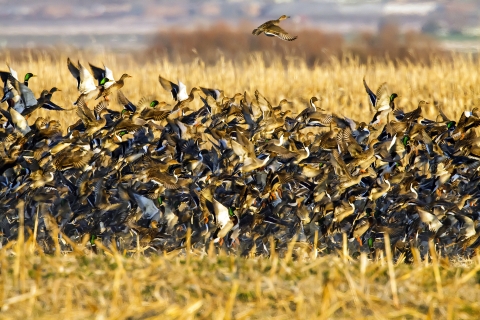
Learn more about sagebrush . The mix of lakes, carved by unimaginable floods during the last ice age, and surrounding irrigated croplands, a result Grand Coulee Dam and the Columbia Basin Irrigation Project, combined with generally mild winters and the protection provided by the refuge, attracts large numbers of migrating and wintering mallards, Canada geese, tundra swans, and other waterfowl. As winter turns to spring and frozen lakes begin to thaw, additional waterfowl return in great numbers. The largest concentrations of ducks, geese, and lesser Sandhill cranes arrive on the refuge in March and April, at times numbering over 75,000 individuals. The arrival of the cranes and other waterfowl draw visitors from all over the region, centering around the annual Othello Sandhill Crane Festival.
Located in the rain shadow of the Cascade Mountains, the refuge averages eight inches of annual precipitation, resulting in an arid environment. Most precipitation is received during late fall, winter, and early spring when weather is generally cloudy and sometimes foggy. When spring moisture is sufficient, refuge uplands bloom with multitudes of wildflowers. Summers are usually sunny, hot, and very dry, and much of the refuge goes dormant until the rains return.
Like the Hanford Reach National Monument, Columbia is tied to the National Park System. The refuge is a highlight along the Ice Age Floods National Geologic Trail, and the flood-torn landscape is recognized as the Drumheller Channels National Natural Landmark National Natural Landmark The National Natural Landmarks Program preserves sites illustrating the geological and ecological character of the United States. The program aims to enhance the scientific and educational value of the preserved sites, strengthen public appreciation of natural history and foster a greater concern for the conservation of the nation’s natural heritage. The program was established in 1962 by administrative action under the authority of the Historic Sites Act of 1935. The first National Natural Landmarks were designated in 1963. Today, there are more than 600 National Natural Landmarks in 48 states, American Samoa, Guam, Puerto Rico and the U.S. Virgin Islands.
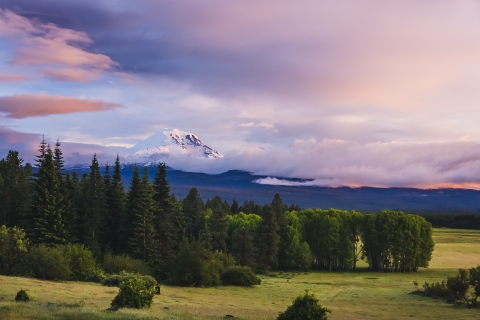
Snow-capped Mt. Adams. Bugling elk. Nesting Sandhill cranes. Rare Oregon spotted frogs. The calls of birds migrating from far-off lands. A special place hidden nearby. Conboy Lake Wildlife Refuge.
Nestled near the foot of Mount Adams in Washington’s Cascade Range, Conboy Lake National Wildlife Refuge is a scenic gem within the National Wildlife Refuge System. Conboy Lake's lush seasonal marshes and vibrant forested uplands beckon to both visitors and wildlife. Located within a easy drive of Portland, Oregon, the refuge is being ‘discovered’ by those seeking diverse scenery, idyllic recreational opportunities, and a link to the history of the Northwest.
While the scenery and the plentiful, charismatic wildlife are what draw people in, visitors soon discover that Conboy Lake offers hidden treats, esoteric gems that will keep them returning for years. Elk and deer may be the stars, but visitors soon learn about—and come to appreciate—Oregon spotted frogs, nesting greater sandhill cranes, and the variety of rare plants found on the refuge. A quiet place outside of hunting seasons, solitude is an easily found commodity and greatly appreciated by those coming from bustling metropolitan areas. As a national wildlife refuge national wildlife refuge A national wildlife refuge is typically a contiguous area of land and water managed by the U.S. Fish and Wildlife Service for the conservation and, where appropriate, restoration of fish, wildlife and plant resources and their habitats for the benefit of present and future generations of Americans.
Learn more about national wildlife refuge , this living system will satisfy your longing for splendor and serenity, just as it did for the indigenous peoples, explorers, loggers, and ranchers who were first drawn to the valley’s plentiful resources.
When you visit the refuge, plan on spending at least half a day there. It might only take you a couple of hours to walk the trails and visit the Whitcomb-Cole Hewn Log Cabin, but you should plan on at least an hour to just sit and unwind. The refuge is exceptionally peaceful, and the sounds of civilization are rare—other than us working to improve habitats and recover the many rare species found on the refuge. We love it when you stop by to ask about what we do.
Thousands of acres of land along the Hanford Reach of the Columbia River and the Saddle Mountain National Wildlife Refuge became the Hanford Reach National Monument in 2000 to protect rare plants, wildlife, and remnants of human history. The 196,000-acre Monument is open, treeless country punctuated by steep rolling hills and canyons. Since 1943, what are now Monument lands have been a safe haven for important and increasingly scarce natural and cultural resources. The lands were allowed to remain wild because they served as a security buffer for the top-secret Manhattan Project during World War II, which produced plutonium for atomic weapons. With limited development and grazing, native plants and animals thrived, and a diverse archaeological record has been preserved. The Monument supports 725 vascular plant species—at least 47 of which are species of conservation concern—42 species of mammals, more than 200 species of birds, 9 reptile and 4 amphibian species, 45 species of fish, and over 1,600 species of insects.
The Hanford Reach National Monument is a biologically diverse landscape, embracing a remarkable natural and historic legacy. The Hanford Reach, the last free-flowing non-tidal stretch of the Columbia River, is the ribbon that weaves shrub-steppe and riverine communities together, defining an irreplaceable landscape—a place to discover the richness of life, to reflect upon history, and to experience nature in solitude.
The Monument’s diversity of plants and wildlife are critical to the biological integrity of the Columbia Basin. The unique combination of an expansive and increasingly rare shrub-steppe ecosystem, the free-flowing river, and the last major salmon spawning grounds in the Columbia River create a diverse and precious mosaic of habitats. The Monument is a refuge for a multitude of species, many new to science.
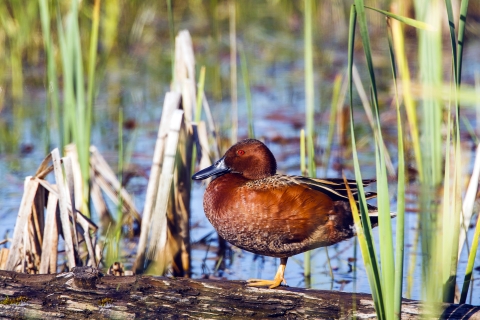
Toppenish National Wildlife Refuge, established in 1964, is an important link in the chain of feeding and resting areas for waterfowl and other migratory birds using the Pacific Flyway. Although Toppenish was established primarily for migratory waterfowl, many other migratory and resident wildlife species live here, such as American bitterns, peregrine falcons, badgers and beavers. The refuge is a broad collection of habitats supporting a diversity of species. Natural wetlands, such as sloughs and oxbows, and artificial wetlands are flanked by riparian riparian Definition of riparian habitat or riparian areas.
Learn more about riparian areas. Many species of migratory waterfowl and nongame birds, such as Virginia rails and savannah sparrows, use the wetlands for feeding and nesting activities. Native shrub-steppe—characterized by greasewood, Wyoming big sage, rabbitbrushes, bitterbrush, and native bunchgrasses, such as Great Basin wildrye, Indian ricegrass, Idaho fescue, and Sandberg bluegrass—once covered the upland areas. Loggerhead shrikes, long-billed curlews, California quail, Brewer’s and sage sparrows, and sage thrashers are only some of the animals that use the shrub-steppe. This diverse combination of habitats is a natural magnet to migratory and resident wildlife, alike.
You are exiting the U.S. Fish and Wildlife Service website
You are being directed to . The page will open in a new window.
We do not guarantee that the websites we link to comply with Section 508 (accessibility requirements) of the Rehabilitation Act. Links also do not constitute endorsement, recommendation or favoring by the U.S. Fish and Wildlife Service.
Click 'I understand' to proceed. Click Cancel to stay on the FWS website.