By Carlos Olivas, American Conservation Experience AmeriCorps Service Member for the U.S. Fish and Wildlife Service
Growing up in Washington State’s Kitsap County surrounded by the beautiful nature of western Washington, the natural environment is particularly important to me. From wildlife to the old growth forests, the environment is a defining piece of who I am today. In my youth, my mother would bring me along with her to many events around western Washington when she worked for Salmon Defense and conducted outreach around recovering salmon populations and their habitat. As a result, the importance of estuaries and keeping natural habitats healthy was instilled in me from a young age. This experience drove my passion for ecological sustainability, inspiring my continued education in fisheries sciences, and the many ways we can leave an impact on our salmon populations and other important aquatic species.
As I finished high school, my personal goal was to grow as my own independent person. To achieve this, I challenged myself by going to college at the State University of New York (SUNY) Maritime College almost 3,000 miles away from home. At SUNY Maritime College I studied marine environmental science with a minor in meteorology and oceanography. SUNY Maritime College encouraged and prepared me to serve in an internship before graduation. I contacted the U.S. Fish and Wildlife Service, not knowing the life changing effects that email would have on my life.
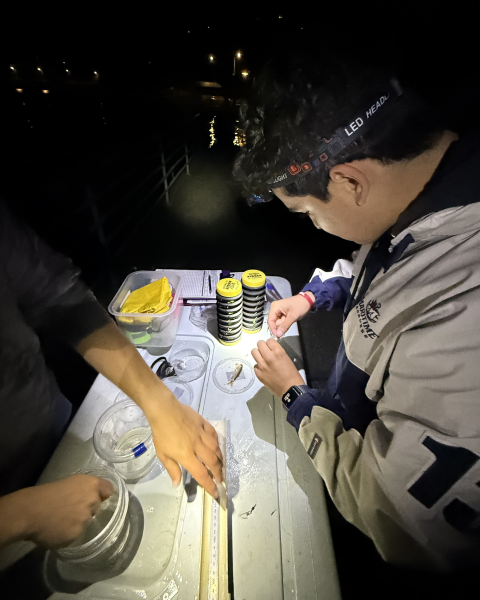
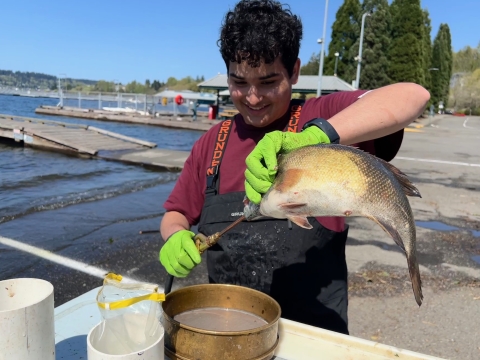
Over the past several months, I had the opportunity to serve with the Service as an AmeriCorps Service Member at the Western Washington Fish and Wildlife Conservation Office. I supported a diverse set of projects in the office, lab, and field, from collecting biological information from salmon at National Fish Hatcheries, to late nights on Lake Washington monitoring predation events of salmon under artificial light. This internship has pushed me to grow both personally and professionally. I look forward to continuing my education and career at the University of Washington where I aim to focus on fisheries and geography to pursue a career in the fish and wildlife field.

One of the biggest surprises I found in my internship was how beginner friendly it was. Coming into the internship, I had little experience in fieldwork or fisheries, aside from my college lab studies at SUNY Maritime College. Coming into this internship I was very timid and unsure, including how to handle fish properly while collecting data. As my term went on, I grew out of my shell and gained confidence in myself to do tasks that had previously intimidated me, such as tagging salmon with Passive Integrated Transponder (PIT) tags. I eventually pushed myself and joined the tagging team. Though I was nervous at first, I gained the confidence I needed to learn new skills and techniques. This experience served to be a great life lesson as I prepare and aim to tackle greater challenges in my career and life.
During the first few months of my term, I supported a project on Lake Washington where we studied how artificial light might influence predation of salmon fry. This project resonated with me as I have a deep fascination with the way urban environments can impact ecosystems. The data has yet to be fully analyzed, but there were times when it appeared that the coho fry were experiencing increased amounts of predation events under the lit dock than they were under the sites where there was no artificial light. This project included many late nights on the docks where I also had the opportunity to learn more about the people in my office, including their career paths, and offered me helpful career advice.
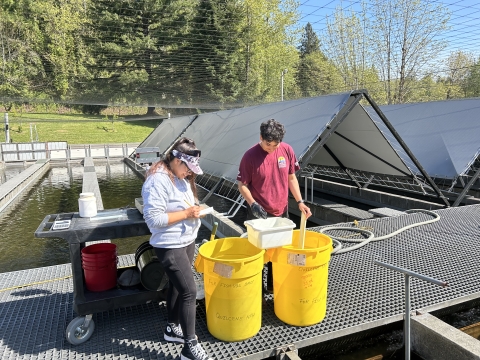
I also showed interest in learning Geographic Information Systems (GIS), and the staff were very supportive. They gave me tasks to practice using ArcGIS software, such as making maps for research papers, and offered advice on related classes to take. They even helped me take a course on R, a software for statistics, and how data science is used in fisheries science. I also spent a lot of time aiding the staff at Quilcene National Fish Hatchery where I gained experience in fish rearing and hatchery maintenance. Fish behavior was particularly interesting. Juvenile coho salmon, for example, have a preferred temperature range for feeding. The staff were very supportive, and I learned a great deal about careers in fish culture.
As a child I recognized the need to do more for the world around me. To me, working in fish and wildlife conservation means making a difference for the future and helping the world stay healthy. The opportunity to intern with the Service has helped me realize my passion for working in fisheries, and in geography to make a difference in the world as new challenges in the environment develop. Going forward I firmly believe that this internship has given me the knowledge and experience I need to make that difference. As I return to school to finish my undergraduate degree, I hope to continue my education by pursuing a master’s degree and continuing to work in the conservation science field, or urban studies.