Small Snail, Big Trouble
Picture a tiny snail eaten by a fish and surviving the eventful journey through its digestive system. It later gets tossed along the banks and dries up, appearing lifeless. Eventually the snail returns to the waterway and reproduces (without a mate) enough offspring to form a dense mat in the water as thick as night. Scary enough, you don’t have to imagine it, because this creature is real and is called the New Zealand mudsnail. Less than a quarter of an inch (5 millimeters) in length, this snail has invaded five continents and was recently found at Alchesay National Fish Hatchery in Arizona. Fortunately, the hatchery team and partners detected New Zealand mudsnail early, eradicated it, and prevented its spread and the hatchery’s possible shutdown- all because of clear communication, partnership and environmental DNA (eDNA).
Where Fish Thrive, Invasives Can Too
Alchesay National Fish Hatchery is located on the Fort Apache Indian Reservation in Whiteriver, Arizona. The hatchery is operated by the U.S. Fish and Wildlife Service and collaborates closely with the White Mountain Apache Tribe Game and Fish Department and the U.S. Geological Survey Northern Rocky Mountain Science Center. At the hatchery, brown and rainbow trout are reared and then stocked into nearby tribal waterways to support recreational fishing. However, the same water that makes fish production possible can also provide a pathway for invasive species invasive species
An invasive species is any plant or animal that has spread or been introduced into a new area where they are, or could, cause harm to the environment, economy, or human, animal, or plant health. Their unwelcome presence can destroy ecosystems and cost millions of dollars.
Learn more about invasive species .
New Zealand mudsnails were first documented in Arizona in 1995. This invasive species is now found in the North Fork of the White River downstream of the hatchery. Because fish hatcheries get water from nearby rivers and streams, invasive species in those waterways can possibly enter hatchery systems. Once they reach high enough numbers, New Zealand mudsnails can alter fish food supplies by consuming algae and other food resources that native fish depend upon. In hatcheries, an infestation could threaten fish production and create costly management challenges. For instance, in 2012, a New Zealand mudsnail infestation resulted in the permanent closure of the Loa Fish Hatchery in Utah.
Staying One Step Ahead of the Snails
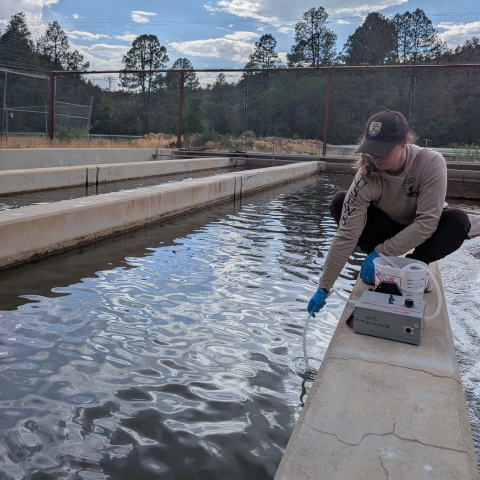
At Alchesay, hatchery staff and partners developed standard operating procedures for detecting New Zealand mudsnails and determining what to do if they were found. These procedures provide clear guidance for surveillance, confirmation, removal, and communication among partners. This preparation is especially important because it is unclear exactly how New Zealand mudsnails made their way to Arizona. Because these snails are small enough to go unnoticed, they can easily be transported through waterways on fishing gear, waders, boats, and other equipment. They can also spread by attaching themselves to waterfowl and other wildlife.
"Application of new and emerging techniques such as eDNA enabled the Fish and Wildlife Service and Tribal natural resource managers to more efficiently respond to mudsnail presence at the Alchesay National Fish Hatchery, allowing the timely development of effective strategies for containment and control,” said Stuart Leon, Director of the White Mountain Apache Game and Fish Department.
Detecting the Unseen
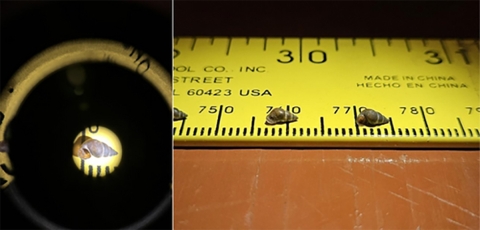
Instead of having to find and physically capture a tiny snail, researchers can instead look for evidence that the species is present in the water. Early detection includes analyzing eDNA, which is the genetic material left behind by organisms. This technique is particularly useful in hatcheries, where invasive organisms can be difficult to see. Water moves through pipes and other areas in the hatchery, making it challenging to inspect every part of the system directly. Spotting a mudsnail only a few millimeters long can be very challenging.
New Zealand mudsnails can leave behind DNA as they move through the water, through sources such as their waste, skin cells and other means. Specialists can collect environmental samples, such as water, and analyze them for genetic traces of particular species. Environmental DNA is not perfect, however. Samples can produce false positives, in which DNA is detected even though the snail is not actually present, or false negatives, in which the snail is present, but its DNA is not detected. For that reason, eDNA works best as part of a broader monitoring and response strategy rather than as the sole source of evidence.
Stopping an Infestation Before it Starts
Four New Zealand mudsnails were detected at the hatchery through the use of eDNA. Luckily, the invasive species were found before it became an infestation. Treatment methods for New Zealand mudsnail infestations include drying out the affected area, although this can be challenging because the area must remain dry for an extended period. Combining heat with drying can provide another effective treatment option by using hot, dry air to eliminate the snails. A variety of chemical treatment options are also available and may be appropriate depending on the location and conditions of the infestation.
Once a New Zealand mudsnail infestation is bad enough, they can be very difficult to remove. Because of their small size it allows them to hide in pipes, equipment, and other hard to reach places. They also can reproduce quickly which makes infestations harder to control.
Sometimes the Smallest Signs Make the Biggest Difference
Innovative snail-detection work at Alchesay National Fish Hatchery was recently highlighted in a scientific article. The hope is that the techniques and lessons learned from the successful early detection effort could be applied at other fish hatcheries to help prevent New Zealand mudsnail invasion and spread across the West. Early detection of New Zealand mudsnail may have prevented closure of Alchesay. Sometimes saving a hatchery starts with finding something almost too small to see!