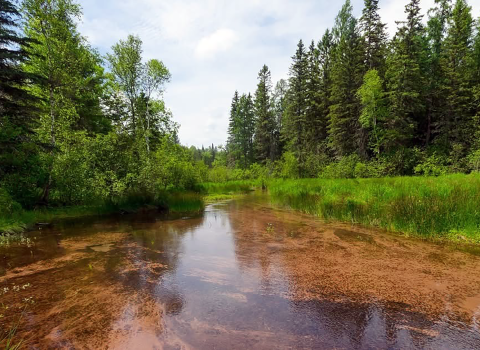
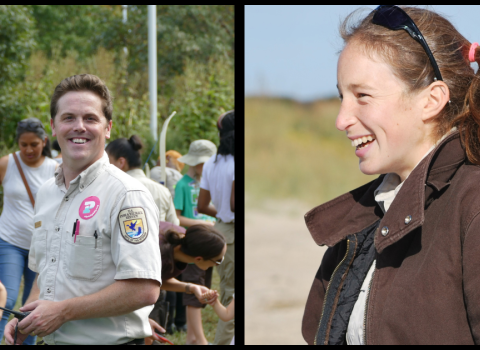
After years of roaming, an eagle’s nest has found its final home at Billy Frank Jr. Nisqually National Wildlife Refuge. But how does a nest wind up traveling? This one is unique…
In 1994, forester Tim Brown removed this eagle’s nest from a tree in Orcas Island. The six-foot diameter, 19.5-foot circumference Douglas-fir was next to a house, and branches often fell on the house and caused damage. But bald eagles and their nests are federally protected. The owners applied for a special permit to have the nest removed.
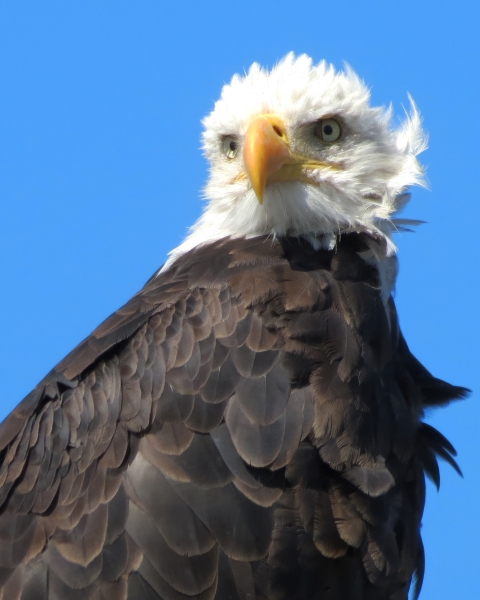
Tim, a Cherokee out of Oklahoma, had plenty of experience with eagles. He was not only a forester and firefighter, but dubbed a “raptor whisperer” by the media. He was often called in to deal with young birds of prey that had fallen out of nests, or with adult eagles entangled in rope, for instance. The Washington State Congress passed a resolution in his honor in 2001, recognizing how much he has done to serve and help people understand, appreciate, and view wildlife. The challenge of cutting the tree without damaging the house below, while preserving the nest for education, was right in his line of work.
The nest belonged to a female eagle whose original mate died. She found a new mate in Canada’s Gulf Islands and brought him back to her territory. But eagles typically maintain multiple nests. In 1994, the pair was using another nest.
Tim flew over the area to size up the job. The tree threatened 24 homes if it were to fall. He considered moving the nest to a greenspace nearby, but this option was not favored. So he decided to try and preserve the nest for education. It was an opportunity to put a real eagle’s nest on public display. He contacted Charlie Vandemoer, a wildlife biologist at the Mount Baker-Snoqualmie National Forest. Charlie organized the necessary paperwork, signed by one state and three federal agencies, and supplied a flatbed truck.
“It took from 7 a.m. to 9:30 p.m. to get it out,” Tim said. He wrapped the nest in tarps, cut the twenty-foot limb that supported it, and lowered it with ropes into the flatbed, a tricky procedure that took hours.
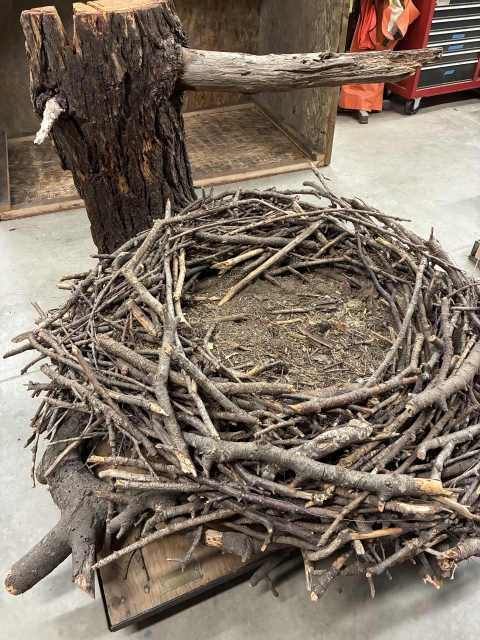
The nest was displayed at Mount Baker-Snoqualmie National Forest and North Cascades National Park events for years. Eagle Scout Andrew Morgan remade a snowmobile trailer in 1995 to haul the nest. But moving it multiple times caused cumulative damage from vibration. The nest was stored in an outbuilding, and mice and insects gradually moved in. It spent some time at the Cedar Falls Interpretive Center, under the purview of the City of Seattle; then was stored at North Bend Ranger Station. There was talk of burning or burying it because of rodent damage.
Jurisdiction over the nest was eventually transferred to the U.S. Fish and Wildlife Service. Conservator Tiffany Hedrick painstakingly restored the nest in 2013. After restoration, it was moved to Billy Frank Jr. Nisqually National Wildlife Refuge, where it was displayed at the annual Nisqually Watershed Festival for many years. Refuge Maintenance Worker Bob Smith built a huge plywood box to cover it and worked around it for years before moving it into the north barn. This barn was once used as an education center, but is now storage for the refuge.
Refuge Manager Glynnis Nakai did her best to find a way to fund an exhibit for the nest. The Friends of Nisqually National Wildlife Refuge Complex provided the funding needed to put it on permanent display at last. The display was designed by Alan Ransenberg of Alchemy of Design, one of the people who designed the original exhibits in the Norm Dicks Visitor Center. He made sure it matched the rest of the exhibits in style.
Mike Ruth, a professor at The Evergreen State College and a specialist in drone photography, volunteered to take images for the backdrop, a key part of the exhibit. The photos were taken near another eagle’s nest (not actively in use at the time) overlooking the refuge from the west.
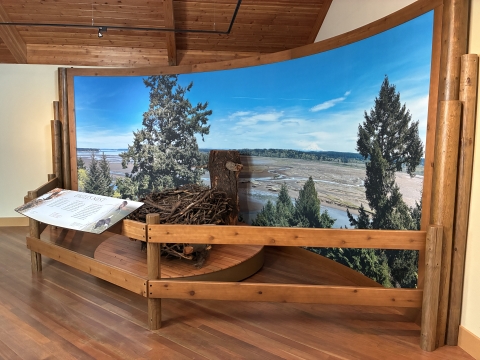
Installation took place October 5 and 6, 2026. Now the nest occupies a place of honor, slightly elevated on a specially built plinth and angled so visitors can easily see inside it. Generations of bald eagles were raised in this nest, with fresh layers of branches, leaves, and other materials added each year. The eagle who laid eggs in this nest is long gone. But it’s likely her offspring continue to live in the region, an area occupied by bald eagles since the glaciers that carved out Puget Sound melted away.
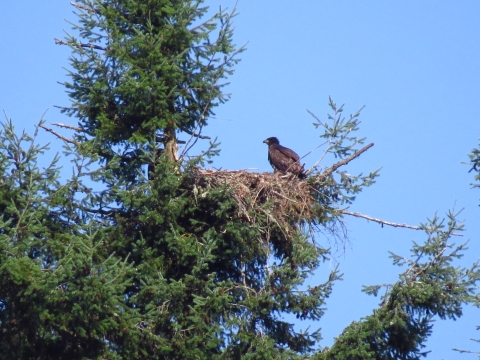
After seeing the nest in the visitor center, people can walk the trails at the refuge and see nests still in use by bald eagles high in cottonwood and Douglas-fir trees. It is easier to appreciate just how large they are once you’ve seen one up close. But bald eagles have not always been so visible. Use of the pesticide DDT had unintentional and severe consequences for birds of prey, causing their eggshells to thin and break. Bald eagle populations plummeted. They were listed as endangered.
After years of effort to ban DDT and protect birds of prey, bald eagles have made a comeback. They are no longer endangered, and are seen every day all year long at the refuge. Thanks to a long line of people dedicated to bringing the story of bald eagles to life, the nest Tim so carefully removed from its tree is here today, helping us better understand the wildlife around us.