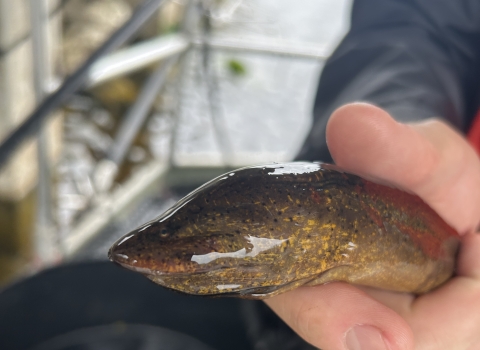
We at the U.S. Fish and Wildlife Service, along with the Saint Louis Zoo and Missouri Department of Conservation, received the inaugural Partners in Amphibian and Reptile Conservation Collaborative Conservation Partnership Award. This award recognizes our partnership with the Saint Louis Zoo WildCare Institute Ron and Karen Goellner Center for Hellbender Conservation which rears, breeds and releases hellbenders into Missouri’s rivers and streams.
The Center for Hellbender Conservation works to help Missouri’s Ozark and eastern hellbender populations rebound from recent decline. Over the past 40 years, populations declined more than 70% due to environmental threats, making the species a conservation priority for our agency and partners. Research, breeding and reintroduction efforts are working to turn the tide. In 2011, captive breeding produced more than 150 larval Ozark hellbenders, a milestone recalled by U.S. Fish and Wildlife Biologist Trisha Crabill. It demonstrated that long-term, sustainable captive breeding was possible. This is significantly important for the recovery of the species. Since 2008, our partners have released more than 12,000 endangered hellbenders back into the wild.
What is a Hellbender?
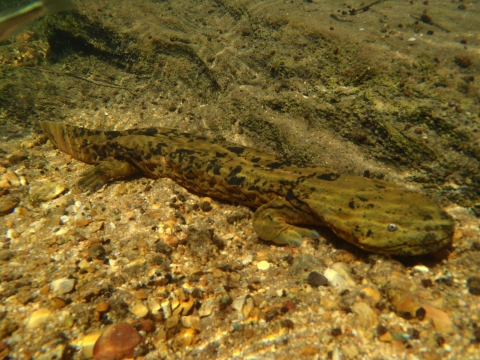
The hellbender is a large, fully aquatic amphibian with a flat head, wrinkled body and paddle-shaped tail. It is usually dark gray or brown with irregular dark spots along its back. Hellbenders breathe entirely through their skin, so they require cool, clear, fast-flowing, well oxygenated streams. Any increase in pollutants, sediment or contaminants directly impacts their ability to survive. Their presence signals exceptionally clean freshwater conditions.
There are two subspecies of hellbenders, and Missouri is the only state where both subspecies are found in the wild. The Ozark hellbender lives in a small number of rivers in Missouri and Arkansas. The eastern hellbender is broadly distributed in 15 states from New York to Mississippi. The Ozark hellbender was listed as an endangered species in 2011, and eastern hellbender populations in Missouri were listed as endangered in 2021. Other populations of the eastern hellbender are currently proposed for listing as endangered under the Endangered Species Act.
Protecting a living fossil
Commonly referred to as living fossils, hellbenders have lived in America’s waterways for tens of thousands of years. They are camouflage experts, spending most of their time nestled under rocks and hunting between strategic hiding places. Sedimentation, siltation and altered flows quickly degrade these habitats, meaning declines in hellbenders reflect broader ecological stress.
Protecting hellbender populations and their habitats is essential for the overall well-being of our freshwater systems, supporting environmental health and helping maintain biodiversity throughout its range. Hellbenders are indicators of healthy, clean water and their presence in a river system signals environmental quality. People can take meaningful actions like keeping streams free of debris, avoiding chemical runoff, supporting habitat restoration efforts and reporting hellbender sightings to conservation agencies.
About the award
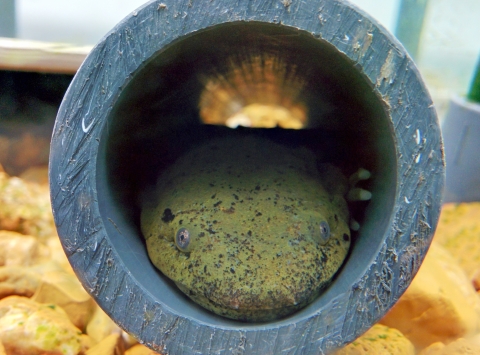
The Partners in Amphibian and Reptile Conservation Collaborative Conservation Partnership Award recognizes outstanding partnerships that significantly further amphibian and reptile conservation. The Center for Hellbender Conservation was selected for this award because of its collaborative spirit as three institutions work together to advance hellbender conservation.