The Chihuahuan desert grassland region known as the Permian Basin is the largest and most prolific oil-producing basin in the United States. Shared between Texas and New Mexico, its alkaline soils and spring systems provide a unique home for several rare species of plants. The region’s industrial capacity brings reliable domestic energy, economic growth, and the potential for negative impact to native habitats. Fortunately, industry partners are working hand-in-hand with federal and state agencies to show how energy independence and species conservation can coexist in this environment.
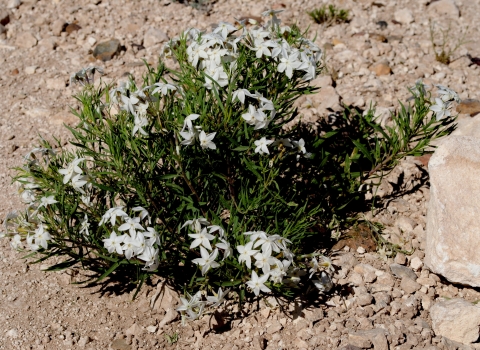
Tharp's bluestar is among the many unique plants of the basin, having adapted to the seasonal temperature ranges and precipitation patterns of the northern Chihuahuan desert. This fascinating and rare plant is a member of the Amsonia genus, commonly known as bluestars. Despite what the name suggests, the flowers of this species are not typically blue at all.
“The blossoms are long and tubular with star-shaped radiating petals,” said Katie Sandbom, U.S. Fish and Wildlife Service botanist and species lead. "They range in color from purple to cream to yellow, and if you look at them in the sun they sparkle.”
Tharp's bluestar is listed as endangered by the state of New Mexico and is currently under review by the Fish and Wildlife Service for possible protection under the Endangered Species Act.
Though not federally listed, agencies still proactively work with oil and gas companies to limit their current and future impact on at-risk species such as Tharp’s bluestar.
Designing Projects Around At-Risk Species
The Bureau of Land Management (BLM) is a major land manager for southeastern New Mexico, and this area includes a large portion of the Permian Basin. An important part of the BLM’s mission is to sustain the health, diversity, and productivity of public lands. BLM leases mineral rights on these lands and works with industry to minimize negative impacts to plants and animals.
“To keep these at-risk species abundant, we collaborate with oil and gas operators, ranchers, and recreationists,” said Ty Allen, Assistant Field Manager at the Carlsbad BLM Field Office. “We help design their projects to avoid impacts on the habitat to support conservation. For Tharp’s bluestar, their soil outcrop habitats are rather finite, so they don’t disrupt oil and gas activities any more than a pond or a fence.”
The New Mexico State Land Office is another major landholder in the Permian Basin, home to two of the three largest Tharp’s bluestar populations. For years, the state has worked with industry to mitigate potential damage to Tharp’s bluestar and its habitat.
One of the largest fossil fuel exploration and production companies in the nation, EOG Resources, Inc., has pioneered conservation leases on New Mexico State Trust lands. This recently created Tharp’s bluestar conservation lease will minimize environmental damage with thoughtful project design, location choice, and the utilization of techniques like horizontal drilling, to avoid habitat disturbance. The New Mexico State Land Office is also collaborating with industry to develop best management practices for avoiding and minimizing impacts to sensitive natural resources, including at-risk plants. Plant surveys are especially critical for avoiding and minimizing impacts to at-risk plants.
New Mexico’s Endangered Plant Protections
New Mexico’s Forestry Division works with industry to protect rare plants and maintains the list of state endangered plant species. When impacts on state endangered plant species are unavoidable, the state Botany and Endangered Plants Program can issue incidental take permits for otherwise lawful activities.
“When rare species are identified during clearance surveys, consultants working on behalf of industry typically submit an incidental take application if impacts to a state-listed endangered plant cannot be avoided. At that stage, we work closely with applicants and partner agencies to identify practical measures to avoid and minimize impacts,” said New Mexico State Botanist Erika Rowe of the New Mexico Energy, Minerals and Natural Resources Department’s Forestry Division. “In many instances, including for Tharp’s bluestar, projects can be adjusted so the species is not directly affected.”
A Future for Tharp’s Bluestar and Energy Independence
Part of what makes Tharp’s bluestar so rare is its specific habitat requirements. It only grows in alkaline soils rich with gypsum or limestone, typically found on hills or escarpments that stand out with their distinct white color. And its habitat is mostly found on public trust lands.
Working together to conserve this habitat is what allows government agencies and energy companies to effectively accomplish their goals while also allowing Tharp’s bluestar to survive in its unique and resource-rich environment.
“By coordinating with federal and state agencies, industry supports the conservation of the Permian Basin's unique ecosystems,” said Sandbom. “It is not conflict, but cooperation. Industry operators have a long history of working with state, federal, and other non-governmental partners to conserve our nation's natural heritage while also promoting our nation's energy independence. These cooperative efforts embody the heart of our mission to work with others to conserve, protect, and enhance fish, wildlife, plants, and their habitats for the continuing benefit of the American people.”