Along the western shore of Galveston Bay is Dickinson Bayou, a small estuarine bay, that tells a story of loss and renewal.
In the 1930s, three islands were built in Dickinson Bay using material dredged from the Dickinson Bay channel. For decades, these islands provided valuable nesting grounds for colonial waterbirds. But the landscape slowly changed. Subsidence and erosion steadily lowered the islands, and by the late 1970s, they had lost enough elevation to become unsuitable for nesting. Then, after a series of tropical storms in the 1980s and 1990s, all three islands disappeared beneath the water.
But the birds and the people who cared about them had not forgotten.
With a long history of monitoring colonial waterbirds throughout Galveston Bay, the U.S. Fish and Wildlife Service’s (Service) Coastal Program recognized an opportunity to bring this lost habitat back. In the early 2000s, the Texas Coastal Program and the Galveston Bay restoration community began exploring how to recreate the islands of Dickinson Bay.
The first success came in 2005, when the Galveston Bay Foundation (GBF) led the restoration of Dickinson Bay Island (DBI). The new island created approximately two acres of nesting habitat and the birds returned. Their return demonstrated what was possible and inspired partners to imagine an even larger restoration effort.
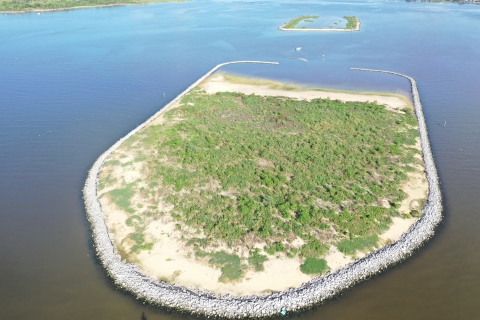
In 2011, the Coastal Program provided $50,000 in financial assistance to GBF to begin planning Dickinson Bay Island II (DBI-2). The Coastal Program staff’s knowledge of colonial waterbird habitats proved to be valuable; but later what proved to be more invaluable was their ability to bring partners together and secure significant additional funding to move the project from an ambitious idea toward reality.
Over the next decade, the project gathered more momentum and resources, with the Galveston Bay Estuary Program, Restore America’s Estuaries, and the National Oceanic and Atmospheric Administration supporting additional planning, engineering, design, and permitting support. In 2017, the Deepwater Horizon Natural Resource Damage Assessment Texas Trustee Implementation Group (TIG) provided funding for final engineering and design and regulatory permitting – transforming a vision into a shovel-ready project.
With additional funding from TIG, construction of DBI-2 began in late 2021 and was completed in spring 2022. The result was impressive: approximately 4.5 acres of new colonial waterbird nesting habitat emerging from the water. In addition, the project restored one-acre oyster reef and 2,000 feet of protective structure that also provides habitat for oysters and fisheries.
Shortly after construction, GBF, project partners, and community volunteers planted more than 2,000 trees and shrubs across the island, creating additional nesting habitat for birds that prefer higher places to nest.
The birds came home.
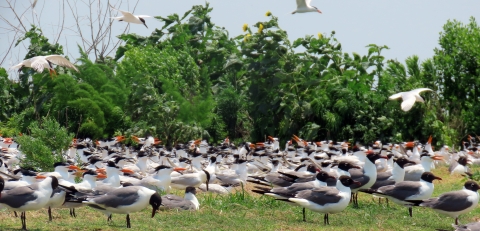
During the 2025 Texas Colonial Waterbird Census, more than 2,500 pairs of colonial waterbirds were estimated to be nesting on DBI-2. Sandwich terns, royal terns, laughing gulls, white ibises, cattle egrets, tricolored herons, little blue herons, snowy egrets, great egrets, great blue herons, and brown pelicans now use the island – a reminder of what thoughtful restoration can accomplish.
The benefits of DBI-2 extend well beyond the birds.
From conceptual design through construction and monitoring, the project represents an investment of more than $6 million. Those dollars supported a remarkable range of people and businesses, from nonprofit and government staff to engineers, GIS specialists, survey crews, and environmental professionals. Construction supported heavy equipment operators, barge crews, tugboat operators, material suppliers, survey crews, and fuel providers.
With the assistance of the Service’s Economic Branch, the Coastal Program conducted an economic evaluation of our personnel compensation and project funds, nearly $11,126,500, for Fiscal Year 2025. The evaluation found that Coastal Program expenditures supported 139 jobs and more than $30 million in economic output nationwide.
Today, the restored island is also a popular destination for recreational anglers. That activity ripples outward, supporting fishing tackle retailers, live-bait shops and fisheries, boat maintenance businesses, and fuel suppliers.
This project is a beautiful example of conservation doing what conservation does best: creating benefits that multiply.
By restoring a place where birds can nest, oysters can grow, fish can thrive, and people can enjoy the water, DBI-2 has become much more than an island. It is a testament to what can happen when partners come together with sound science, persistence, resources, and a shared vision for a healthier coast.
The islands of Dickinson Bay were once lost to erosion and rising water. Today, two islands have been restored along with thousands of birds, thriving habitat, and a new chapter for the community that surrounds it.