Written By

The U.S. Fish and Wildlife Service’s Partners for Fish and Wildlife Program in Washington has been supporting partners in the San Juan Islands with efforts to restore and protect native habitats through reducing fuel loads and creating fire breaks. The islands are home to over 18,000 people and are a popular destination for residents and tourists alike to experience rare wildlife and habitats along with scenic vistas and natural areas.
A Growing Threat of Wildfire
In recent years, the threat of wildfire in the increasingly populated islands has become a central community concern. While the San Juans are often mischaracterized as having a traditional western Washington precipitation regime and ecosystem structures, the archipelago can be more accurately described as a dryland, fire-adapted savanna ecosystem in the rain shadow of the Olympic Mountains.
With the loss of historic indigenous burning and forestry regimes compounded by hotter, drier summers, the fuel loads in the islands have increased to a point where many areas are prone to wildfire risk and property loss. At the same time, the islands are losing rare plant communities and habitat types that have historically been part of their natural ecosystem.
Partners Restoring Resilience and Native Plant Communities
Along with partners at the San Juan Islands Conservation District, the San Juan County Conservation Land Bank, the San Juan Preservation Trust, the Samish Indian Nation Department of Natural Resources, and the Ecostudies Institute, the PFW Program in Washington has been assisting with these fuels reduction efforts at numerous sites across the islands. These efforts aim to decrease the chances of catastrophic wildfire while also restoring native habitats and making way for rare and endangered species to reoccupy the areas where they once thrived.
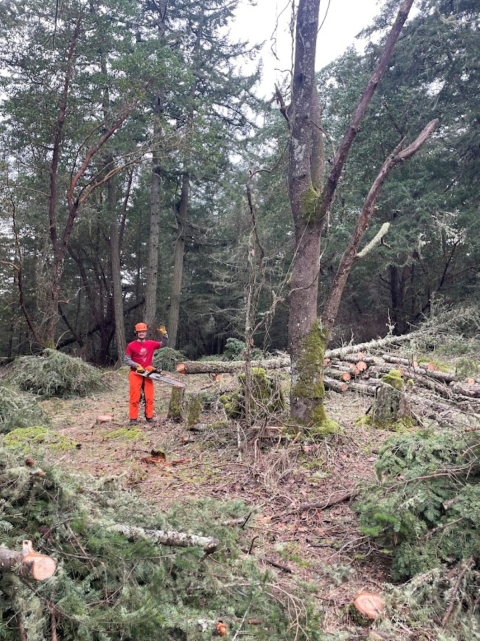
By cutting and clearing encroaching Douglas fir trees and other undesirable species, the partners have successfully released native Garry oaks from shading and overcrowding at a number of sites across the archipelago. This clearing has made way for sunlight to reach the understory for the first time in years, which has elicited an incredible response from both oaks and forbs without putting a single seed on the ground.
Native species like fawn lily, shooting star, and common camas have all emerged in droves while the suppressed Garry oaks—now decades old—have room to flourish and spread their acorns into more suitable surrounding conditions. Additionally, species of rare and endangered pollinators will also benefit from this type of work, including the Propertius duskywing butterfly, western bumble bee, and many more. This work may also benefit the endangered Taylor’s checkerspot butterfly, which has been extirpated from the islands but could use these habitats if future translocation occurs.


Turning Woody Debris into Habitat and Soil Benefits
The removed woody debris is being piled in a fashion to create wildlife habitat in the form of simulated downed old-growth logs, or it is being piled and burned for biochar, which is then spread in the project area to amend the soil where native forbs, grasses, and oaks will eventually be planted. Prescribed fire activities are also planned and will minimize fuel loads in the understory and increase soil fertility.
Looking Ahead: A Safer and More Resilient Archipelago
The partnership will continue this work to help ensure not only a safer human environment and living conditions for the community but also provide more opportunities for habitat restoration and enhancement for the benefit of the San Juan Island’s imperiled habitats and species.