For over 14 years, the U.S. Fish and Wildlife Service’s Partners for Fish and Wildlife (PFW) Program and the Western Reserve Land Conservancy (WRLC) have built a powerful and enduring partnership that exemplifies the impact of collaborative, landscape-scale conservation. Together, we have restored and protected thousands of acres of critical wetland and upland habitat across northeast Ohio, work that continues to benefit a wide range of threatened and endangered species, migratory birds, and native pollinators. These efforts also deliver meaningful benefits to surrounding communities by improving water quality, reducing flood risk, supporting pollinators essential to local agriculture, and creating new opportunities for outdoor recreation, education, and connection to nature.
Transforming Northeast Ohio's Landscape
While their collective efforts span numerous properties and private parcels, two marquee sites totaling more than 2,200 acres stand out as flagship examples of what this partnership has achieved. Historically dominated by agriculture, mining, and degraded habitat these landscapes have since been transformed into thriving natural ecosystems. Today, they feature a rich mosaic of high-quality wetlands, including open water, scrub-shrub, swamp forest, and vernal pools, alongside mature upland and floodplain forests. One of the sites includes a 3.5-mile-long flow-through wetland system, representing one of the most significant wetland restoration efforts in the region, including the revival of a rare tamarack swamp—a unique type of wetland dominated by tamarack trees, Ohio’s only native deciduous conifer. These swamps are remnants of glacial landscapes and support a variety of rare plant and animal species, making their restoration both ecologically and historically significant.

Funding and Collaboration at Scale
PFW Program biologists and WRLC conservation staff have worked side-by-side to design, implement, and monitor these restoration projects. Their success has been made possible through strategic funding from the PFW Program, H2Ohio, Clean Ohio, the Ohio Environmental Protection Agency, the North American Wetlands Conservation Act, and the Great Lakes Restoration Initiative. To date, more than $3.5 million has been invested in these efforts, underscoring the scale, complexity, and ecological importance of the work.
National Recognition for Conservation Leadership
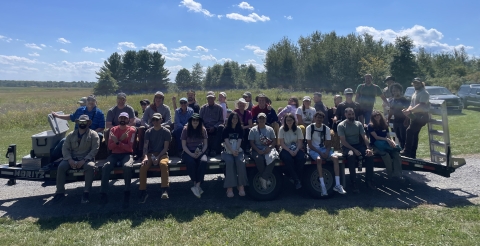
Recently, the national conservation community took notice. During the Land Trust Alliance’s Rally 2025, held in Cleveland, Ohio, WRLC was honored with the National Land Trust Excellence Award, recognizing its leadership in land protection and restoration. As part of Rally programming, WRLC and PFW Program staff, alongside partners from Ohio State University, The Nature Conservancy, Ashtabula Soil and Water Conservation District, and the Ohio Department of Natural Resources, co-hosted a full-day field tour of the two flagship restoration sites. The tour welcomed over 40 participants from across the country, including attendees from California to Maine and even Hawaii, highlighting the collaborative role that land trusts and the PFW Program play in connecting people and communities to the natural world around them.

A Blueprint for Landscape-Scale Conservation
This long-standing collaboration between the PFW Program and WRLC is more than a conservation success story, it is a national model for how federal programs and nonprofit land trusts can work together to achieve lasting, landscape-scale impact. By combining technical expertise, local knowledge, and shared conservation goals, this partnership continues to deliver measurable ecological benefits while inspiring a broader movement to protect and restore America’s natural heritage.
To learn more about the Western Reserve Land Conservancy’s conservation work, visit their website and watch a short video highlighting the impact of this award-winning partnership.