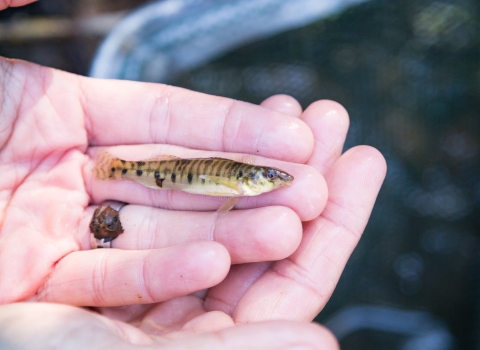
No one knows for certain, but the shortnose sturgeon may simply have been a victim of the company it kept. Never a primary target of the 18th century fishing industry, it was swept up anyway, often with schools of its larger cousin, the Atlantic sturgeon. And while the shortnose sturgeon managed to survive in several other waterways, scientists have long since concluded that it disappeared from the Potomac River about 100 years ago.
That makes it easy to understand why U.S. Fish and Wildlife Service biologist Steve Minkkinen was excited last April when one of the fish in the Potomac was captured in a gillnet, radio-tagged and tracked, was full of eggs and on a spawning run. Since then, a second female has been tagged.
That, said Minkkinen, is significant. Little information on shortnose sturgeon existed before Minkkinens project took place. Tracking has revealed where essential seasonal habitats occur and where potential spawning may take place. Minkkinens work has also shown where shortnose spend their time; that will help pinpoint future sampling in hope of tagging more fish.
Heres a fish, after all, that came into great demand decades ago both for its eggs, marketed as caviar, as well as its smoked meat. Like many early fisheries, the more sturgeon the more demand increased for still more fish. That level of fishing, coupled with dams and the dumping of sewage and other pollutants, took a fast toll.
Now there is at least a glimmer of hope that the shortnose sturgeon could be reclaiming one of its early homes. "They are obviously not abundant, but there are enough to provide hope," said Minkkinen. "I think they have a fighting chance."
Since 1996, in fact, a total of 10 shortnose sturgeon have been counted in the Potomac River, but its not possible to know where they came from, how they got there, or if they have been there all along.
Still, Minkkinen and his partner, Matt Breece, are careful to note other encouraging signs; the two egg-laden females, said Minkkinen, behaved like resident fish. In other words, like they lived in the river for awhile.
Still, neither Minkkinen nor Breece - nor any other researchers, for that matter - can say that they know for certain that the female shortnose sturgeon that seemed on a spawning run, did in fact, spawn.
Minkkinen notes that collecting eggs is the surest way of knowing that fish have spawned; at about the time the females could have deposited their eggs, that part of the Potomac was subject to a sudden, heavy flow, curtailing sampling efforts.
Now the team will be looking at other parts of the Potomac bottom to see if they can find suitable spawning sites that they may want to revisit in the future.
The U.S. Fish and Wildlife Service is the principal Federal agency responsible for conserving, protecting and enhancing fish, wildlife and plants and their habitats for the continuing benefit of the American people. The Service manages the 95-million-acre National Wildlife Refuge System, which encompasses 547 national wildlife refuges, thousands of small wetlands and other special management areas. It also operates 69 national fish hatcheries, 64 fishery resources offices and 81 ecological services field stations. The agency enforces federal wildlife laws, administers the Endangered Species Act, manages migratory bird populations, restores nationally significant fisheries, conserves and restores wildlife habitat such as wetlands, and helps foreign and Native American tribal governments with their conservation efforts. It also oversees the Federal Assistance program, which distributes hundreds of millions of dollars in excise taxes on fishing and hunting equipment to state fish and wildlife agencies.
; -FWS-