


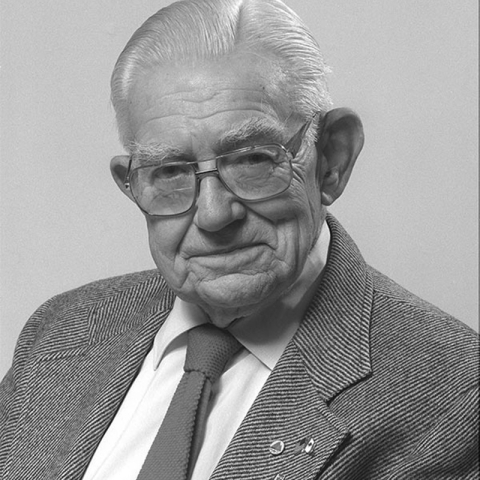
About Jack Holmes Berryman (1921 – 1999)
I first met Mr. Berryman – it was the longest time before I was half way comfortable calling him Jack – in 1965. He was the brand new Chief of the Division of Wildlife Services in Washington, D.C. Mr. John Gottschalk (I never ever thought of calling him John) was then the new Director of the U.S. Fish and Wildlife Service. He had been the Regional Director in Region Five in Boston and everybody there knew he was a first class gentleman.
In 1965 I was the N.Y. State Supervisor in the Division of Wildlife Services (with nobody to supervise) at Cornell University. Mr. Berryman had called and asked me to lend a hand in a staff capacity to help revamp the Service’s animal damage control program. Although we had an understanding that I was to serve in Washington for two years and then move on, I stayed for the next 33 years.
Mr. Berryman was the most dedicated, hardest working, finest man I have ever known. Those of us who were privileged to have worked with him admired his truly exceptional personal qualities as well as his many substantial professional achievements. He set and maintained an example of high standards day after day that was emulated by his staff – and his supervisors as well. Almost every morning he visited with each staff member individually in their office for a few minutes and we talked very freely. He ferreted out points of friction or concern and built a loyal team. He had a unique talent of bringing out the best in people, and had he asked, we staff members would have walked through fire for him. We all thrived in an atmosphere of mutual, wholehearted support and the concept of teamwork, quality work, common sense, and we all did our darndest to providing the best possible service to our customers, the general public. Mr. Berryman hated the term, popular at the time, “Good enough for Government work”.
Jack and I car pooled together for many years. We parked at the Kennedy Center when the cost was $22.00 per month, and walked to the Wyatt Building on the corner of 14thand H streets. We took pride in getting to work on time regardless of the weather. He had discovered that his big Oldsmobile would climb snow covered hills better in reverse – much to the amazement of onlookers. When he drove, I became the navigator and the truth is that some of those backward rides were memorable, to say the least!
As a kid, Jack had worked in a garage and had somehow specialized in greasing automobile wheel bearings, so he had an uncanny way of recognizing the trouble with a disproportionate number of broken down cars along the side of the road – “Wheel bearing problems” he would declare – “not enough grease!”
I suspect most people who knew him were never aware of the profound effect the Second World War had on him – the horrendous memories that surely burdened him all his adult life. He rarely spoke of the years he served in the United States Marines – from 1941 to 1945, and he was twenty years old in 1941. His unit suffered over 70 percent casualties. All told there were over 4,000 killed and 14,000 wounded. He served with the Second Marine Division during the Saipan, Tinian and Okinawa operations and the occupation of Nagasaki. He was wounded twice during the Saipan/Tinian operation and was awarded the Silver Star and a Purple Heart with cluster. One night, on the point, he and another Marine in a foxhole fought an overwhelming force of elite (six feet or taller) Japanese Imperial guards, with rifles and grenades and finally in hand to hand combat with their bayonets. Both Marines survived the night, but just barely. Jack’s chest x-ray showed a spent Japanese rifle bullet and multiple fragments of a hand grenade. Later he witnessed the suicides, forced and otherwise, of civilians on the southern tip of Tinian. When we traveled together, his sleep (and mine) was frequently interrupted by nightmares – he often relived his hand to hand combat experiences. It’s easy to understand why thereafter he wanted to live his life to the fullest – he treasured and was thankful for every day. It probably explains, too, his compassion and sensitivities for all people around him in all walks of life. As one small example, he learned the names of the four female elevator operators in the Wyatt Building, and you can be sure they all though very highly of him.
My good wife Elizabeth and I have two fine offspring. Jack was their first visitor in the hospital shortly after each was born and he praised them for all their fine attributes. He frequently inquired as to their status of their tooth eruptions and their grades in school. He was present at the Court of Honor when our son became an Eagle Scout. He wrote letters of recommendations for both George and Amanda to accompany their college applications, and these carefully crafted, heartfelt letters will always be treasured. When he telephoned our home and one of our children answered, he would invariably talk with them for several minutes, even though the conversation was sometimes painfully one sided. He had tremendous personal charm, a twinkle in his eye, a delightful sense of humor, a memory that was simply astonishing – and great wisdom. He just seemed to understand without words having been spoken.
He was so proud of the Berryman Institute for Wildlife Damage Management at Utah State University and for being the recipient of the Aldo Leopold Memorial award. For me, his legacy will be lessons he taught everyone around him about professionalism and values. He espoused with pride the so-called old fashioned, traditional values – education, family, patriotism, loyalty, honesty, dependability, clear independent thinking, hard work and most of all, excellence.
It has been my view that natural resources-oriented people have unusual difficulty expressing affection, but for many of us, the years we spent working closely with Mr. Berryman will be openly cherished as THE most rewarding from a professional and personal standpoint. Those of us who worked with Jack in the service of the American public owe him a great debt of gratitude for his leadership, support and friendship. He was truly a remarkable, wonderful man.