


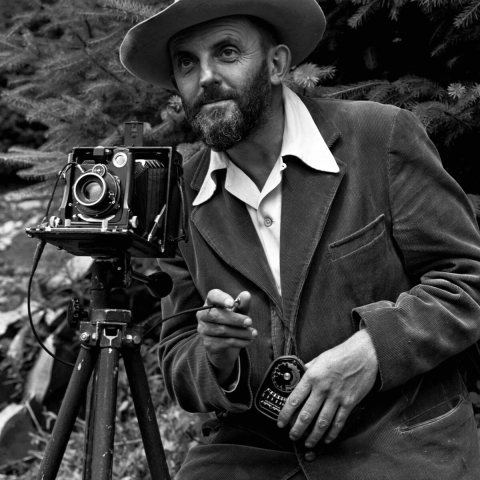
About Ansel Adams (1902-1984)
I believe the approach of the artist and the approach of the environmentalist are fairly close in that both are, to a rather impressive degree, concerned with the ‘affirmation of life.’ . . . Response to natural beauty is one of the foundations of the environmental movement.
Ansel Easton Adams was born in San Francisco, California, where he developed a passion for photography and environmentalism. Adams was transformed and transfixed by his first visit to Yosemite National Park in 1916, which led to a life-long love for photographing nature with his Kodak Box Brownie #1 camera, a gift from his parents. Vital to Adams early success as a photographer was his decision to join the Sierra Club in 1919, where he published photographs and writings and had his first photography exhibit. He was known as a photographer, lecturer, and writer, but perhaps best known for his ability as a communicator through his photography. The black and white images of national parks and the environment itself portrayed in his photography became symbols and icons of wild America. His work as an activist for numerous conservation groups including the Sierra Club and his lobbying Congressmen, cabinet officers, and American Presidents, all reinforced the need to preserve wilderness values. Adams captured people’s desire to experience the magic of the wilderness when he stated in a letter to colleagues: “Wilderness is not only a condition of nature, but a state of mind and mood and heart.” Although our wilderness areas have become fewer and far between due to urbanization, Adams’ photography inspired people’s sociological and philosophical desire to understand the beauty of nature, while also spurring future photographers to use their abilities in the cause of environmental preservation.
The plaque was created by SUTL Cohort 33.
Photo Credit: J. Michael Greany (1947).