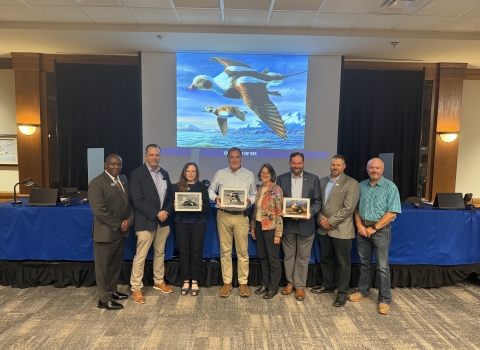
The U.S. Fish and Wildlife Service is awarding more than $6.6 million to federally recognized Native American and Alaska Native tribes to benefit fish and wildlife resources and their habitats. This year’s funding will support 35 tribes for conservation projects across 15 states, benefiting a wide range of wildlife and habitat, including species of cultural or traditional importance to Indigenous communities. Nine of the awarded proposals are to tribes that have never received Tribal Wildlife Grants funds in the past. These awards reflect President Donald J. Trump’s commitment to supporting and empowering tribes.
“Tribes are vital partners in wildlife conservation, and we’re proud to support projects that reflect their connection to the land and leadership in protecting it,” said Service Director Brian Nesvik. “These investments support tribal sovereignty while advancing our shared conservation goals."
The Tribal Wildlife Grants program helps fulfill federal trust responsibilities and achieve tribal sovereignty by expanding tribes’ natural resource capacity. Since its inception in 2003, including this year’s grants, the competitive Tribal Wildlife Grants program has awarded more than $131 million to Native American and Alaska Native tribes, providing support for 732 conservation projects. Across the United States, over 100 million acres of habitat are influenced or managed by 575 federally recognized tribes.
Tribal Wildlife Grants help tribes develop increased management capacity, improve and enhance relationships with conservation state partners, address cultural and environmental priorities, and help train the next generation of conservationists by engaging tribal students interested in fisheries, wildlife and related fields of study. Some grants have been awarded to support recovery efforts for federally listed threatened and endangered species.
Examples of projects approved this year include:
- Native Village of Nanwalek (within Alaska) (Strengthening Tribal-Led Salmon Monitoring and Habitat Assessment in the English Bay Lakes System) - $198,728 to improve monitoring of salmon spawning and further develop tribal-state collaboration through the Nanwalek Fishery Working Group.
- White Mountain Apache Tribe (within Arizona) (Paradise Creek Barrier Replacement to Conserve Apache Trout) - $200,000 to support recovery of the Apache trout in Paradise Creek, adding 6.5 kilometers of high-quality protected recovery habitat and replacing a failing barrier to maintain separation from a nonnative, managed sportfish population.
- Tolowa Dee-ni’ Nation (within California) (Reconnecting Ranges: Restoring Chis-chu (Roosevelt Elk) Habitat Connectivity in the Upper Smith River) - $200,000 to restore habitat connectivity and enhance Roosevelt elk habitat in northern California.
- Miccosukee Tribe of Indians of Florida (Tree Island Restoration Project) - $200,000 to restore and protect critical tree island habitats and aid recovery of culturally and ecologically important species and traditional lifeways.
- Coeur d’Alene Tribe (within Idaho) (Fisher Augmentation and Den Site Research in the Idaho Panhandle) - $198,637 to support the recovery and long-term viability of fisher populations in the Idaho panhandle through research and monitoring.
- Passamaquoddy Tribe - Pleasant Point (within Maine) (Restoring the Balance: A Passamaquoddy Bay Initiative to Green Crab Removal) – $199,705 to protect and restore biodiversity and cultural lifeways of the Passamaquoddy People by reducing the invasive European green crab population, allowing key habitats in Passamaquoddy Bay to recover.
- Little Traverse Bay Bands of Odawa Indians (within Michigan) (Restoration of Tributary Atikameg (Lake Whitefish) Feasibility Project) - $200,000 to restore Lake Michigan’s whitefish population via reintroduction into the Bear River, returning spawning to the largest tributary of Little Traverse Bay.
- Northwestern Band of Shoshone (within Utah) (Battle Creek and Bear River Streamflow, Water Quality, Weather, Fisheries and Macroinvertebrate Monitoring) - $200,000 to restore the culturally important Wuda Ogwa site and the riparian riparian
Definition of riparian habitat or riparian areas.
Learn more about riparian and aquatic habitats within Battle Creek, supporting monitoring of restoration outcomes, improving water quality and supporting cultural revitalization.
The grants are provided exclusively to federally recognized Native American and Alaska Native tribal governments and are made possible under the Related Agencies Appropriations Act of 2002 through the State and Tribal Wildlife Grants program. To learn more about the grant program and application process, please visit: https://www.fws.gov/service/tribal-wildlife-grants.
For additional information about the Service’s Native American Programs, visit: https://www.fws.gov/program/native-american.
The U.S. Fish and Wildlife Service works with others to conserve, protect and enhance fish, wildlife, plants and their habitats for the continuing benefit of the American people. For more information, visit www.fws.gov and connect with us on social media: Facebook, Instagram, X (formerly known as Twitter), LinkedIn, Flickr and YouTube.
--FWS--
Latest Press Releases