


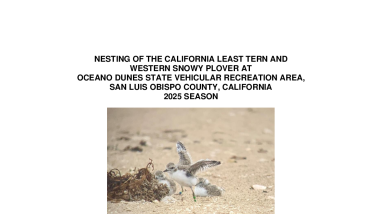
Staff of Oceano Dunes State Vehicular Recreation Area (Oceano Dunes SVRA, ODSVRA) and Point Blue
Conservation Science (Point Blue) monitored breeding California least terns (Sternula antillarum browni)
(least tern, tern) and western snowy plovers (Anarhynchus nivosus nivosus) (snowy plover, plover) at
ODSVRA, San Luis Obispo County, California, in 2025. This is the 24th consecutive year of both intensive
banding of snowy plover chicks and predator management that includes options for selective relocation or
removal of predators. Banding of least tern chicks began in 2003.
Least tern
There were an estimated 40-41 least tern breeding pairs in 2025, similar to the 40 breeding pairs in 2024,
and the average of 40-43 pairs (range=23-60) in the 20-year period 2005-2024. During the 2025 season a
minimum of 15 banded birds with known origins were documented breeding at the park, with 13 banded
as chicks and fledged from ODSVRA, and two banded as chicks and fledged from Vandenberg Space Force
Base, Santa Barbara County, California (VSFB).
There were 42 known nesting attempts. Of the 40 nests with known location and fate, 28 hatched. Twelve
nests failed attributed to the following causes: abandoned unknown if pre- or post-term (2); wind (1); raven
(1); event, raven (1); coyote (4); and event, coyote (3). The hatching rate for known location and fate nests
was 70.0% (28/40), compared to the average of 86.0% (737/857) during the previous 20-year period 2005-
2024. In 2025, 22.5% (9/40) of tern nests were lost to predation, a notable increase compared to the longterm
average of 2.1% (21/1021) from 2002-2024. Prior to 2025, no tern nests were documented lost to
raven and the previous documented nest lost to coyote was in 2013.
Forty-five chicks hatched and of these 42 were color-banded to individual, and 31 chicks are known to have
fledged (seen when 21 days old or older). The 2025 chick fledging rate of 68.9% (31/45) is similar to the
70.5% average for the 19-year period 2006-2024 (banding chicks to individual began in 2006). However,
the estimated 0.76-0.78 chicks fledged per pair in 2025 is lower than the 1.07-1.14 average for the 2006-
2024 period, due in part to a reduced hatch rate caused by nest predation.
Snowy plover
There was a minimum of 266 breeding snowy plovers (159 males and 107 females) in 2025, a decrease of
5.3% from the previous year and compares to an average of 167 adults (range=32-281) for the 23-year
period 2002-2024. One hundred and twenty-four banded birds with known origins were documented as
breeding with 92.7% (115/124) banded as chicks and fledged from ODSVRA.
There were 333 known nesting attempts, including 27 identified only by detection of brood (unknown nest
location). Of the 306 nests from known locations, 177 (57.8%) were in the Southern Exclosure, 45 (14.7%)
in Oso Flaco, 81 (26.5%) in the Foredune closure, two in the closed buffer area, and one near the Pismo
Creek lagoon. Of the 298 nests with known location and fate, 219 hatched for a nest hatching rate of 73.5%.
This is similar to the average of 72.9% for the previous 23-year period 2002-2024. Seventy-nine nests
failed, attributed to the following causes: abandoned pre-term (10); abandoned post-term (3), abandoned,
unknown pre- or post-term (6); failed, nonviable eggs removed by staff (11); event, tide (1); cause unknown
(6); unidentified predator (4); raven (24); event, raven (3); gull (1); coyote (6); and event, coyote (4). Of
note this season, seven circular exclosures were removed from nests in South Oso Flaco prior to hatch in
response to an increased threat of breeding adult mortality after two plover carcasses were found at two
nests in circulars. Of these nests, three hatched, one was depredated by raven, and three were abandoned
pre-term (potentially reflecting additional undetected adult mortality).
Of the 610 hatching chicks, 378 were color-banded to brood with 46.8% (177/378) fledging, and the fate
of the 232 unbanded chicks is believed known with 38.4% (89/232) fledging. A total of 266 chicks fledged
2
(seen when 28 days old or older) for a fledging rate of 43.6% and is above the average fledge rate of 39.1%
(range=7.4-66.0%) for the 23-year period 2002-2024. One chick fledged per breeding male is the estimated
number needed to prevent the population of snowy plovers from declining and productivity of 1.2 chicks
fledged per male should provide for moderate population growth (assuming approximately 75% annual
adult survival and 50% juvenile survival) (U.S. Fish and Wildlife Service 2007). In 2025, an estimated 1.67
chicks fledged per breeding male at ODSVRA. For the previous 23-year period, average productivity was
1.47 chicks fledged per breeding male.
Publication date
Type of document
Lands
Media Usage Rights/License
Public Domain
Program

Species

FWS Focus

FWS Focus
Ecosystem
FWS and DOI Region(s)