


Species that are considered high risk have a well-documented history of invasiveness in at least one location globally and are of establishment concern for the contiguous United States based on a climate matching analysis."
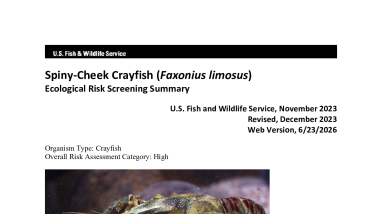
Faxonius limosus, the Spiny-cheek Crayfish is native to Mid-Atlantic coastal drainages in the United States. F. limosus was introduced to Europe in 1890 has successfully spread to numerous countries. It has also been introduced to and become established in Canada and Morocco. This crayfish has been reported to occupy a wide range of habitats; reproduction can occur twice a year where females that mate in fall can store sperm until spring. Additionally, in a laboratory setting females have reproduced through facultative parthenogenesis. F. limosus is reportedly used as live bait, in aquariums, and for human consumption. Although no States provide regulations specific to F. limosus, at least 11 States regulate either crayfish within the family Cambaridae, which includes F. limosus, or non-native crayfish in general. The History of Invasiveness for F. limosus is classified as High due to established populations outside its native range with confirmed negative environmental and social-economic impacts. The climate matching analysis for the contiguous United States indicates establishment concern exists for this species outside its native range, particularly in the Northeast, Midwest, and coastal Southeast. The Certainty of Assessment for this ERSS is classified as High. The Overall Risk Assessment Category for F. limosus in the contiguous United States is High.
Publication date
Type of document
High Risk
Media Usage Rights/License
Public Domain
Program


Species