


Species that are considered high risk have a well-documented history of invasiveness in at least one location globally and are of establishment concern for the contiguous United States based on a climate matching analysis.
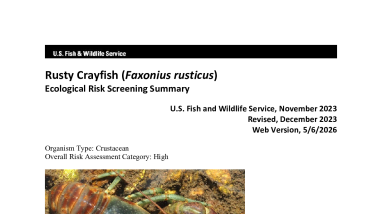
Faxonius rusticus, Rusty Crayfish, is a crustacean native to the Ohio River Basin in the United States. It can be found in a variety of aquatic habitats and is an opportunistic omnivore. A single female can produce over 500 eggs per reproductive cycle. No evidence was found of online trade of F. rusticus and many U.S. States have placed regulations on its possession and trade. This species has been widely introduced throughout the United States in addition to Canada and France, likely through its use as fishing bait and through intentional release by schools, commercial harvesters, or for biological weed control. The History of Invasiveness for Faxonius rusticus is classified as High due to the existence of numerous established populations outside of its native range and documented negative impacts from those introductions. These negative impacts include competition with and displacement of native crayfish; increased predation on native snails and bivalves; and reductions in macrophyte, sport fish, and native macroinvertebrate abundance. The climate matching analysis for the contiguous United States indicates establishment concern for this species outside its native range. Most of the contiguous United States has a high climate match, excluding the Gulf and Pacific Coasts. The Certainty of Assessment for this ERSS is classified as High due to the abundance of peer-reviewed literature supporting the nonnative establishment and negative impacts of F. rusticus. The Overall Risk Assessment Category for Faxonius rusticus in the contiguous United States is High.
Publication date
Type of document
High Risk
Media Usage Rights/License
Public Domain
Program


Species