


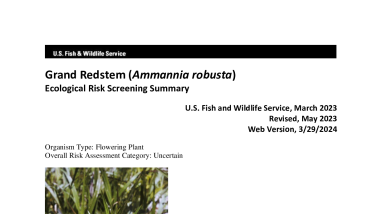
Ammannia robusta, Grand Redstem, is a flowering wetland plant that is native to a wide area ranging from southern Canada to Central America. This species is native to a large portion of the contiguous United States, and it has been reported as introduced to Hawaii through rice seed contamination, although no further information on current status or impact is available for Hawaii. Outside of the United States, A. robusta has been documented as introduced to Spain, France, Italy, India, Argentina, Brazil, the Philippines, multiple Pacific Islands, and the Caribbean. A. robusta has been named a problematic weed in the rice industry in Arkansas and Mississippi, where it is a native species. However, no documentation is available on impacts or lack thereof outside the native range. The History of Invasiveness for A. robusta is classified as Data Deficient due to this lack of documentation of impacts from the introduced range. The climate matching analysis for the contiguous United States indicates establishment concern for this species outside its native range, with nearly all of the contiguous United States exhibiting a medium or high climate match. The Certainty of Assessment for this ERSS is classified as Low due to lack of information from which to assess its invasive potential. The Overall Risk Assessment Category for A. robusta in the contiguous United States is Uncertain.
Publication date
Type of document
Uncertain Risk
Media Usage Rights/License
Public Domain
Program

