


Species that are considered uncertain risk need a more in-depth assessment beyond the Ecological Risk Screening Summary to better define the species’ risk to U.S. environments.
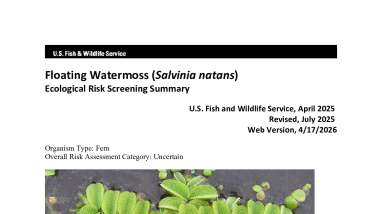
Salvinia natans, Floating Watermoss, is a plant that is native to Europe, Asia, and northern Africa. This species is reported in the aquarium trade in the United States, although at least some reports may be misidentifications of Salvinia molesta. S. natans is regulated in five U.S. States, and although it has been reported as introduced in the past, no populations are currently reported as established and may have been misidentifications. S. natans has also been reported as introduced and established in Jamaica and Cuba. In the Kashmir region of central Asia, S. natans grows in thick mats that cause changes in water temperature and reduce dissolved oxygen concentrations, potentially affecting native plant and fish health. However, there is disagreement in the literature over whether the species is native or nonnative in the Kashmir region, so the History of Invasiveness for Salvinia natans is classified as Data Deficient. The climate matching analysis for the contiguous United States indicates establishment concern. For most of the contiguous United States, climate match was generally high. The areas of highest climate match were found in the Great Lakes, Appalachian Range, and parts of the Southern Plains and Northern Plains regions. The Certainty of Assessment for this ERSS is classified as Low due to limited information on establishment and impacts of introduction and a history of misidentification. The Overall Risk Assessment Category for Salvinia natans in the contiguous United States is Uncertain.
Publication date
Type of document
Uncertain Risk
Media Usage Rights/License
Public Domain
Program


Species