


Species that are considered uncertain risk need a more in-depth assessment beyond the Ecological Risk Screening Summary to better define the species’ risk to U.S. environments.
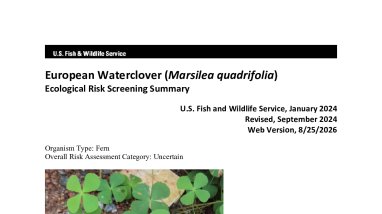
Marsilea quadrifolia, European Waterclover, is a semi-aquatic fern that is native to Europe and Asia. This species grows in temperate climates and can reproduce vegetatively and sexually. M. quadrifolia has a long history of human use in medicine and as a food source. It was introduced as an ornamental in the Northeastern United States during the 19th century and escaped cultivation. Marsilea quadrifolia is regulated in Connecticut, New Hampshire, Oklahoma, and Ohio. There is little known about impacts of introduction. The History of Invasiveness for Marsilea quadrifolia is classified as Data Deficient due to the limited and inconsistent information about impacts of introduction. The climate matching analysis for the contiguous United States indicates establishment concern for this species. Areas of high climate match were found from Missouri and Iowa east to the Mid-Atlantic and Northeast. The Certainty of Assessment for this ERSS is classified as Low due to misidentifications impacting the understanding of the distribution and a lack of information regarding impacts from introductions. The Overall Risk Assessment Category for Marsilea quadrifolia in the contiguous United States is Uncertain.
Publication date
Type of document
Uncertain Risk
Media Usage Rights/License
Public Domain
Program


Species