


Species that are considered uncertain risk need a more in-depth assessment beyond the Ecological Risk Screening Summary to better define the species’ risk to U.S. environments.
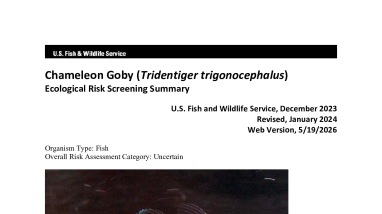
Tridentiger trigonocephalus, the Chameleon Goby, is a fish that is native to marine and estuarine areas of eastern Asia including the Yellow Sea, East China Sea, and Sea of Japan. T. trigonocephalus has established populations outside its native range, including in California, Australia, and Ukraine. Populations were likely introduced as eggs or larvae in the ballast water of ships or through the trade of oysters contaminated with T. trigonocephalus eggs. T. trigonocephalus is regulated in Hawaii and New Mexico as part of the Gobiidae family. The History of Invasiveness for Tridentiger trigonocephalus is classified as Data Deficient due to the absence of evidence of impacts or lack of impact of introductions. The climate matching analysis for the contiguous United States indicates establishment concern for this species. Locations with the highest climate match include areas of southern California (where it is currently established), parts of the Florida Peninsula and up the Atlantic coast as well as parts of the Pacific Northwest. Tridentiger trigonocephalus prefers marine or brackish waters with salinities of at least 22 ppt, which limits establishment potential in much of the interior of the United States. The Certainty of Assessment for this ERSS is classified as Low due to the lack of information on impacts of introduction and the salinity requirements of this species. The Overall Risk Assessment Category for Tridentiger trigonocephalus in the contiguous United States is Uncertain.
Publication date
Type of document
Uncertain Risk
Media Usage Rights/License
Public Domain
Program


Species