


Species that are considered high risk have a well-documented history of invasiveness in at least one location globally and are of establishment concern for the contiguous United States based on a climate matching analysis.
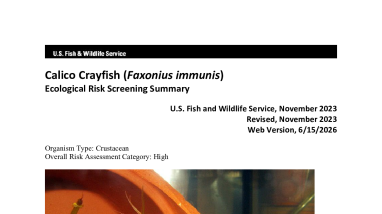
Faxonius immunis, the Calico Crayfish, is a crustacean that is native to the midwestern and northeastern United States, and southeastern Canada. It is a generalist species that is commonly used as bait, but it also occurs in the pet trade in the United States and Germany. It has established populations along the Rhine River in France and Germany, as well as outside the boundaries of its native range within the United States and Canada. Impacts of the established populations in Germany include significant changes to macroinvertebrate communities, and changes to habitat structure and macrophyte communities. This species is a known carrier of the crayfish plague. F. immunis is regulated in nine U.S. states. The History of Invasiveness for Faxonius immunis is classified as High due to the known nonnative population establishment and negative impacts of introduction. The climate matching analysis for the contiguous United States indicates establishment concern for this species outside its native range. High climate matches were concentrated in and around the native range but also extended west into the Great Basin and south into the inland Southeast. The Certainty of Assessment for this ERSS is classified as High because there was quality information available for each aspect of the assessment. The Overall Risk Assessment Category for Faxonius immunis in the contiguous United States is High.
Publication date
Type of document
High Risk
Media Usage Rights/License
Public Domain
Program


Species