


Species that are considered high risk have a well-documented history of invasiveness in at least one location globally and are of establishment concern for the contiguous United States based on a climate matching analysis.
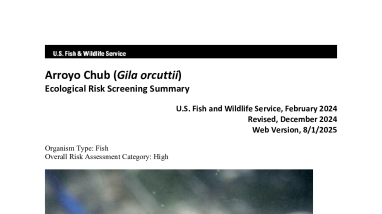
Gila orcuttii, Arroyo Chub, is a fish that is native to Pacific drainages along the southern California coast. G. orcuttii has been released in California outside its native range by means of bait bucket introductions and stock contamination, resulting in established populations throughout southern California. Gila orcuttii is not known to be in trade within the United States, and no species-specific regulations are known pertaining to its possession or transport as a nonnative species. The History of Invasiveness for Gila orcuttii is classified as High due to its successful establishment in nonnative aquatic habitats within southern California. These established populations have been linked to declines in the endangered Mohave tui chub (Siphateles bicolor mohavensis), and hybridization of nonnative G. orcuttii with multiple native species has been reported. The climate matching analysis for the contiguous United States indicates establishment concern for Gila orcuttii outside its native range. The highest climate matches were found in central and southern California, southern Nevada, and western Arizona. The Certainty of Assessment for this ERSS is classified as medium due to adequate evidence on history of invasiveness but uncertainty regarding parts of the native distribution of this species. The Overall Risk Assessment Category for Gila orcuttii in the contiguous United States is High.
Publication date
Type of document
High Risk
Media Usage Rights/License
Public Domain
Program


Species
FWS Focus