Draft Compatibility Determination for the Harvest of Horseshoe Crabs, Cape Romain National Wildlife Refuge

The Service is evaluating for compatibility of American horseshoe crab harvest throughout the Cape Romain National Wildlife Refuge in response to two applications for special use permits (SUP).

Publication date
Type of document
Policy
Facility
Loggerhead sea turtle hatchling in shallow surf heading to the ocean at Cape Romain NWR
Cape Romain National Wildlife Refuge, extending 22 miles along the South Carolina Coast, is a rich mosaic of barrier islands with forest and ponds, vast salt marshes and intricate waterways. This diverse and dynamic system supports over 293 bird species and a myriad of other wildlife. Over fifty...
Program
A bright blue sky obstructed by fluffy white clouds reflected off of a stream shot from inside a kayak
The U.S. Fish and Wildlife Service manages an unparalleled network of public lands and waters called the National Wildlife Refuge System. With more than 570 refuges spanning the country, this system protects iconic species and provides some of the best wildlife viewing opportunities on Earth.
Species
Grey, white and black bird on sand in the foreground

Size: 18 cm (7.25 in) in length. Color: Breeding season: Pale brown above, lighter below; black band across forehead; bill orange with black tip; legs orange; white rump. Male: Complete or incomplete black band encircles the body at the breast. Female: Paler head band; incomplete breast band....

FWS Focus
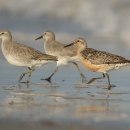
A group of juvenile and adult red knot forage along the shoreline.

Length: 25-28 cm. Adults in spring: Above finely mottled with grays, black and light ochre, running into stripes on crown; throat, breast and sides of head cinnamon-brown; dark gray line through eye; abdomen and undertail coverts white; uppertail coverts white, barred with black. Adults in...

FWS Focus
A large sea turtle swimming along a reef

Loggerheads were named for their relatively large heads, which support powerful jaws and enable them to feed on hard-shelled prey, such as whelks and conch. The carapace (top shell) is slightly heart-shaped and reddish-brown in adults and sub-adults, while the plastron (bottom shell) is...

FWS Focus
Ecosystem
Subject tags
Wildlife refuges
Harvest management
Migratory birds