By Jill Ory, geospatial ecologist, Pacific Region
I stared at a rock for two days.
At first glance it appears to just be a scenic, towering rock in the ocean with some gulls flying overhead. But as I looked closer, focusing the lens of my spotting scope, a whole world sharpened into view.
I was at Cannon Beach, Oregon, to survey tufted puffins at Haystack Rock, part of Oregon Islands National Wildlife Refuge. For a couple days, at regular intervals, I followed a survey protocol, squinting through my scope and scanning the known burrow locations and grasses on the rock, marking boxes in a survey app to show puffin numbers, locations and behaviors. Surveys are conducted by scientists, volunteers, and ecologists like me to help conservation managers better understand species population dynamics, behaviors, and trends over time. Many seabird species rely on Haystack Rock to nest and rest, but the stars of the show are the tufted puffins with their extravagant hairdos and neon orange bills.
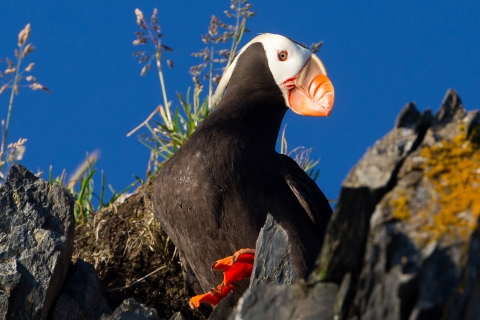
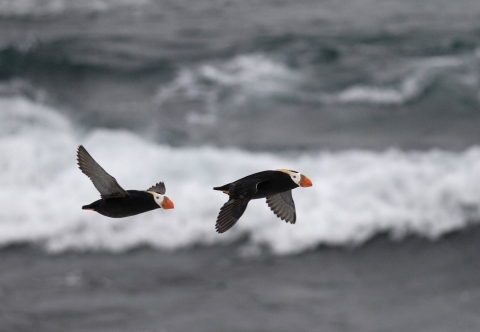
The first morning I was out surveying I saw a handful of puffins doing their puffin things: basking in the sun, wandering in and out of burrows, taking flight, circling the rock, putting out their bright feet to land only to pull them up at the last minute to take another go ‘round. Zooming in on a pair with my spotting scope, I saw them face each other, bow, and then rapidly rub their bills like a puffin butterfly kiss. Love was in the air!
That evening when I returned from my observation break, it was cold out and the tide was high. I was disappointed to see only one, lone puffin, no matter how many times I scanned the rock. Just as I was getting ready to fold up the scope after the last survey of the night, that lone puffin grabbed a bill full of grass and waddled into the burrow. Success! For the first time, I observed a puffin gathering nesting material.
The next morning, though my shoulders ached from holding binoculars and toting gear up and down the beach the previous day, I rushed to set up my spotting scope to get the first count started by 8:00 a.m. As I focused my scope, I immediately saw a cluster of eight puffins all sitting together. Quickly, I zoomed around the rock and the air to finish my count. On the opposite side of the rock were six more puffins scattered on the ledges and grassy zones. My amateur birder-heart beat a little faster!Fourteen puffins on the first look of the day, my record so far! The rest of the morning continued with puffins seemingly wherever I looked, lifting my spirits and the weight from my sore shoulders.

As I was about to start my second-to-last count, I heard a loud ruckus and saw the birds stream off the top of the rock into what looked like a funnel cloud of wings.I grabbed my binoculars and looked up in time to see a pair of bald eagles, one dipping down at the top of the rock and carrying what looked like a baby bird in its talons. Heading back to shore and toward the trees, the gull parent was in hot pursuit but could not catch up with the faster eagle. As an ecologist, I knew that eagle pair would be able to feed their own chicks with their catch, but as a mom, watching the gull give up the pursuit to save its own chick brought a tear to my eye. I wiped it away thinking about the difficult and beautiful parts involved in surveying nature.
More than science
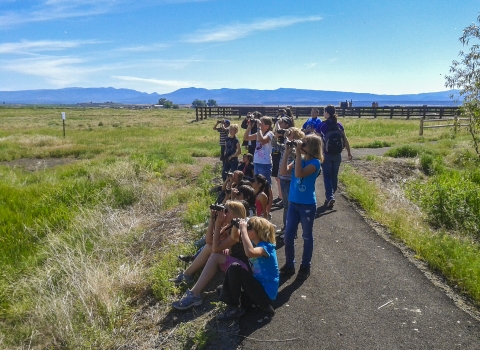
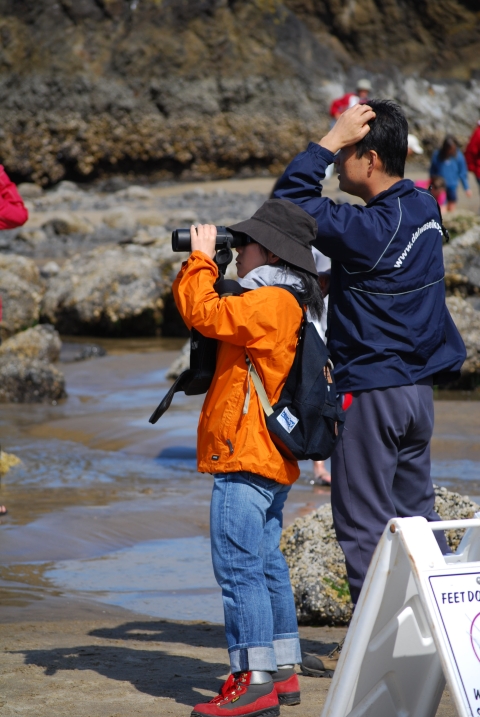
Viewing tufted puffins is extremely popular for anyone from seasoned bird watchers to the casual beach walker. Haystack Rock is one of the only places along the coast where the birds can be easily seen from the shore. Throughout my two days on Cannon Beach, beach visitors stopped and asked about the puffins. It was an opportunity to not only help folks see the birds, but also talk about how counting birds helps us better protect them.
I met many people on the beach. A couple from Pittsburg was visiting and said seeing puffins was on their bucket list. I was excited to help them check that box! A family took turns looking through the spotting scope, and their teenage daughter impressively named each of the bird species she saw. Everyone had questions about why there weren’t as many puffins as there used to be, it was heartening to hear so many people care about their welfare.
I stared at a rock for two days. In doing so, I observed birds, chatted with people, and gathered important scientific information. It was great.As I packed up my gear to leave, I knew I would return.
Why are we counting tufted puffins
Since the 1990s, tufted puffin populations in Oregon have been declining. The second largest nesting population in the state is at Haystack Rock, and in 2010 the U.S. Fish and Wildlife Service began monitoring the rock’s tufted puffin population. Understanding how many puffins live, rest, and nest in a place over time helps scientists and managers protect them and their habitat. This citizen science survey program is led by biologists from the Oregon Coast National Wildlife Refuge Complex, but without folks like me volunteering to help, conservation managers would not be able to collect this data to inform science-based decision making. Volunteers also engage thousands of visitors each year as they visit Haystack Rock, providing education and an opportunity for folks to learn about the birds and Oregon Islands National Wildlife Refuge. Tufted puffins are currently listed as a sensitive species by the Oregon Department of Fish and Wildlife (ODFW) due to the multiple threats faced by their population and habitat. The survey data is also shared with ODFW, Haystack Rock Awareness Program, Friends of Haystack Rock and other partners working to ensure Oregon’s puffins have a future.
If you are interested in volunteering, please reach out to Dawn Harris, Visitor Services Manager, Oregon Coast National Wildlife Refuges, at dawn_harris@fws.gov.