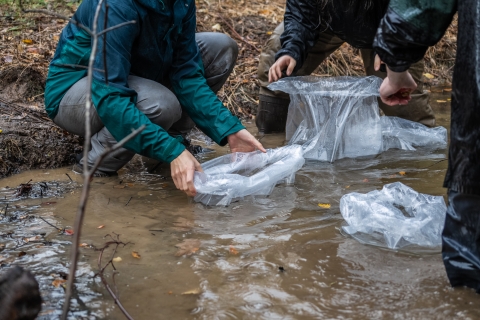
On a gloomy, rain-soaked November day hundreds of federally endangered fish were finally set free within their native landscape. Hailing from a handful of remote sites in south central Tennessee, the Barrens topminnow (fundulus julisia) population has faced rapid decline for several decades following the introduction of Gambusia, the western mosquito fish. It was thought this introduction would act as an ecological weapon to fight unwanted mosquito populations. As it turns out, the mosquito fish were not so enticed by mosquito larvae and instead preyed upon Barrens topminnow eggs. This, combined with other factors like habitat destruction and pollution, led to the BTM's being classified as endangered in 2019.
Fortunately, these little fish have been under the watchful eye of several biologists spanning across multiple agencies. Through exhaustive efforts and intentional net-working (pun intended), the Barrens Topminnow Working Group was born. Comprised of staff from various agencies and aquatic backgrounds, the working group provided a full-spectrum approach to save these overlooked Fundulids. Folks from Conservation Fisheries, Inc., Tennessee Wildlife Resources Agency, Tennessee Aquarium, and the U.S. Fish & Wildlife Service banded together deciding each site should be sampled for population assessments. Once a recovery plan was put into place, biologists were quick to roll up their sleeves and unroll their seines!
After close monitoring, it was discovered that some of the waters these fish were found in suffered tremendously under drought conditions; with some of the sources threatening to dry up altogether. This required immediate action to ensure the survival of as many fish as possible--having such a scant population makes the loss of even one individual cause for concern. The population assessment provided a census record for each site and resulted in fish being rescued from the drought-induced stressors. Some of the rescued fish became broodstock broodstock
The reproductively mature adults in a population that breed (or spawn) and produce more individuals (offspring or progeny).
Learn more about broodstock (parent fish to produce young in a facility), while others were transferred to grow out facilities where they would grow until water conditions were favorable again. In this case, Wolf Creek and Dale Hollow National Fish Hatchery were eager to volunteer their T&E (threatened and endangered) labs for respite.
Staff at Conservation Fisheries, Inc. took the lead on spawning measures, working diligently to produce offspring that could later be grown out at these facilities as well and ultimately be released. Before the topminnows are discharged, they are given an elastomer tag. Applied with a syringe just under the skin, each tag is color-coded and assigned to a particular side of the dorsal fin, allowing biologists to easily identify these individuals when they are recaptured in future surveys. In preparation for the release, the populations at the grow out facilities were given their tags. The population released from Wolf Creek National Fish Hatchery specifically received a green elastomer tag on the right side of the dorsal fin, opposite of the red tag they received previously to designate their year class and time of release. Sporting their red and green tattoos (just in time for the holiday season), 131 individuals of the Hickory Creek topminnows were released back into the wild.
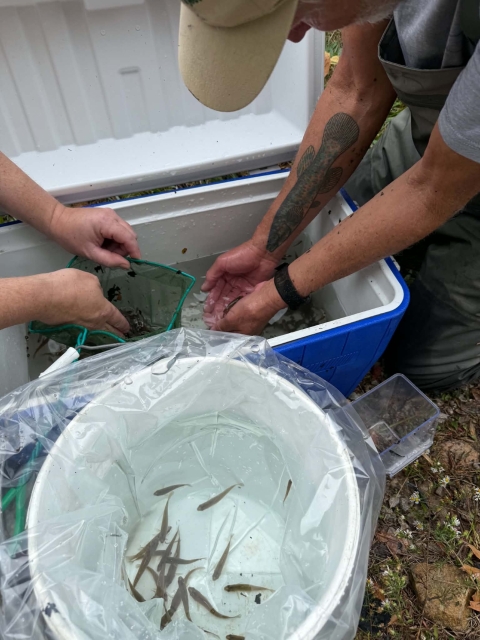
On the same day, members of the BTM working group met at the Type Locality (where a species is first found/described) site to assess drought conditions once again. Upon arrival, it was evident an extended period of no rainfall had left the pool of water disconnected from the spring head, with hundreds of topminnows fighting to survive in a compact puddle. After making several passes through the water with a seine net, the working group was able to capture numerous wild BTM's. Of those caught, 40 adults were transferred to Conservation Fisheries, Inc. to be part of their broodstock program while 145 adult topminnows and 47 juveniles were transported to Wolf Creek National Fish Hatchery for safe keeping until habitat conditions improve.
Partnerships have proven essential in the success of imperiled species time and time again since the designation of the Endangered Species Act in 1973--and the story of the Barrens topminnow is no different! We would like to thank all of our partners for their commitment to conservation for the continued success of this species.