On a damp spring morning, a lone Appalachian Trail backpacker approached a group of people gathered around a bathroom at Roan Mountain, on the edge of North Carolina’s Pisgah National Forest, and simply asked if the bathrooms were available.
This is one of the highest points not only on the Appalachian Trail, but east of the Mississippi, where weather can be harsh and unpredictable, so the seasonally available bathrooms were still winterized and closed to the public. Also, there were 4,000 red spruce trees stored in the bathrooms, waiting to be planted by the assembled group.

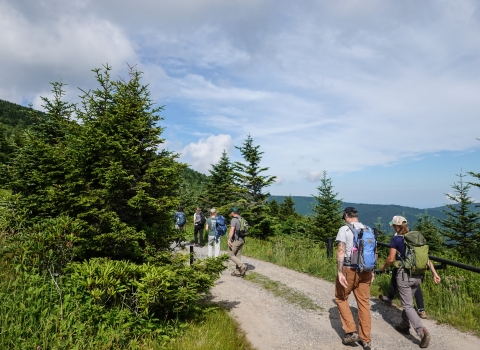
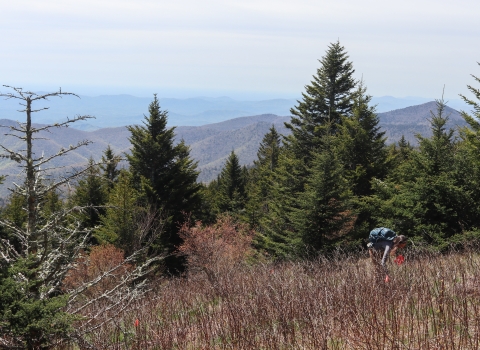
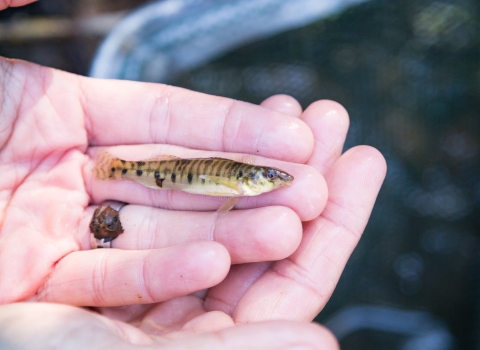
Roan Mountain, straddling the North Carolina/Tennessee state line and Pisgah and Cherokee National Forests, is one of the most beloved spots in Southern Appalachia. The eastern end of the massif is topped with grass-covered peaks, providing hikers some of the best views around; the western end is covered in red spruce and Fraser fir, a forest type found only found in Southern Appalachia; and the Appalachian Trail runs across it all. Roan Mountain is a “sky-island,” a high-elevation area home to habitats and species not found at the surrounding lower elevations. As an administrator of the Endangered Species Act, the U.S. Fish and Wildlife Service’s interest in Roan Mountain lies with its seven endangered species: Indiana bat, northern long-eared bat, Carolina northern flying squirrel, spruce-fir moss spider, spreading avens, Roan Mountain bluet, and rock gnome lichen.

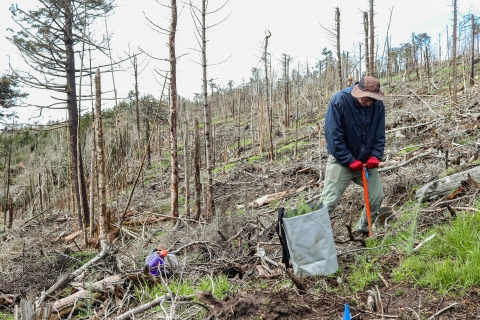
In late September of 2024, Tropical Storm Helene passed over Roan Mountain, the storm’s high winds damaging many areas and laying waste to a 25-acre patch of high-elevation spruce-fir forest on the mountain’s broad peak. The treefall turned the forest into fuelwood, and the disappearance of the evergreen canopy dried an area normally kept moist by fog and drizzle. This instantly created wildfire concerns in a habitat that naturally burns every few centuries and, as an area of high public use, addressing the fuel load was prioritized. When post-storm clearing of fuelwood subsided, attention turned to restoration. Marquette Crockett, of the Southern Appalachian Highlands Conservancy, ordered 4,000 red spruce trees, grown out in a Washington state nursery of Appalachian seed, with the vast majority of seed coming from the conservancy’s Haw Orchard Preserve – less than one mile from the planting site. The Appalachian Trail Conservancy’s Matt Drury worked closely with U.S. Forest Service staff to take point on planting the trees. The emphasis was on red spruce over Fraser fir because young trees were readily available and they don’t have the long-term viability concerns of the fir, which is attacked by an invasive insect, the balsam woolly adelgid. The young trees were packaged as plugs – a small tree with a column of soil enveloping its roots – frozen, packed into cardboard boxes and shipped to North Carolina, with Drury storing them in Roan Mountain’s seasonally closed bathrooms to await planting day.


As one of the most ecologically and recreationally important areas in Southern Appalachia, Roan Mountain has a lot of stakeholders, and U.S. Fish and Wildlife Service staff joined staff from the Appalachian Trail Conservancy, U.S. Forest Service, The Nature Conservancy, Southern Appalachian Highlands Conservancy, and an assortment of individual volunteers to help plant. Following the instructions of Forest Service silviculturalist Marcus Woods, more than 4,000 trees were put into the ground over two consecutive April days, beginning the process of restoring the cool, moist conifer forest that defines the western end of Roan Mountain.