


Environmental Contaminants Investigations and Prevention
We work with others to conduct field studies to determine sources of pollution and to investigate pollution effects on fish and wildlife and their habitats. We also work with federal and state agencies to assure water quality regulations are protective of threatened and endangered species and other fish and wildlife resources. Some of our projects are listed below.
Farallon NWR Contaminants
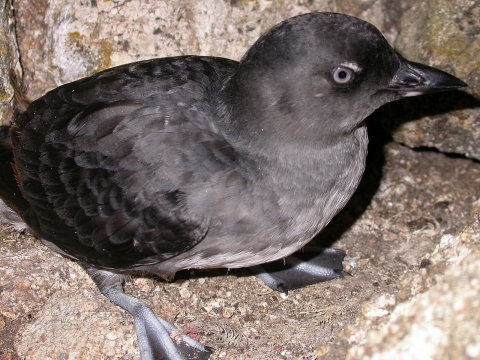
The Farallon National Wildlife Refuge sits off the California coast and supports the largest breeding population of marine birds south of Alaska. However, environmental contaminants may be posing a risk to birds nesting on the refuge. Of particular concern is soil contaminated by lead from paint used on old structures removed by the U.S. Coast Guard.
Removing lead contaminated soil on the isolated islands is difficult and will negatively impact nesting burrows. In order to determine what actions are needed, Refuge staff must weigh the impacts of cleanup activities against the benefit to wildlife resulting from removal of the soil.
This study is looking at lead concentrations in soil and nestling feathers while comparing the results to fledging success in nestlings from contaminated and non-contaminated sites. Also, we are looking at contaminants in failed-to-hatch eggs of several marine bird species nesting on the islands because previous investigations documented contaminant concentrations in eggs at or above toxicity thresholds known to cause problems.
Effects of Herbicides on Butterflies
Since 2008 we have been assisting Antioch Dunes National Wildlife Refuge in assessing whether herbicides used by the refuge to control invasive plants are harming the Lange's metalmark butterfly. There has been a dramatic decline of these endangered butterflies at the refuge since 1999. The refuge is evaluating all possible causes of the butterfly decline including refuge herbicide use.
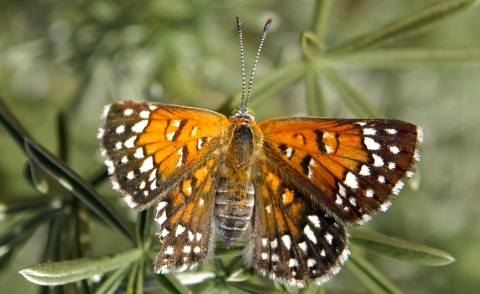
We provided an initial review of the herbicide formulations being used and their application procedures, coordinated emergency toxicity work and implemented a study to assess the toxicity of three herbicides used by the refuge. We evaluated the potential toxic effects on Behr’s metalmark, a close relative of the Lange’s metalmark.
All three herbicides reduced the number of pupae and the number of adults that emerged from pupation. Exposure to triclopyr (Garlon 4 Ultra) resulted in a 24% reduction in adult emergence compared with the control. Exposure to sethoxydim resulted in a 27% reduction, while exposure to imazapyr resulted in a 36% reduction in adult emergence. If these herbicides act in a similar manner in Lange’s metalmark, they may contribute to the decline of the species.
Based on early results, we recommended the refuge limit herbicide use until final study results could be assessed and final recommendations made on the use of herbicides as a tool to control invasive plant species at the refuge. Results of the study can be viewed in Environmental Pollution, May 2012.
Grassland Bypass Project—Selenium Monitoring in Biota
Under an agreement with the Bureau of Reclamation, we monitor selenium levels in fish, bird eggs, aquatic invertebrates and plants quarterly at key sites on Mud and Salt sloughs in the San Joaquin Valley.
Historically, farmers in the Grassland area of the western San Joaquin Valley have discharged subsurface agricultural drainwater through wetland channels to the San Joaquin River. This drainage contains elevated concentrations of selenium, salt, boron and other trace elements.
To convey this drainwater more directly to the San Joaquin River, bypassing wetland channels, a portion of the San Luis Drain was reopened in September 1996 as the Grassland Bypass Project. This project allows discharge through about 8 miles of Mud Slough, a natural waterway that runs through the San Luis National Wildlife Refuge Complex and a section of the North Grassland Wildlife Area.
At the same time, the area farmers are successfully meeting monthly and annual selenium load limits that have been decreasing over time. Ultimately the farmers must remove their discharge from the system. Selenium concentrations significantly declined in the fish and invertebrates of Salt Slough, the principal wetland channel from which drainwater has been removed by the project. In Mud Slough, selenium levels remain high, as expected; however, selenium has been removed from over 90 miles of wetland channels.
Continued biological monitoring is needed to ensure the project will not have a net negative effect on the ecosystems of the San Joaquin Valley. All the Grassland Bypass Project monitoring data including results of the biological monitoring can be found in annual reports maintained by the San Francisco Estuary Institute.
Toxicity of Delta Water to Larval Delta Smelt (2012)
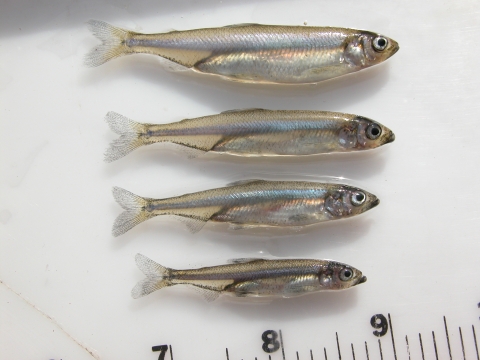
The Delta smelt is listed as threatened and contaminants are one of several stressors thought to be the cause of the decline in this species’ numbers. The primary object of this investigation is to evaluate the effect of waterborne contaminants on larval Delta smelt.
Although contaminant levels may not be acutely toxic, they have the potential to impair Delta smelt growth, survival and reproduction. Assessing these sub-lethal effects will lead to a better understanding of the role contaminants play in recent population collapses. Our goals are to determine if exposure of Delta smelt yolk-sac larvae to Delta water impairs survival, growth or ability to feed; assess any temporal influences between April and July on survival or feeding; and assess correlations between organophosphate, organochlorine, pyrethroid or fungicide concentrations in Delta water with six-day post-hatch survival, growth or ability to feed.
