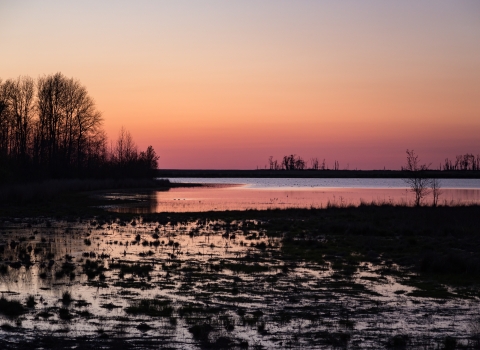
Middletown, R.I. -- The U.S. Fish and Wildlife Service and The Nature Conservancy are working to restore and strengthen salt marsh salt marsh
Salt marshes are found in tidal areas near the coast, where freshwater mixes with saltwater.
Learn more about salt marsh habitat at Sachuest Point National Wildlife Refuge to better withstand impacts of sea-level rise and coastal storm surge.
The project focuses on the Maidford River marshlands, adjacent to Third Beach. The work is part of a $1.98 million cooperative agreement between The Nature Conservancy and the U.S. Fish and Wildlife Service, supported by federal funding for Hurricane Sandy recovery. It is also part of a larger $4.1 million Sandy-funded effort to restore coastal areas from Rhode Island to Southern Maine.
Jennifer White, Service wildlife biologist and coordinator for the restoration project, said the Service and TNC will begin work next year to address similar marsh restoration issues involving the Narrow River at the John H. Chafee National Wildlife Refuge in Narragansett.
White said storm surge and wave erosion, combined with the lack of replenishment from estuaries whose rivers have been dammed or choked off by centuries of development, have left once-hardy tidal marsh ecosystems at a point where saltmarsh elevations cannot keep up with sea-level rise.
Sachuest Point, the section of the marsh behind Third Beach, is too low to drain properly at low tide, leaving it particularly vulnerable to heavy flooding during storm surges. These prolonged periods of inundation impede the growth of high-marsh vegetation and impact healthy fish and wildlife habitats.
Healthy saltmarsh is sometimes able to retreat slowly over time, colonizing adjacent areas as sea level rises. At Sachuest Point, however, the marsh is constrained by Third Beach to the north and upland areas to the east and south. With little opportunity for migration, the best solution to protect Sachuest Point wetlands is to raise the elevation of the marsh itself.
To do that, the Service and the Conservancy are applying a technique called “thin-layer deposition” (TLD), where sand is strategically spread onto areas of the marsh that are too low. This technique, combined with high-pressure spray dredging, has been successfully used in coastal areas in Delaware, Maryland and New York to restore marshes adversely affected by accelerated sea-level rise.
White said elevation enhancement will improve growth of salt marsh plants and reduce overall deterioration of the marsh, benefiting species such as the federally listed Saltmarsh Sparrow, which relies on high marsh as nesting habitat. She said marshes also play a key role in cleaning and filtering water, and act as a buffer to absorb wind, waves and flood water -- a key factor in storm protection.
"The completion of this project will yield a higher marsh than we had before, and we hope to improve tidal flow through the marsh as we have cleared ditches and have added shallow runnels to help drain water,” White said. “Ultimately, the project allows the marsh to last into the future and keep pace with sea-level rise.”
White said the project will raise the elevation of 11 acres of marsh at a cost of $644,000. Through a cooperative agreement, the funds were awarded to The Nature Conservancy, which is working all along Rhode Island’s south coast to promote shoreline resiliency efforts, including salt marsh restoration and oyster reef construction.
“The U.S. Fish and Wildlife Service is a tremendous partner, and we’re working closely together on habitat restoration and other great conservation work all across the country,” said Scott Comings, Rhode Island associate state director for The Nature Conservancy. “Sachuest Point Refuge draws birders and tourists from all over the world. The Conservancy is excited to join the Service in making the Sachuest marshes more resilient for the benefit of people and wildlife.”
The marsh restoration project at Sachuest Point NWR is among 70 projects managed by the Service through $167 million in federal funding for Hurricane Sandy recovery. The Service is working in partnership with other agencies and municipalities to restore and strengthen coastal and inland areas in 14 states along the Atlantic Coast.
For more information on the FWS Hurricane Sandy recovery effort, visit http://www.fws.gov/hurricane/sandy/